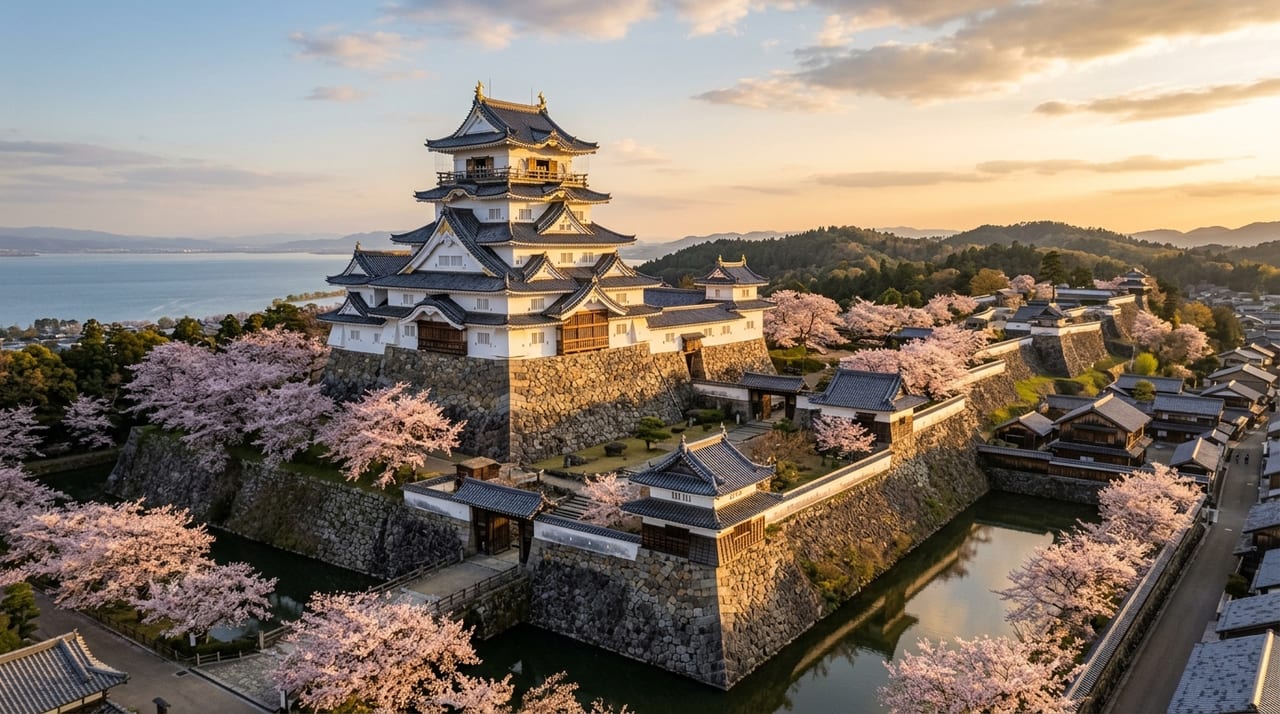
 * Image is for illustrative purposes only.
Sawayama Castle
佐和山城
Sawayama Castle is a historic castle in the Kansai region (Founded in the Kamakura period; major renovation by Ishida Mitsunari from Tenshō 19 (1591) onward; abandoned in Keichō 11 (1606)). Its lord was Ishida Mitsunari / Tokugawa clan (demolished).
Overview
Sawayama Castle is a mountain castle built on Mount Sawayama, 232 meters above sea level, located in the northwestern part of Hikone City, Shiga Prefecture. It played an important role from the medieval period through the Sengoku period as a key stronghold of Ōmi Province. The castle's history is said to begin with a fortress built in the Kamakura period by Saho Tokitsuna, the sixth son of Sasaki Sadatsuna, and in the Sengoku period it became the object of contention among the Rokkaku, Asai and Oda clans.
It was Ishida Mitsunari, known as one of the Five Magistrates of the Toyotomi regime, who inscribed this castle into history. Mitsunari entered Sawayama Castle as its castellan in Tenshō 19 (1591), and in the 4th year of Bunroku (1595) he formally became lord of the castle, being granted 194,000 koku, and carried out a large-scale renovation of the castle. Drawing on his talents as an administrator and economic figure, Mitsunari developed the castle and its castle town, and Sawayama gained great weight as a key stronghold linking the Kinai region with the eastern provinces.
As the verse goes, “Two things are beyond Mitsunari: Shima Sakon and Sawayama Castle,” the castle already had a special presence as Ishida Mitsunari's castle at the time. The castle was developed as an early modern castle with a five-story (some say three-story) tenshu, but after Mitsunari was defeated at the Battle of Sekigahara (1600), it was attacked by the Eastern Army and fell. With the completion of Hikone Castle, it was abandoned in the 11th year of Keichō (1606). After Mitsunari's death, the house of Ii Naomasa, who received an order from Tokugawa Ieyasu, built Hikone Castle right near Sawayama Castle, and it is also said that stone from Sawayama Castle was reused.
Today only the enclosure ruins such as the Honmaru, Ninomaru and Sannomaru remain, and no structures survive at all, but many visitors come to the site as a sacred place for fans of Ishida Mitsunari. From the summit, Lake Biwa and Hikone Castle can be seen at the same time, allowing visitors to appreciate the strategic importance of the past.
Connection to Swords
The relationship between Sawayama Castle and swords is deeply tied to the complex historical position of Ishida Mitsunari and to the Toyotomi regime's sword hunt policy. Mitsunari was outstanding more as an administrator and economic bureaucrat than as a warrior, but he was also one of the magistrates of the Toyotomi regime. The “Sword Hunt Edict” issued by that regime in Tenshō 16 (1588) was a historic policy that confiscated weapons from farmers and clearly separated the status of samurai and farmers.
However, Mitsunari himself also experienced battles as a warrior, and in particular fought at the center of the Western Army in the Battle of Sekigahara.
Mitsunari's father, Ishida Masatsugu, looked after Sawayama Castle in place of Mitsunari, who often stayed at Fushimi. The sword “Ishida Masamune” (Important Cultural Property), said to have passed through the hands of Mōri Wakasanokami and Ukita Hideie before becoming Mitsunari's possession, is also called “Ishida Kirikomi Masamune” because of the cut marks remaining on its spine.
Highlights
- Honmaru, Ninomaru and Sannomaru ruins — the enclosure remains of Ishida Mitsunari's castle survive in the mountains
- Views of Lake Biwa and Hikone Castle from the summit — experience the terrain that was a strategic stronghold
- A sacred site of Ishida Mitsunari — many fans visit as the castle ruins associated with Mitsunari
- Sawayama Castle hiking trail — a mountain path of about 30 minutes on foot from the Ryōtan-ji trailhead to the Honmaru ruins
- Combined sightseeing with Hikone Castle — comparative visits with Hikone Castle, tracing the history of reused stone
- Ryōtan-ji — a temple that owns the Sawayama Castle ruins and has the trailhead within its precincts
* Opening hours and admission fees are subject to change. Please check the official website before visiting.