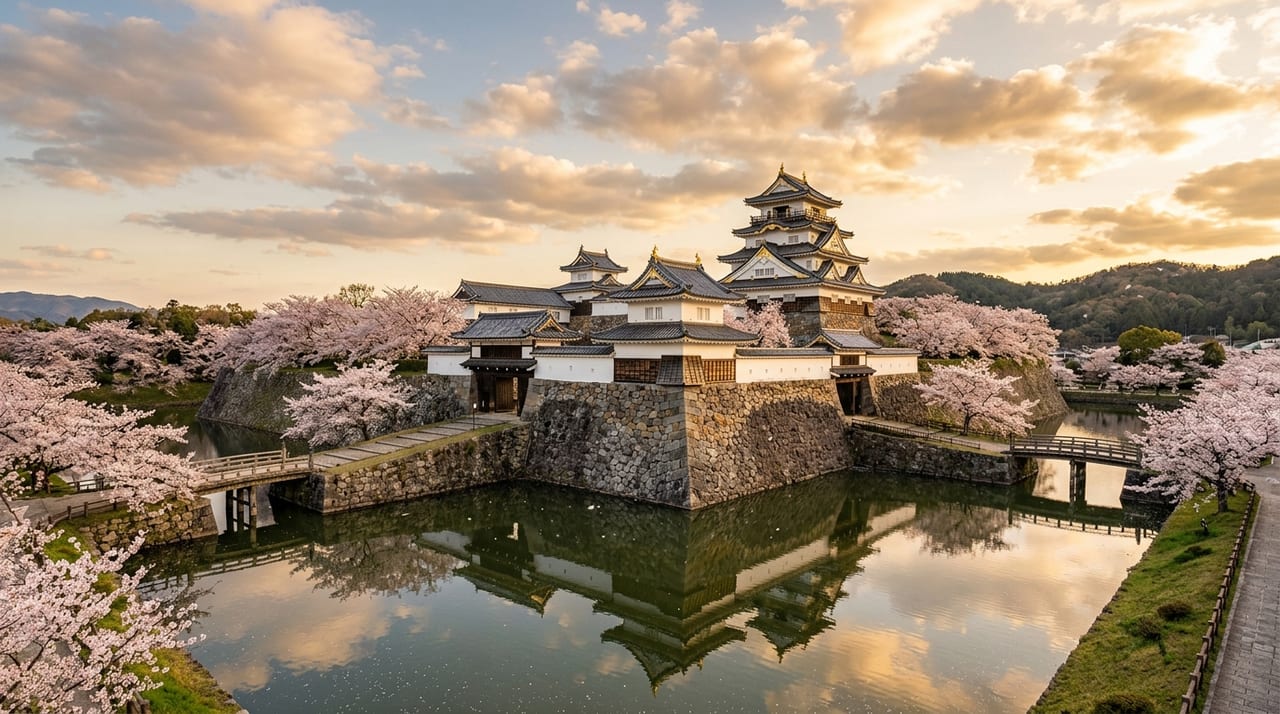
 * Image is for illustrative purposes only.
Tanabe Castle (Maizuru Castle)
田辺城(舞鶴城)
Tanabe Castle (Maizuru Castle) is a historic castle in the Kansai region (Built in 1580 (Tensho 8)). Its lord was Hosokawa Fujitaka (Yusai).
Overview
About the Castle
Tanabe Castle is an early modern castle in Maizuru, Kyoto Prefecture (formerly Tanabe in Tango Province). Hosokawa Fujitaka (later Yūsai) entered Tango in Tenshō 8 (1580), built the castle, and made it the center of his administration of Tango. Fujitaka was a rare warrior who served three "masters of the realm": Oda Nobunaga, Toyotomi Hideyoshi, and Tokugawa Ieyasu. He was a man of many talents, excelling not only in military strategy but also in waka poetry, the Kokin Denju, renga, yōkyoku chanting, and archery. The name "Yūsai" was the Buddhist name he took after shaving his head and entering the priesthood, and it symbolizes his refined image in later life.
The Tanabe Castle Siege and the Kokin Denju
The greatest event that Tanabe Castle left in Japanese history is the Tanabe Castle Siege on the eve of the Battle of Sekigahara in Keichō 5 (1600). Surrounded by a large army from Ishida Mitsunari's side (the Western Army), Yūsai fought through a siege of about 50 days with only 500 men. This siege had special significance because Yūsai was the sole inheritor of the Kokin Denju. The Kokin Denju was a secret technique for passing down the secret interpretations of the Kokinshū orally from teacher to disciple. Fearing that the secrets of waka would be lost forever if Yūsai died in battle, the Imperial Court dispatched an imperial envoy of Emperor Go-Yōzei to the eastern and western armies at Tanabe Castle and ordered a truce. Following the imperial command, Yūsai opened the castle and moved to Tanba-Kameyama Castle. This episode is one of the most dramatic in Japanese history, where military force, culture, and royal authority intersected.
Tanabe Castle Today
Tanabe Castle was abandoned in the early Meiji period and is now developed as Maizuru Park. Within the park stand the two-storey turret Shōkokan, reconstructed in Shōwa 15 (1940), and a gate rebuilt as a replica in Heisei 4 (1992). Inside the gate, the Tanabe Castle Museum introduces the history of Hosokawa Yūsai and Tanabe Castle. Even today Maizuru is known as a port city that hosts a Maritime Self-Defense Force base, and its unique cityscape combines red-brick former naval facilities with the history of Tanabe Castle.
Connection to Swords
Hosokawa Yūsai (Fujitaka) is famous as a cultured figure in waka and the Kokin Denju, but his side as a warrior was also outstanding. Yūsai was well versed in the art of war, studied swordsmanship under Tsukahara Bokuden, and received a certificate of mastery (inka) in archery. The Hosokawa family has long been known as a distinguished house of sword collectors, and Yūsai's son Tadaoki (Sansai) is known for owning the famous sword Kasen Kanesada. In the historic Tanabe Castle siege, the sword that Yūsai and his 500 samurai gripped together is a symbolic presence that combines his role as a guardian of the culture of the Kokin Denju with his identity as a warrior. The ideal of "the unity of letters and arms" was the very life of Hosokawa Yūsai, and it deeply resonates with the ideal of "the unity of sharpness and beauty of form" in swords. Art objects and historical materials handed down in the Hosokawa family are now housed in the Eisei Bunko in Mejirodai, Tokyo, and include swords such as the National Treasure "Kokin Denju no Tachi" (a sword by Bungo no Kuni Yukihira). The Tanabe Castle Museum displays materials on Hosokawa Yūsai and Tanabe Castle, conveying an image of an ideal warrior who combined martial and cultural accomplishment.
Highlights
- Castle Gate, Shōkokan, and Castle Ruins Park — the gate, rebuilt as a replica in Heisei 4 (1992), and the two-storey turret, reconstructed in Shōwa 15 (1940)
- Tanabe Castle Museum — detailed exhibits on the life of Hosokawa Yūsai, the Tanabe Castle siege, and the Kokin Denju
- Maizuru Red Brick Park — a group of red-brick warehouses from Meiji-period naval facilities (Important Cultural Properties)
- Maizuru Port — Repatriation Memorial Park and the UNESCO Memory of the World item "Return to Maizuru"
- Amanohashidate (about 40 minutes by car) — one of Japan's Three Views, a spectacular sand spit lined with pine trees
* Opening hours and admission fees are subject to change. Please check the official website before visiting.