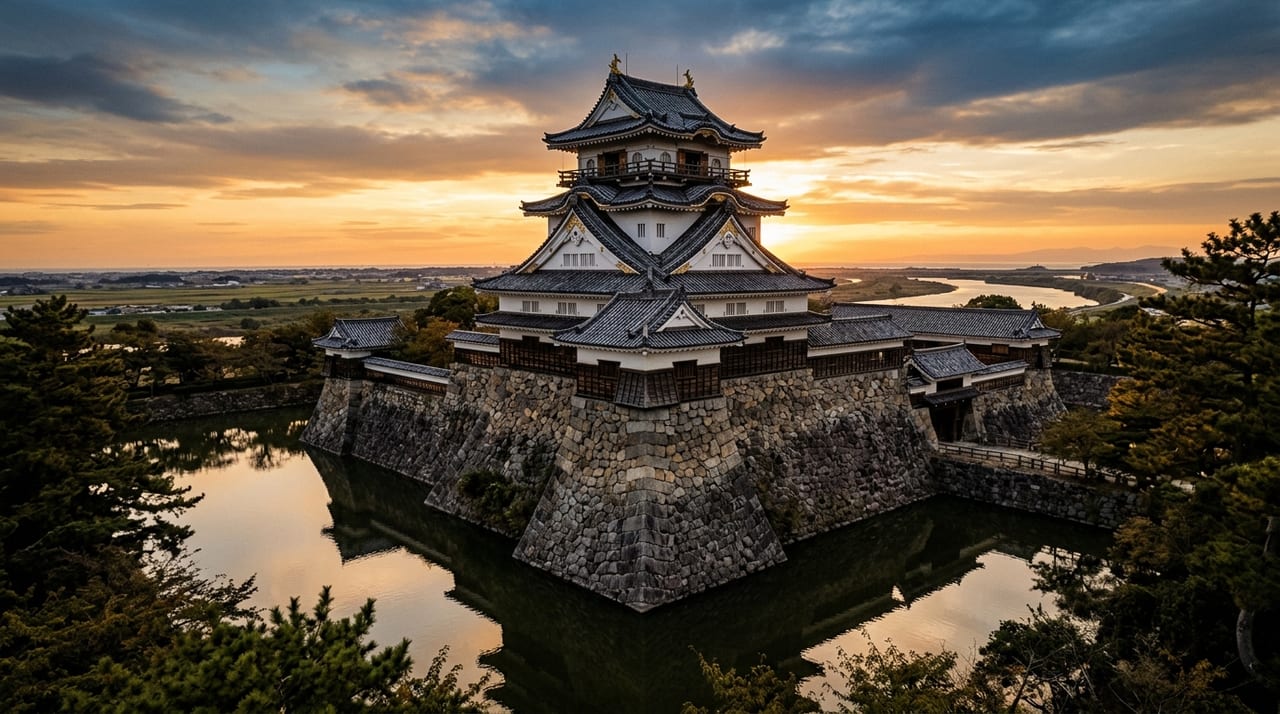
 * Image is for illustrative purposes only.
Kuwana Castle
桑名城
Kuwana Castle is a historic castle in the Kansai region (Edo period (founded 1601)). Its lord was Honda Tadakatsu, Matsudaira (Hisamatsu) clan, Matsudaira (Okudaira) clan.
Overview
Overview
Kuwana Castle is a flatland castle located in Kuwana City, Mie Prefecture. It was built at the Ibigawa River estuary, a strategic point facing Ise Bay. It is known as the castle where Honda Tadakatsu entered as lord under the orders of Tokugawa Ieyasu in Keichō 6 (1601) and began large-scale castle construction. Built as an early modern castle, it boasted a magnificent scale, with a four-tier, six-story main tower (tenshu), 51 yagura turrets, and 46 tamon turret-walls. With the Tōkaidō's Shichiri-no-Watashi ferry crossing at its northern edge, it was a water castle equipped with a landing stage, and it functioned as a strategic base controlling maritime traffic in Ise Bay.
History
In the Kuwana area, a settlement formed early as a water-transport hub, and during the Sengoku period the base of the Nagashima Ikkō uprising existed nearby. After the Honnō-ji Incident, under the Toyotomi regime, Hitotsuyanagi Kayū and Ujiie Yukihiro served as castle lords. Honda Tadakatsu, who contributed to the Eastern Army at the Battle of Sekigahara (1600), entered with a fief of 100,000 koku and began full-scale castle construction in 1601. After Tadakatsu's death, his son Honda Tadamasa succeeded him. From Genna 3 (1617) onward, the Matsudaira (Hisamatsu) clan held the domain; from Hōei 7 (1710), the Matsudaira (Okudaira) clan; and from Bunsei 6 (1823), the Matsudaira (Hisamatsu) clan again. The domain prospered as the castle town of the Kuwana Domain. At the end of the shogunate period, the domain lord Matsudaira Sadaaki took the side of the shogunate as Kyoto shoshidai (Kyoto Deputy). As a result, in the Boshin War (1868), the Kuwana Domain was declared an enemy of the throne, and after the Meiji Restoration the castle was dismantled and abolished. It is now developed as Kyūka Park, and the Banryū Turret has been reconstructed on the castle site.
Structure and Features
At the time of construction, the castle stood on the Ibigawa River delta, and it was a typical water castle that used the water moats and Ise Bay as natural moats. A four-tier, six-story main tower, 51 yagura turrets, and 46 tamon turret-walls surrounded the Honmaru, Ni-no-maru, and San-no-maru. However, the main tower was lost in the great fire of Genroku 14 (1701), and it was never rebuilt afterward. As the eastern gateway of the Shichiri-no-Watashi, the castle town was a hub of the Tōkaidō, and travelers and merchants passing along the Ise Road flowed in constantly, so the town also prospered economically. Parts of the stone walls and moats still survive, including around Kyūka Park.
Connection to Swords
The first lord, Honda Tadakatsu, is known as one of the strongest generals, counted among the Four Heavenly Kings of the Tokugawa and the Sixteen Generals of the Tokugawa. It is said that he took part in 57 battles, large and small, in his lifetime and never sustained so much as a scratch. His favorite famous spear, Tonbokiri, is counted among the Three Famous Spears of the Realm, and it is currently on deposit at the Sano Art Museum (Mishima City, Shizuoka Prefecture).
Access and Current State
The site is now developed as Kyūka Park, where parts of the stone walls and moats and the reconstructed Banryū Turret remain. It is about a 15-minute walk from Kuwana Station on the Kintetsu Nagoya Line or from Kuwana Station on the JR Kansai Main Line. Admission is free.
Connection to Swords
The first lord, Honda Tadakatsu, is one of the Four Heavenly Kings of the Tokugawa. He is renowned as the owner of the spear Tonbokiri, one of the Three Famous Spears of the Realm.
Highlights
- A water castle built by Honda Tadakatsu along the Ibigawa River
- A four-tier, six-story main tower, 51 yagura turrets, and 46 tamon turret-walls
- A maritime transport base facing the Tōkaidō's Shichiri-no-Watashi
- The castle of Honda Tadakatsu, owner of Tonbokiri, one of the Three Famous Spears of the Realm
* Opening hours and admission fees are subject to change. Please check the official website before visiting.