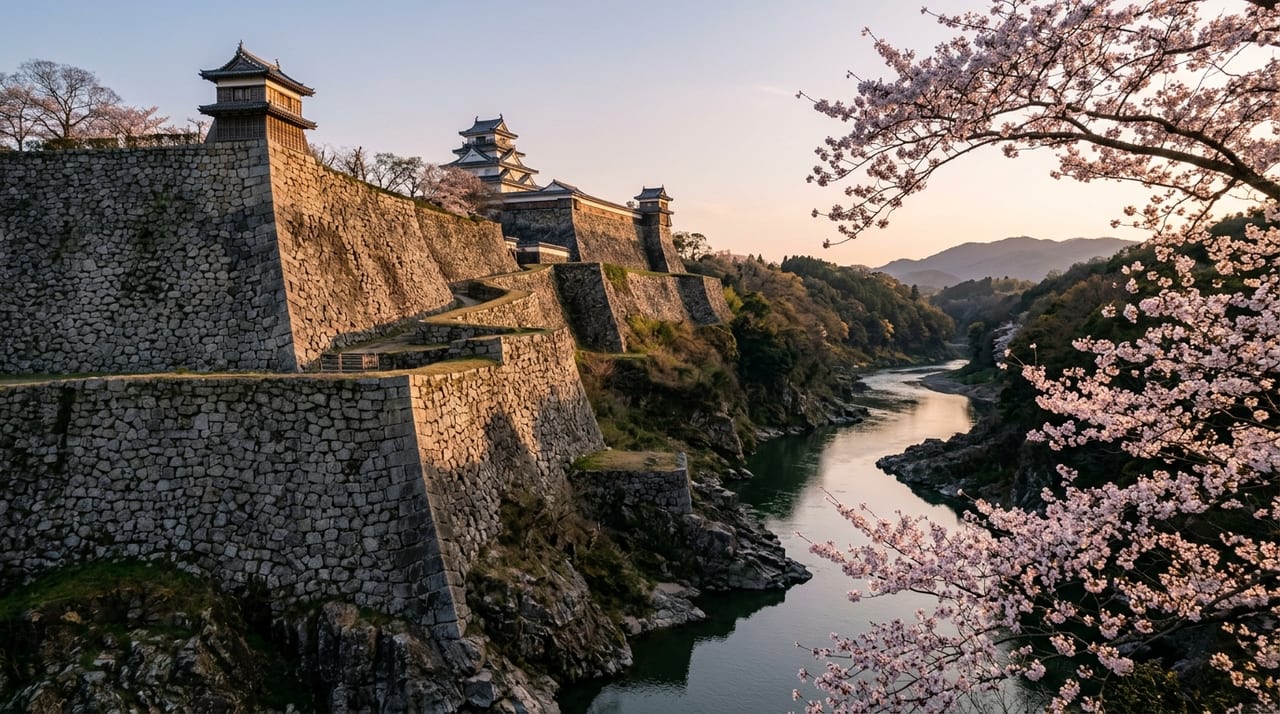
 * Image is for illustrative purposes only.
Kamaha Castle
鎌刃城
Kamaha Castle is a historic castle in the Kansai region (Late Muromachi period to 1574 (Tenshō 2), when it was abandoned). Its lord was Hori clan (Hori Hidemura).
Overview
Overview and Location
Kamaha Castle is a mountain castle located in Banba, Maibara City, Shiga Prefecture, at an elevation of 384 meters with a relative height of 250 meters. As a 'border castle' (sakaime no shiro) dividing Kōhoku (Northern Ōmi) from Kōnan (Southern Ōmi) in Ōmi Province, it played an important role in the history of conflict in medieval Ōmi. The castle area extends about 400 meters east to west and about 500 meters north to south, and is a large mountain castle with 17 enclosures (kuruwa) arranged along the ridge extending from the main enclosure. In March 2005 it was designated a National Historic Site, and in 2017 it was selected as one of the Continued 100 Famous Castles of Japan (No. 156).
Construction and Changes of Lords in the Muromachi Period
The exact date of construction of Kamaha Castle is unknown, but it is presumed to have been built around the Ōnin War (1467) to secure the border of Ōmi Province. The Imai Gunki contains an account of an attack on Kamaha Castle in Bunmei 4 (1472) by retainers of the Kyōgoku family, and it is believed the castle already existed at that time.
During the Tenbun period, the Rokkaku clan, shugo of Ōmi, attacked the Hori clan, retainers of the Kyōgoku family stationed at Kamaha Castle, and in Tenbun 7 (1538) the castle fell into Rokkaku hands. The Hori clan thereafter switched allegiance between the Rokkaku and Asai clans, and from around Eiroku 2 (1559) belonged to the Asai clan.
Hori Hidemura, Higuchi Naofusa, and Oda Nobunaga
The most important figures in the history of Kamaha Castle are its last lord, Hori Hidemura, and his chief retainer, Higuchi Naofusa. Because his father died suddenly while Hidemura was still young, real authority over the household was held by Higuchi Naofusa, who is known as a great general renowned as 'the foremost strategist in Ōmi.' Higuchi is also well known for sheltering Takenaka Shigeharu (Takenaka Hanbei Shigeharu) when he briefly fled to northern Ōmi after losing Inabayama Castle (Gifu Castle).
In Genki 1 (1570), when Oda Nobunaga set out to subjugate Asakura Yoshikage of Echizen, Asai Nagamasa's defection put Nobunaga's army at risk of having its line of retreat cut off. In the 6th month of that same year, on the recommendation of Higuchi Naofusa, who had been won over by Takenaka Shigeharu, a retainer of Kinoshita Tōkichirō (later Toyotomi Hideyoshi), the 15-year-old Hori Hidemura left the Asai clan and joined Oda's side, and took part on Nobunaga's side in the Battle of Anegawa in that same month.
Afterward, Kamaha Castle functioned as an Oda-side castle. However, in Tenshō 2 (1574), the chief retainer Higuchi Naofusa, who had been entrusted with defending Kinome Castle in Echizen, abandoned that castle and made an unauthorized truce with the Ikkō uprising. He was pursued by Hideyoshi and killed, Hori Hidemura was stripped of his domain, and Kamaha Castle was soon abandoned. Hidemura is believed to have subsequently served Toyotomi Hidenaga, and died in Keichō 4 (1599) at the age of 43.
Structure and Features of the Remains
The remains of Kamaha Castle were clarified in detail through excavation surveys conducted over three years starting in fiscal 1998 (Heisei 10) by the former Maibara Town Board of Education. Some enclosures, including the main enclosure, are built with limestone masonry around their perimeters, and together with features such as the hira-koguchi gateways, they are considered remains that show the pinnacle of castle-building technology before the Oda-Toyotomi period.
Also, at the base of the cliff below the dry moat at the southernmost end lies Seiryū Falls, and at the top of the falls, remains of a water source (mizu no te), said to have channeled water into the castle, can be confirmed.
The tips of all the ridges are defended by dry moats, and a series of vertical moats (tate-bori) is installed on the western ridge, demonstrating the thoroughness of its defenses. From the enclosure on the northern ridge, the remains of a large semi-subterranean building with a grid of stone footings and internal pillars (presumed 8 ken north to south and 7 ken east to west) have also been found. Excavations also revealed that when the castle was abandoned, a thorough dismantling (hajō) was carried out, including breaking down the tops of the stone masonry and filling the gateways with stone.
Present State and Highlights
The remains of Kamaha Castle are open to the public as a mountain castle site maintained by the Maibara City Board of Education. Many remains, including stone walls, dry moats, vertical moats, and the water source remains, survive in good condition, and its scale is among the largest in Kōhoku.
Access is by JR Tōkaidō Main Line to Maibara Station, then Kokoku Bus to Banba bus stop, then about 45 minutes on foot (mountain path). Beware of wildlife such as bears, leeches, and hornets, and long sleeves and boots are recommended when visiting the castle.
Highlights
- National Historic Site; Continued 100 Famous Castles of Japan No. 156
- Limestone masonry surrounding the main enclosure and others: castle-building technology before the Oda-Toyotomi period
- Water-source remains at the top of Seiryū Falls
- Dry moats at the ridge tips, a series of vertical moats on the western ridge, and 17 enclosures
- Hori Hidemura's switch to the Oda side (1570) and the groundwork for the Battle of Anegawa
* Opening hours and admission fees are subject to change. Please check the official website before visiting.