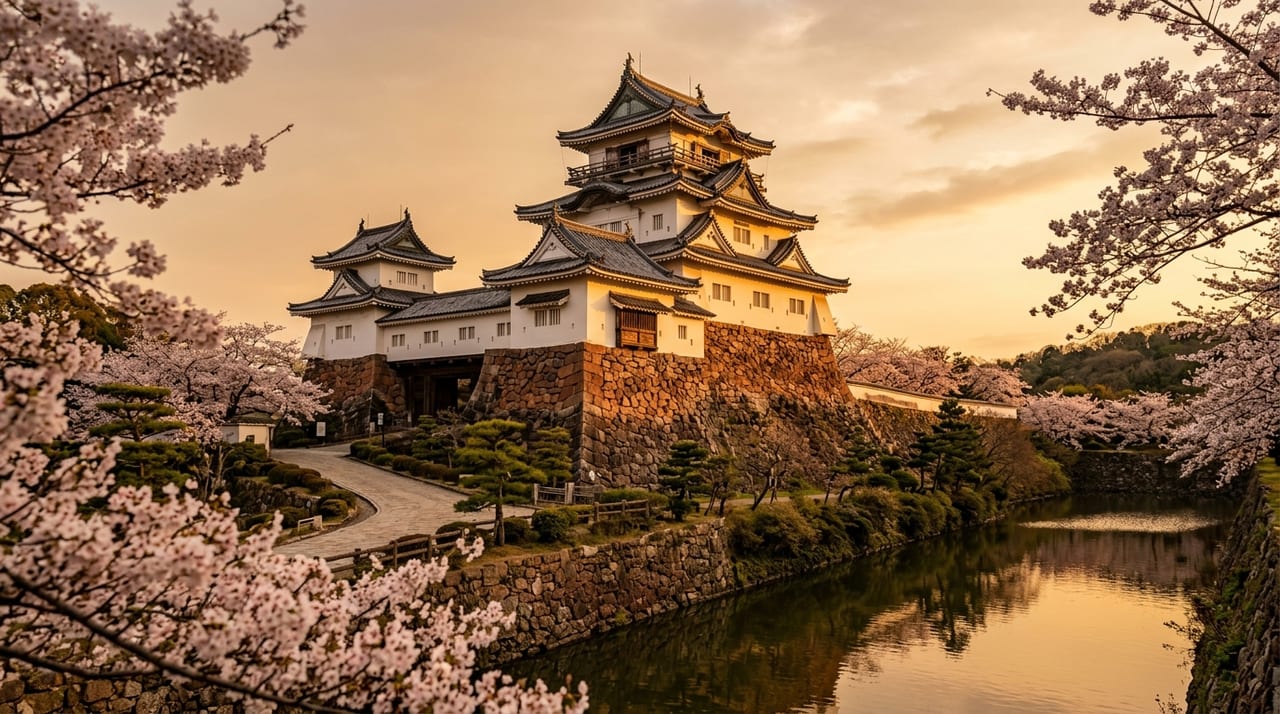
 * Image is for illustrative purposes only.
Wakayama Castle
和歌山城
Wakayama Castle is a historic castle in the Kansai region (Tenshō 13 (1585) construction; burned in Kōka 3 (1846), rebuilt in Kaei 3 (1850)). Its lord was Tokugawa Yorinobu (first lord of Kishū domain).
Overview
Seat of the Kishū Tokugawa Family — A Key Point on the Nankaidō
Wakayama Castle originated in a castle built atop Mount Torafusu by Hashiba Hidenaga, younger brother of Toyotomi Hideyoshi, after the Kishū campaign in Tenshō 13 (1585). Later, under Asano Yoshinaga, it was extensively developed, and in Genna 5 (1619) Tokugawa Ieyasu's tenth son, Tokugawa Yorinobu, entered the castle as lord of a 555,000-koku domain. From then on, Wakayama Castle remained the seat of the Kishū Tokugawa family and the center of the Nankaidō for more than 250 years, until the Meiji Restoration.
As one of the Gosanke (Owari, Kii, and Mito), the Kishū Tokugawa family held the highest rank, with the standing to succeed the Tokugawa shogunal family. Yoshimune, the eighth Tokugawa shōgun, and Iemochi, the fourteenth shōgun, both assumed the shogunate from the Kishū Tokugawa family. Yoshimune in particular is remembered in history as a renowned lord credited with restoring the house, who carried out the 'Kyōhō Reforms.' Even after Yoshimune became shōgun, Wakayama Castle continued to embody Tokugawa authority as the main castle of Kishū domain, and its majestic keep added dignity to the southern seascape visible from the mouth of the Kinokawa River.
The Keep's Changing History — Majesty over Mount Torafusu
The keep of Wakayama Castle went through several changes over its long history. The year the keep was founded is unknown; there are theories that Asano Yoshinaga built it and that Tokugawa Yorinobu built it. In Kōka 3 (1846), the keep was destroyed by fire caused by a lightning strike, and the three-tier, three-story main keep rebuilt in Kaei 3 (1850) kept its Edo-period appearance until it was burned down in the air raids of Shōwa 20 (1945).
The current keep is a reinforced-concrete reconstruction from Shōwa 33 (1958). Its configuration as a connected keep (renritsu-shiki tenshu), with the main keep and small keep linked by Inui Yagura and Ni-no-mon Yagura via connecting turrets (watari-yagura), faithfully restores the Edo-period form. Its majestic figure, set against the green of Mount Torafusu, can be seen from many points in the city. Moats remain around the castle, and the enclosures of Suna-no-maru, Ni-no-maru, Nishi-no-maru and others evoke the layout of the original castle.
Notable Stone Walls — Nozura-zumi and Kirikomi-hagi
One of the highlights of Wakayama Castle is its group of stone walls, in which the masonry techniques of each era coexist. The oldest layer retains Toyotomi-period nozura-zumi (a method of stacking natural stones as they are), while Asano-period uchikomi-hagi and Tokugawa-period kirikomi-hagi were added.
Green schist was used for the Toyotomi-period nozura-zumi, Izumi sandstone for the Asano period, and Kumano granite porphyry for the Tokugawa period. The fact that the stone differs by era is a feature of Wakayama Castle's walls. Moss and wildflowers grow in the gaps between the stones depending on the season, creating a landscape in which the weight of history and natural beauty blend.
Kishū Tokugawa Sword Culture — the Gosanke and Famous Blades
As one of the Gosanke, the Kishū Tokugawa family held a sword collection equal to that of the shogunal family. Yorinobu inherited famous blades as keepsakes of his father Ieyasu, and the Kishū Tokugawa sword collection was passed down through generations thereafter.
Of particular note is the connection to the sword policy of the eighth shōgun, Yoshimune. During the Kyōhō era (1716–1736), Yoshimune commissioned the Hon'ami family to compile the 'Kyōhō Meibutsuchō,' a record of famous swords across the country. The book records the famous blades of the shogunal family and the Gosanke at its head, along with famous blades handed down in the Kishū Tokugawa family.
Kii also has its own tradition as a sword-producing region. Nanki Shigekuni is known as a swordsmith of Kii Province. The first Shigekuni was summoned by Tokugawa Ieyasu at Sunpu, later moved to Kishū following Tokugawa Yorinobu, and from then until the end of the Edo period served as the official swordsmith of the Kishū domain for eleven generations. Shigekuni's blades are known for their bold Sōshū-den style, and many excellent examples survive today. Wakayama Castle is, in a sense, the spiritual home of these Kishū blades.
Tourism and Nature — Harmony of Castle and Park
Wakayama Castle, with its keep at the center and the expansive castle ruins park, forms a unified whole and is beloved as a place of rest for citizens. It is known as a cherry-blossom spot in spring, and the combination of castle, cherry blossoms and stone walls is a signature spring scene of Wakayama. The interior of the keep is open as a museum, with rich exhibits on the history and culture of the Kishū Tokugawa family.
The view of Wakayama city and the Kinokawa River from the castle ruins is exceptional. On clear days, when the mountain ranges of the Kii Peninsula and the Pacific Ocean can be seen in the distance, visitors can relive the view of 'the key point of the Nankaidō' that the first lord, Yorinobu, saw. Wakayama Castle is not merely a historic structure but a living cultural asset that conveys the culture and sword tradition of the Kishū Tokugawa family to the present day.
Connection to Swords
As the seat of the Kishū Tokugawa family (Gosanke), Wakayama Castle was the center of a sword culture equal to that of the Tokugawa shogunal family. The first lord, Tokugawa Yorinobu (1602–1671), is said to have had a high level of martial accomplishment and to have possessed many famous blades, including those that were his father Ieyasu's keepsakes.
The most famous swordsmith connected with Kishū is Nanki Shigekuni. Shigekuni was a native of Yamato Province and belonged to the lineage of the Yamato Tegai school. He was summoned by Tokugawa Ieyasu at Sunpu and later followed the Kishū domain founder, Tokugawa Yorinobu, to Kii, where he became an official swordsmith. The name 'Nanki Shigekuni' is a title tied to Kii Province, indicating a deep connection with Kishū. Shigekuni's style is known for bold, wild-patterned hamon based on the Sōshū-den and an imposing form, and TOUKENZA's swordsmith pages also introduce him in detail.
The compilation of the 'Kyōhō Meibutsuchō,' commissioned by Yoshimune after he took office as shōgun from the Kishū domain lord during the Kyōhō era (1716–1736), was a project that recorded 274 famous swords. The book lists the swords of the shogunal family and the Gosanke at its head, along with swords handed down in the Kishū Tokugawa family.
Today, the museum inside Wakayama Castle's keep exhibits swords, armor and sword fittings connected with the Kishū Tokugawa family, allowing visitors to directly experience the martial culture of the Gosanke. The Wakayama Prefectural Museum also holds many swords connected with Kishū, making Wakayama a well-rounded destination for sword enthusiasts.
Sendai's Date family, where TOUKENZA is based, and the Kishū Tokugawa family, though differing in standing as a Gosanke and a tozama daimyō, were both warrior houses with a high sword culture and shared an aesthetic sensibility. The beauty of Sōshū-den blades seen through Nanki Shigekuni has points in common with Sendai's swordsmithing culture.
Highlights
- Renritsu-shiki Tenshukaku (connected keep) — an elegant layout of the main keep and small keep, with turrets linked by connecting turrets, a white keep standing out against the green of Mount Torafusu
- Museum inside the keep — rich exhibits of Kishū Tokugawa family swords, armor, sword fittings, old documents and more
- Stone walls — a textbook of stonework where the techniques of each era coexist, from Toyotomi-period nozura-zumi to Edo-period kirikomi-hagi
- Nishi-no-maru Garden — a stroll garden that retains the traces of an Edo-period daimyō garden, with a tea house, a restful space
- Cherry blossom festival (spring) — a contrast between cherry blossoms and the white keep, a spring landscape representative of Wakayama City
- Ni-no-maru Palace site — the place where the core of domain administration was located; now a maintained open plaza that conveys the castle's history
* Opening hours and admission fees are subject to change. Please check the official website before visiting.