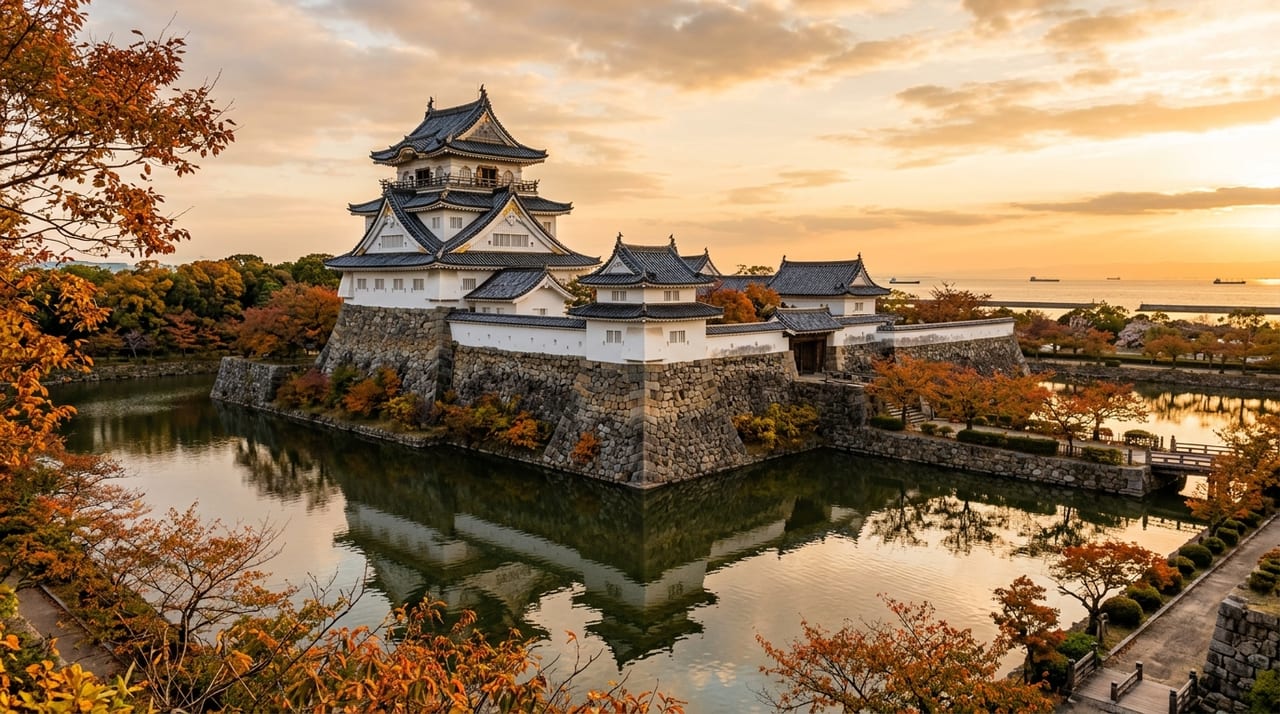
 * Image is for illustrative purposes only.
Kishiwada Castle
岸和田城
Kishiwada Castle is a historic castle in the Kansai region (Origins in the late 15th century; developed ca. 1585 (Tenshō 13)). Its lord was Okabe Nobukatsu / Okabe clan.
Overview
About the Castle
The origins of Kishiwada Castle lie in a mountain castle (Kishiwada Kojō) built in the late 15th century about 500 m southeast of the present site. During the Azuchi–Momoyama period it underwent major renovation and was developed into an early modern castle. The castle first figures prominently in history in Tenshō 13 (1585), when Toyotomi Hideyoshi campaigned against the Negoro and Saika ikki. Afterward, Hideyoshi made Koide Hidemasa the castle lord. Later, in Kan'ei 17 (1640), Okabe Nobukatsu entered the castle, and from then on the Okabe family governed the Kishiwada Domain until the end of the Bakumatsu period. The castle stands on a low hill near Osaka Bay called Ibuseyama, and since ancient times, as a castle with a view of the sea, it has caught the eye of travelers. The tenshu was destroyed by lightning in Bunsei 10 (1827). The present tenshu, rebuilt in Shōwa 29 (1954), is reinforced concrete. However, the castle's stone walls and moats still preserve their former scale, and even without the old tenshu, the power of Kishiwada Castle as a fortress remains intact.
Kishiwada Danjiri Festival
What has made the name Kishiwada resound throughout Japan is, above all, the “Kishiwada Danjiri Festival.” Held every year in September, this festival is famous for “yarimawashi,” in which wooden danjiri (festival floats) weighing several tons are driven at full speed around corners in the narrow streets of the castle town. Its boldness, which is also called “a festival staked on life itself,” symbolizes the fierce temperament of the people of Kishiwada. The origins of the festival go back to the Edo period. The carvings on the danjiri depict battle scenes and images of warlords, showing a deep connection with the martial culture of Kishiwada.
Architecture and Structure
The inner moat surrounding the castle's honmaru is wide and maintains the imposing presence of castle architecture. The honmaru garden is known as “Hachijin-no-niwa” (Garden of the Eight Formations), a famous garden designated as a Place of Scenic Beauty by the nation. Designed by the Shōwa-era garden designer Shigemori Mirei, inspired by Zhuge Liang's Eight Formations strategy, the garden's composition of tense stone arrangements leaves a deep impression on viewers. Kishiwada Castle and its garden together form a unique space in which the two worlds of the castle as a military facility and the garden as a spiritual culture are fused.
Development of the Castle Town
Throughout the Edo period, the Kishiwada castle town prospered as a commercial center and a key hub of maritime transport linking to Osaka. Artisan and merchant quarters were arranged in an orderly fashion in the town. In particular, the cotton textile industry of Izumi Province (Senshū cotton) was an important pillar of the castle town's economy. The production and distribution of Senshū cotton supported the finances of the Kishiwada Domain and enriched the merchant house culture of the castle town.
Sightseeing and Experiences
On the first floor of the castle's tenshu keep there is a permanent exhibition room. At the “Danjiri Kaikan,” located right near the castle, visitors can see exhibits and experience video presentations on danjiri culture throughout the year. The old townscape of the castle town is also well suited for strolling. The castle, the garden, and the festival, these three together, form the core of Kishiwada sightseeing.
Connection to Swords
The sword culture of the Kishiwada Domain developed under the geographical blessing of being located in Osaka and Izumi, Japan's largest sword distribution sphere. Osaka, as the nation's commercial capital, was a major sword center where swordsmiths and sword-fittings craftsmen from across the country gathered, and Kishiwada was located near that Osaka. Domain retainers of Kishiwada were in an environment where they could easily obtain good swords at the Osaka market, and many swords by Osaka's renowned smiths circulated in the castle town. Izumi has long been known as a production center for blades, and the forging techniques for kitchen knives and farm tools and those for Japanese swords developed in mutual influence within the same community of craftsmen. The warrior carvings on the Kishiwada danjiri (Kusunoki Masashige, Sanada Yukimura, Katō Kiyomasa, and others) show that the people of Kishiwada deeply revere the heroic images of the warlords who carried swords. In particular, Kusunoki Masashige (Dainankō) came from Chihayaakasaka Village, near Kishiwada, and is still venerated today as a spiritual hero of the people of Kishiwada. Negoro-ji in Kii Province, the headquarters of the Negoro-shū and a base of a religious armed group famous for firearms, was attacked along with Kishiwada Castle: in Tenshō 12 (1584), the Negoro-shū, the Saika-shū, and others attacked Kishiwada Castle. The permanent exhibition room of the Kishiwada Castle tenshu keep serves as a gateway to understanding the warrior culture of the castle town.
Highlights
- Hachijin-no-niwa (Place of Scenic Beauty designated by the nation) — Shigemori Mirei–designed garden, with stone arrangements expressing Zhuge Liang's Eight Formations
- Danjiri Kaikan — exhibition facility where danjiri culture can be experienced throughout the year
- Kishiwada Danjiri Festival (September) — high-speed “yarimawashi” of festival floats, staked on life itself
- View of Osaka Bay from the castle tenshu — a spectacular view of a castle facing the sea
- Strolling the castle town — a charming townscape where Edo-period merchant houses remain
- Chihaya Castle and Akasaka Castle ruins, Kusunoki Masashige historic sites (about 1 hour by car) — Southern Court historic sites associated with Dainankō
* Opening hours and admission fees are subject to change. Please check the official website before visiting.