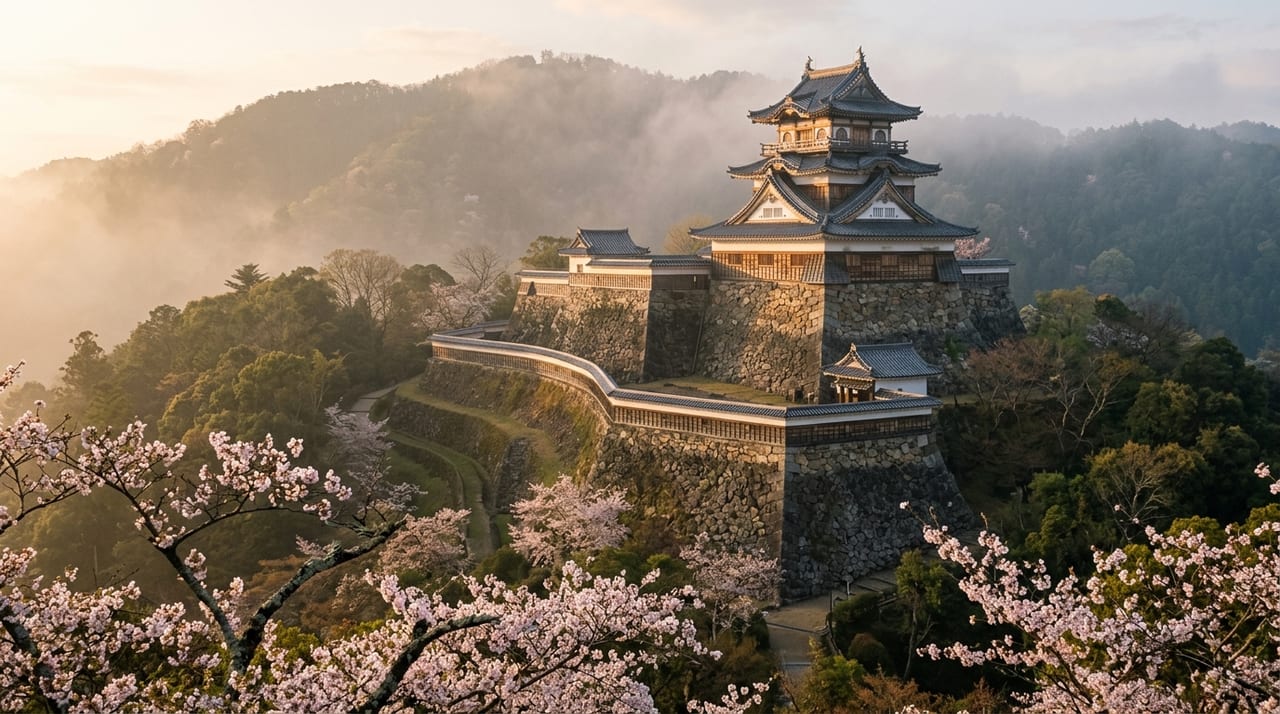
 * Image is for illustrative purposes only.
Ikeda Castle (Settsu Ikeda Castle)
池田城(摂津池田城)
Ikeda Castle (Settsu Ikeda Castle) is a historic castle in the Kansai region (A kokujin castle in Settsu, said to have been built by Ikeda Noriyori around Kenmu 1 (1334). After Araki Murashige's rebellion (the Battle of Arioka Castle), it was abandoned in Tenshō 8 (1580) on the orders of Oda Nobunaga). Its lord was Ikeda clan (powerful Settsu kokujin) → Araki Murashige (took control of the Ikeda family) → abandoned.
Overview
Ikeda Castle is a medieval mountain castle located on Shiroyama in Ikeda City, Osaka Prefecture. It served as the seat of the Ikeda clan, a powerful kokujin lord in Settsu Province (northern Osaka Prefecture and southeastern Hyogo Prefecture), from the Nanboku-chō period through the Sengoku period. The Ikeda clan was a kokujin lord who governed Toyoshima District. As a family controlling the Ina River basin, a key transport hub of the Kinai region, it had close ties with Kyoto's commerce and culture.
As Oda Nobunaga advanced in pacifying the Kinai, the Ikeda clan kept its power in Settsu while serving within the Oda forces. However, in Genki 1 (1570), Ikeda Tomomasa, a member of the clan, and retainers including Araki Murashige drove out the head of the house, Ikeda Katsumasa, and Murashige eventually came to control the Ikeda family. In Tenshō 6 (1578), Nobunaga's senior retainer Araki Murashige suddenly rebelled against Oda Nobunaga at Arioka Castle (Itami Castle) (the Araki Murashige Rebellion, or the Arioka Castle Rebellion). In this battle, Murashige did not garrison troops at Ikeda Castle; instead, Nobunaga set up his camp at Ikeda Castle and attacked Arioka Castle. When Arioka Castle fell in Tenshō 7 (1579), Ikeda Castle was abandoned on Nobunaga's orders in the following year, Tenshō 8 (1580).
The Ikeda Castle ruins are now open to the public as Ikeda Castle Ruins Park, developed by Ikeda City. Remains found in a four-year excavation survey starting in 1989, such as foundation stones, wells, and karesansui dry gardens, have been restored. Inside the castle ruins park are an observation rest house built like a yagura turret, a Japanese garden, and a tea room. The park is also known as a cherry blossom spot in spring.
Ikeda City is known as the setting of classic rakugo stories such as 'Ikeda no Shishikai.' As a historically rich city with a deep cultural heritage, it serves as a tourism base in northern Osaka. The Ikeda Castle ruins hold an important place as a site where two historical layers overlap: the culture of Settsu kokujin and the Oda regime's control of the Kinai region.
Connection to Swords
The connection between Ikeda Castle and Japanese swords is rooted in Araki Murashige, who took control of the Ikeda family, and in the Battle of Arioka Castle, which led to the castle's abandonment.
While besieged at Arioka Castle (Tenshō 6–7), Araki Murashige had many retainers, warriors, merchants and townspeople within the castle. In the end, however, he left his family and retainers behind and fled himself to Amagasaki and Hanakuma Castle. Murashige's conduct in this Arioka Castle Rebellion is strongly criticized as a matter of samurai ethics. Afterward, he reinvented himself as a tea man under the name Dōkun, becoming a sukisha (tea connoisseur). In this way, the Arioka Castle Rebellion and the abandonment of Ikeda Castle are discussed in both sword history and tea history as the event where the dual culture of 'the warrior's sword and the world of the tea ceremony' intersects most clearly.
Highlights
- Ikeda Castle Ruins Park — A medieval castle park with restored excavated remains such as foundation stones, wells and karesansui gardens; a cherry blossom spot in spring
- Observation rest house — A two-story building built like a yagura turret, overlooking the streets of Ikeda; the park also includes a Japanese garden and a tea room
- Itsuō Art Museum — An art museum associated with Kobayashi Ichizō, founder of Hankyū Railway; holds tea utensils and Japanese paintings (a contrast with modern culture)
- Rakugo Museum (Kamigata Rakugo Archives Exhibition Hall) — A municipal rakugo archive in Ikeda, the setting of 'Ikeda no Shishikai'
- Arioka Castle Ruins (Itami City) — The castle ruins where Araki Murashige held out under siege; a nationally designated historic site in front of JR Itami Station, about 20 minutes by car
* Opening hours and admission fees are subject to change. Please check the official website before visiting.