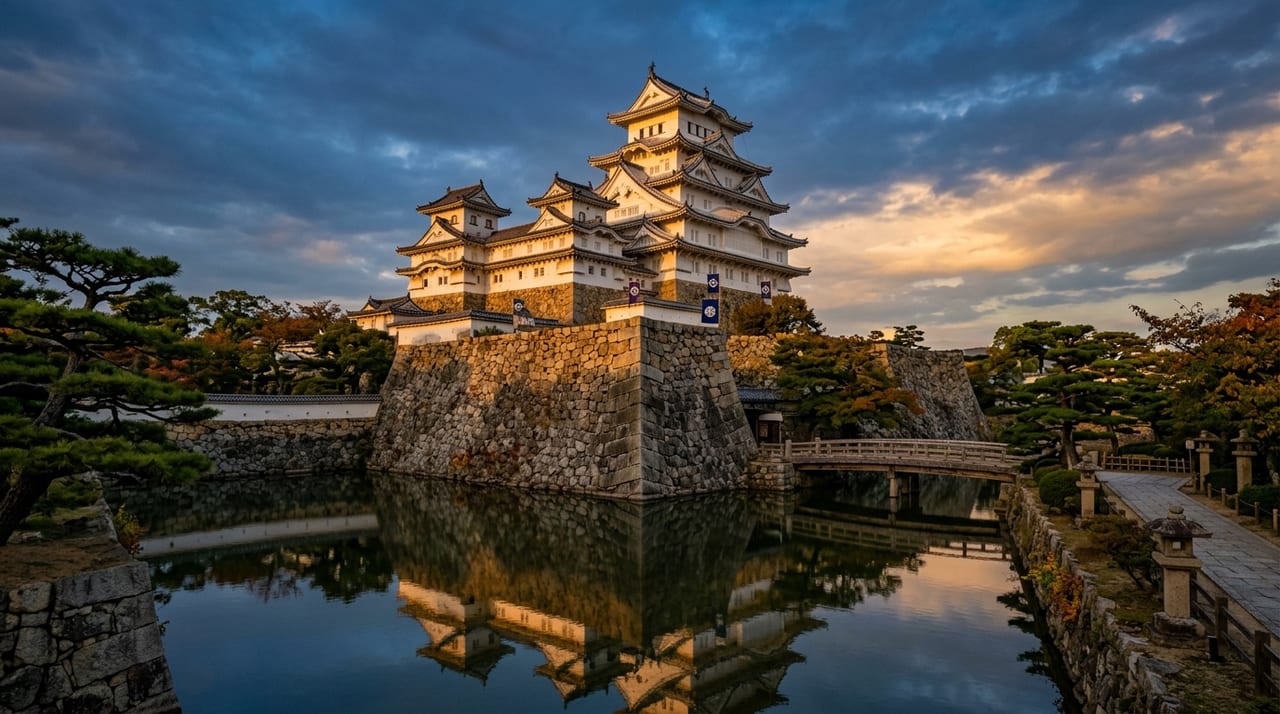
 * Image is for illustrative purposes only.
Tsu Castle
津城
Tsu Castle is a historic castle in the Kansai region (Origins in the Eiroku era (1558–70); major renovation after 1611 (Keichō 16)). Its lord was Tōdō Takatora.
Overview
About Tsu Castle
Tsu Castle is a castle located in Tsu, the prefectural capital of Mie Prefecture in Ise Province, and is known as an early modern castle that was extensively renovated by Tōdō Takatora. Originally, during the Eiroku era, Oda Nobukane, a younger brother of Oda Nobunaga, was enfeoffed there and developed it into a full-fledged castle. Afterward, in Keichō 13 (1608), Tōdō Takatora was enfeoffed at Tsu as daimyo of the two provinces of Ise and Iga, and from Keichō 16 (1611) he carried out large-scale renovation work that completed the basic form of today's Tsu Castle. Takatora was known as a "master castle builder" who worked on many castles, and Tsu Castle is highly regarded as one of his representative works. The layout of Tsu Castle, featuring tall stone walls and a broad moat, embodies Takatora's castle-building philosophy of "a castle that is easy to defend and hard to attack."
Tōdō Takatora's Castle-Building Philosophy
Tōdō Takatora is known as a warlord who changed lords seven times, and he had the political flexibility to successfully navigate the transition from the Toyotomi regime to the Tokugawa regime. Takatora had expertise in architecture and civil engineering, and he raised his standing by designing and building castles for his lords. The hallmarks of Takatora's castle construction are his frequent use of tall stone walls, wide water moats, and masugata gateways. The remains of Tsu Castle include the Honmaru, the Nishi-no-maru, and part of the inner moat, and the stone walls connecting the Honmaru and Nishi-no-maru show the level of Takatora's stonework techniques.
Ise Province and Culture
Ise Province, where Tsu Castle is located, is a special land that houses Ise Grand Shrine, a sacred site of national renown. Tōdō Takatora brought the Sangū-kaidō, the road to Ise Grand Shrine, into the castle town, and Tsu's castle town also developed as a post town bustling with travelers on the Ise pilgrimage.
Development of the Castle Town
The 320,000-koku Tsu Domain developed in both commerce and culture by taking advantage of its location close to the Kinai region. The Tōdō family encouraged scholarship for generations, and they established the domain school Yūzōkan, putting into practice an education that emphasized both learning and martial arts.
Sightseeing and Experiences
Today's Tsu Castle site (Oshiro Kōen) retains the stone walls of the Honmaru and Nishi-no-maru and part of the inner moat, and a mock three-tiered turret built in Shōwa 33 (1958) stands there. An equestrian statue of Takatora stands on the castle site, honoring his achievements as a master castle builder. Combined sightseeing with Ise Grand Shrine, Matsusaka, and Iga is also enjoyable.
Connection to Swords
Tōdō Takatora was a warlord renowned as a master of castle architecture, and over his lifetime he served seven lords. Takatora's castle-building philosophy pursued the "beauty of practicality," seeking in castles a balance of solidity and functional beauty. This idea deeply resonates with the ideal of "balancing sharpness and beauty of form" in swords. Takatora also displayed martial prowess in battle, and at the Battle of Sekigahara he supported Tokugawa Ieyasu as part of the Eastern Army. In the Bunroku–Keichō campaigns (the Japanese invasions of Korea), he distinguished himself by commanding naval forces. In the late Edo period, the Tsu Domain fought in the Boshin War as part of the new government forces. A tour of "Takatora's castles" combined with Iga Ueno Castle (a castle of the same Tōdō family) is an ideal itinerary for gaining a deep understanding of Japanese castle architecture and sword culture.
Highlights
- Mock three-tiered turret — a concrete mock turret built in Shōwa 33 (1958)
- Stone walls of the Honmaru and Nishi-no-maru and the inner moat — representative remains showing Tōdō Takatora's castle-building techniques
- Equestrian statue of Tōdō Takatora — the imposing figure of the "master castle builder" standing on the castle site
- Mie Prefectural Museum (MieMu) — a prefectural museum introducing the history and nature of Mie Prefecture
- Iga Ueno Castle (about 1 hour by car) — a castle built by Takatora; the Ueno tenshu is a wooden mock tenshu built in Shōwa 10 (1935)
- Ise Grand Shrine (about 1 hour by car) — Japan's largest sacred site; combined castle-and-shrine trips are popular
* Opening hours and admission fees are subject to change. Please check the official website before visiting.