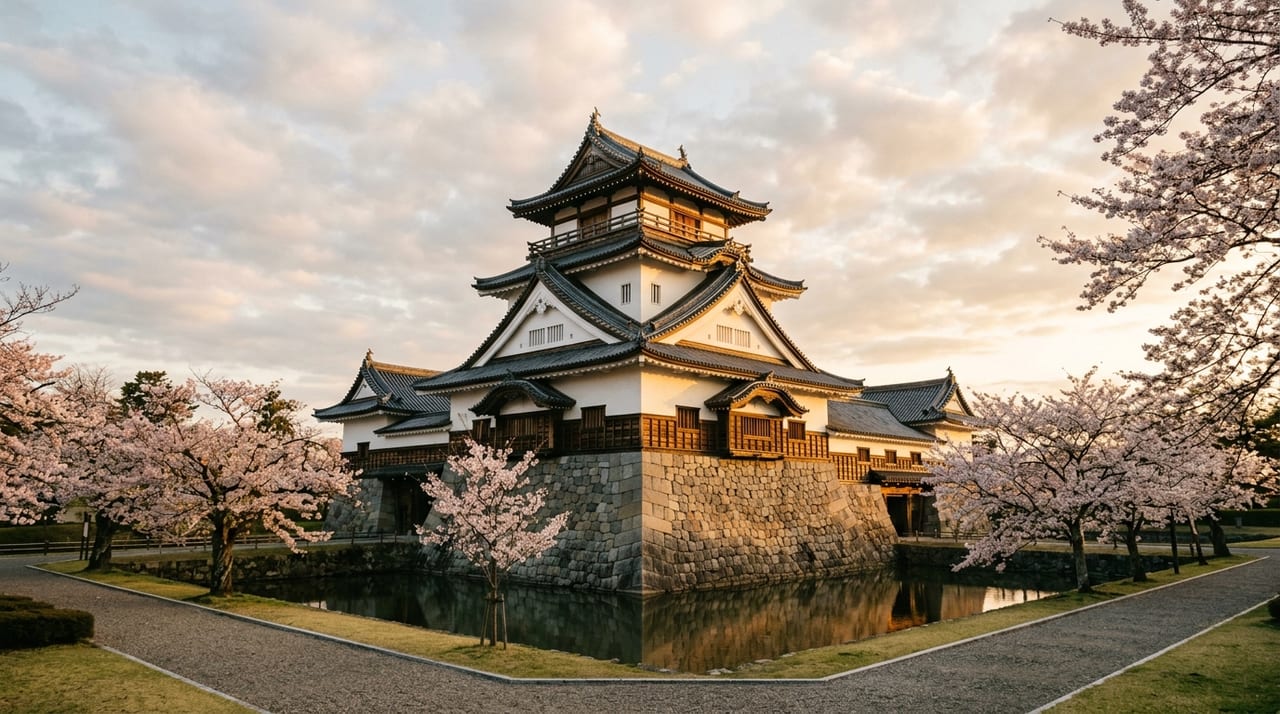
 * Image is for illustrative purposes only.
Tamonyama Castle (Tamon Castle)
多聞山城(多聞城)
Tamonyama Castle (Tamon Castle) is a historic castle in the Kansai region (Sengoku period (built in 1559; destroyed in the sixth month of 1577)). Its lord was Matsunaga Hisahide (builder), Matsunaga Hisamichi, Ban Naomasa.
Overview
Overview
Tamonyama Castle stood on Mikenji-yama in Hōren-chō, Nara City, a hilltop castle estimated at roughly 100 m in both directions. It gave its name to the tamon-yagura — the long, row-house-style turret — and occupies a pivotal place in the history of Japanese castle architecture as a forerunner of the early-modern castle.
Founding and History
It was built between 1559 and the following year by Matsunaga Hisahide, a senior retainer of Miyoshi Nagayoshi who had pushed into Yamato Province. Hisahide chose a site overlooking Tōdai-ji and Kōfuku-ji, the entrenched powers of Yamato, and made it the base of his rule over the province. His son Matsunaga Hisamichi later held it, and after Hisahide submitted to Oda Nobunaga the castle passed to Nobunaga's retainer Ban Naomasa. When Naomasa fell in battle at Ishiyama in the fifth month of 1576, Nobunaga ordered the castle demolished in the sixth month of 1577.
Structure
The castle was groundbreaking in using foundation stones and stone walling throughout its baileys and in lining them with permanent tile-roofed buildings. It is thought to have had a four-storey turret (shikai-yagura) equivalent to a later tenshu, together with turrets linked in a long row — the origin of the term tamon-yagura. The main bailey held a lavish residence said to imitate the Muromachi shogunate's Hana-no-Gosho, along with gardens and a chamber known as the "Yang Guifei Room." The Jesuit missionary Luís de Almeida, who visited in 1565, praised walls of a whiteness and lustre he had never seen in Christendom and wrote that nowhere in the world was there a castle so fine. Contemporary sources such as the Tamon'in Nikki and the Yagyū Monjo also describe the site.
Present State and Access
After the demolition, its timbers were reused for the new Nijō palace in Kyoto and its stone for Tsutsui and Kōriyama castles. Levelling work for school construction in 1948 largely erased the remains of the central baileys, but traces of earthworks and a vertical moat survive on the raised ground west and north of the school buildings, with bailey remains on the southern slope. A stone marker reading "Tamon Castle Ruins" stands at the entrance. About a 10-minute walk from the "Kōnoike" Nara Kōtsū bus stop, reached from Kintetsu Nara Station.
Highlights
- The castle that gave its name to the *tamon-yagura* and is regarded as a forerunner of the early-modern castle
- Built in 1559 by Matsunaga Hisahide as the base of his rule over Yamato Province
- Employed a four-storey turret equivalent to a tenshu, with foundation stones, stone walling, and tile-roofed permanent buildings throughout
- Praised by the Jesuit Luís de Almeida as a castle without equal anywhere in the world
* Opening hours and admission fees are subject to change. Please check the official website before visiting.