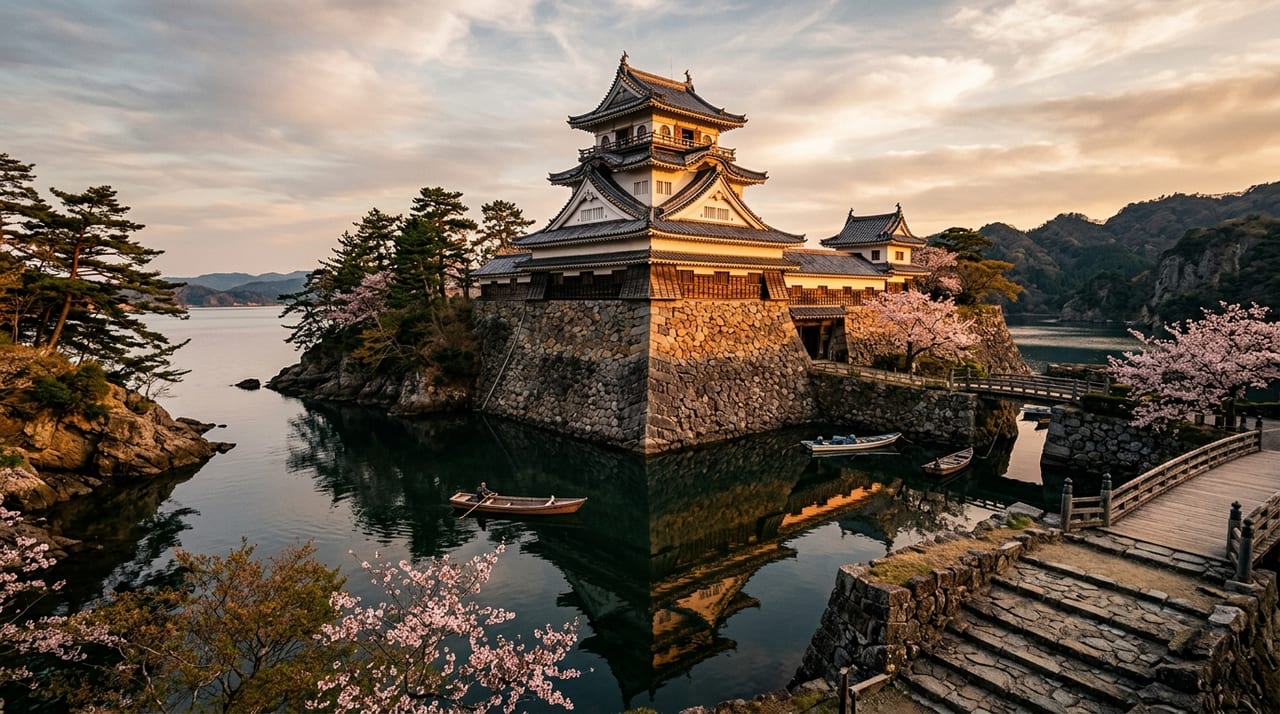
 * Image is for illustrative purposes only.
Toba Castle
鳥羽城
Toba Castle is a historic castle in the Kansai region (Built by Kuki Yoshitaka in Bunroku 3 (1594); a sea castle with its main gate opening toward the sea). Its lord was Kuki Yoshitaka → Kuki Moritaka → Naitō clan → Doi clan → Inagaki clan.
Overview
Toba Castle is a castle located in Toba City, Mie Prefecture. Also called a "sea castle" (umi-shiro) or "floating castle" (uki-shiro), it is one of the most original castle structures in Japanese history. The castle was built on a hill jutting into Toba Bay, and its layout makes the fullest use of a site surrounded by sea on three sides. It is rare nationwide as a naval castle, built with its main gate projecting toward the sea, treating the sea as the front of the castle.
The castle was built by Kuki Yoshitaka (九鬼嘉隆), leader of the "Kuki naval forces." Yoshitaka is known as a pirate lord who controlled the seas of Ise and Shima, and he served Oda Nobunaga and Toyotomi Hideyoshi by providing naval forces. In particular, at the Battle of Kizugawaguchi in Tenshō 6 (1578), he is said to have won a sea battle against the Mōri naval forces (Murakami navy) using iron-armored warships (tekkansen). Views differ on the actual structure and armor of those ships.
At the Battle of Sekigahara in Keichō 5 (1600), Kuki Yoshitaka sided with the Western Army (the faction of Ishida Mitsunari). His son Moritaka sided with the Eastern Army, which put father and son in opposition. After the Western Army was defeated, Yoshitaka died by suicide. Moritaka was allowed to continue as lord of the Toba domain for his service to the Eastern Army. However, a succession dispute arose in the next generation, the Kuki family lost Toba and was transferred to Mita in Settsu and Ayabe in Tanba, and its naval forces were lost.
Afterward, Toba Castle changed hands among the Naitō, Doi, and Inagaki families, and it functioned as the government office of the Toba domain until the Meiji Restoration. The "Toba" in the Battle of Toba–Fushimi (Keiō 4 / 1868), which began the Boshin War, is a place name south of Kyoto and has no connection to this Toba Castle in Shima. The castle was damaged by the Ansei 1 (1854) earthquake, which collapsed the main tower and other buildings. It was abandoned and dismantled in Meiji 4 (1871), but the stone walls of the main bailey and the former chief retainer's residence remain, and it is designated as a historic site of Mie Prefecture.
Connection to Swords
The connection between Toba Castle and the Japanese sword is concentrated in the figure of the castle lord Kuki Yoshitaka and in the history of the Sengoku-period sea battles and maritime trade in which the Kuki naval forces were active.
Kuki Yoshitaka was not simply a "pirate lord." As Oda Nobunaga's commander of naval forces, he held authority equal to that of land generals. When Yoshitaka sided with the Western Army at Sekigahara, he is said to have ended his life by suicide. This scene can be discussed in the context of the Japanese sword's use in the final act of a Sengoku warrior.
Along the coast of the Shima Peninsula, shrines and temples that convey the activities of the Kuki naval forces are scattered. Through both its original castle structure built on the sea and the figure of Kuki Yoshitaka, an outstanding warrior, Toba Castle holds a firm place in the history of the Japanese sword.
Highlights
- Toba Castle Honmaru site and stone walls — Mie Prefecture Historic Site; the stone walls of the main bailey and the former chief retainer's residence survive
- View of Toba Bay from Shiroyama Park — overlooking Mikimoto Pearl Island, Sakatejima, and Toshijima
- Toba Aquarium and Mikimoto Pearl Island — sightseeing facilities where visitors can experience the marine culture of Shima spread through the castle town
* Opening hours and admission fees are subject to change. Please check the official website before visiting.