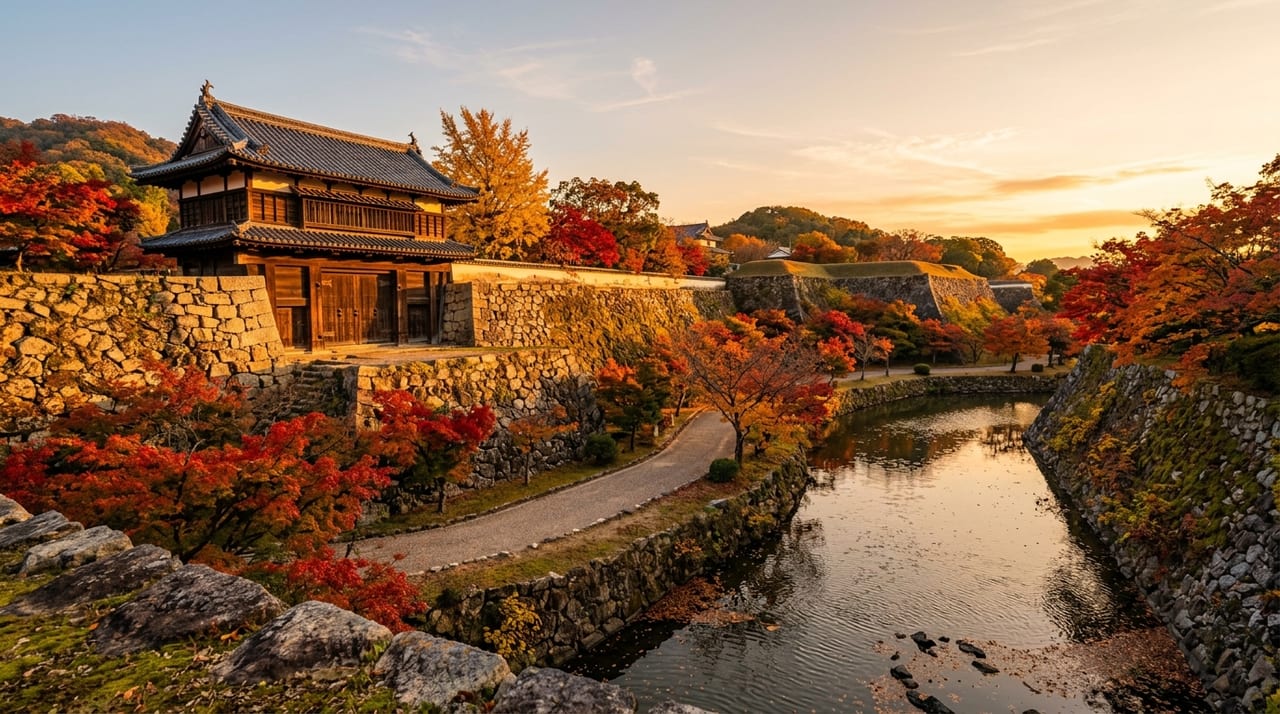
 * Image is for illustrative purposes only.
Ibaraki Castle
茨木城
Ibaraki Castle is a historic castle in the Kansai region (The year of construction is unknown (various theories exist, including a claim that Kusunoki Masashige built it during the Kenmu era). Nakagawa Kiyohide repaired and expanded it during the Genki and Tenshō eras). Its lord was the Ibaraki clan, Nakagawa Kiyohide, Katagiri Katsumoto, and others.
Overview
A Key Position in Settsu
Ibaraki Castle was a flatland castle located in Ibaraki City, Osaka Prefecture. As one of the important castles in Settsu Province (northern Osaka), it played a major role during the Sengoku and Azuchi-Momoyama periods. The castle site lies in the center of present-day Ibaraki City, but urban development has advanced and few remains survive. At Ibaraki Elementary School there is a marker stone for the site of the honmaru and a reconstructed yagura gate. The east gate of Ibaraki Shrine is said to have been relocated from the karamete (back) gate of Ibaraki Castle.
The Rebellion of Araki Murashige
The most dramatic event in the history of Ibaraki Castle was the rebellion of Araki Murashige, which took place in Tenshō 6 (1578). Araki Murashige (1535–86) had been entrusted with Settsu Province as a powerful retainer of Oda Nobunaga. Suddenly, however, he rebelled against Nobunaga and shut himself up in his base, Arioka Castle (present-day Itami City). At this time, Nakagawa Kiyohide, lord of Ibaraki Castle, also followed Murashige through personal ties. Later in the same year, however, he responded to Nobunaga's persuasion, opened Ibaraki Castle, and switched to the Oda side. In Tenshō 7 (1579), Murashige left Arioka Castle and moved to Amagasaki Castle. He then spent the second half of his life as a tea man, a curious fate.
Nakagawa Kiyohide and the Battle of Shizugatake
After the Ibaraki clan was destroyed in the Battle of Shirai-kawara in Genki 2 (1571), Nakagawa Kiyohide became lord of Ibaraki Castle. Kiyohide switched from serving under Araki Murashige to the Oda side, and after the Honnō-ji Incident he served Hashiba Hideyoshi. In the Battle of Shizugatake in Tenshō 11 (1583), Kiyohide was killed in action after a surprise attack by Sakuma Morimasa while he was defending Ōiwayama Fortress. When his son, Nakagawa Hidemasa, was moved to Miki in Harima, Ibaraki became a direct domain of Hideyoshi. After the Battle of Sekigahara, in Keichō 6 (1601), Katagiri Katsumoto became lord of the castle.
Katagiri Katsumoto and Behind the Scenes at Osaka Castle
Katagiri Katsumoto (1556–1615) was a warrior who served Toyotomi Hideyoshi. As lord of Ibaraki Castle, he administered Settsu Province, and he is known for devoting himself to maintaining the Toyotomi house after Hideyoshi's death. Katsumoto was placed in a difficult position as the negotiator with Tokugawa Ieyasu. Before the Osaka campaigns, he left Osaka Castle, in a manner of being driven out by the Toyotomi house. Afterward, Ibaraki Castle was abandoned under the One-Castle-per-Province Edict. The castle's gate is said to have been relocated to Ibaraki Shrine, temples, and other sites.
Connection to Swords
Araki Murashige and His Transformation into a Tea Man
After his rebellion against Nobunaga, Murashige left Arioka Castle and went into hiding. He then associated with tea masters including Sen no Rikyū and immersed himself deeply in the world of the tea ceremony. He lived for the tea ceremony under the name 'Dōkun' and spent the second half of his life at a distance from the swords of a warrior.
Katagiri Katsumoto and the Spirit of the Sword
Katagiri Katsumoto is counted among the Seven Spears of Shizugatake and was a retainer of Toyotomi Hideyoshi. His loyalty to his lord and the hardships of his later years have been passed down as a typical tragedy of bushidō. After negotiations with the Tokugawa, Katsumoto was compelled to leave the Toyotomi house, and he died just 20 days after the fall of Osaka Castle. Katsumoto's life, connected with Ibaraki Castle, testifies to an age in which warriors lived with the sword as a symbol of the soul, and it deeply illuminates the spiritual background of sword culture.
Highlights
- Ibaraki Shrine East Gate — a gate said to have been relocated from the karamete (back) gate of Ibaraki Castle
- Ibaraki City Cultural Heritage Museum — a city museum housing historical materials of Ibaraki
- Site Associated with the Rebellion of Araki Murashige — the stage where castle lord Nakagawa Kiyohide followed Murashige, then opened the castle and switched to the Oda side
- Reconstructed Yagura Gate and Honmaru Marker Stone at Ibaraki Elementary School — landmarks for recalling the past at the urbanized castle site
- Easily accessible from Osaka and Kyoto by Hankyu and JR — convenient as a base for sightseeing in the Kansai region
* Opening hours and admission fees are subject to change. Please check the official website before visiting.