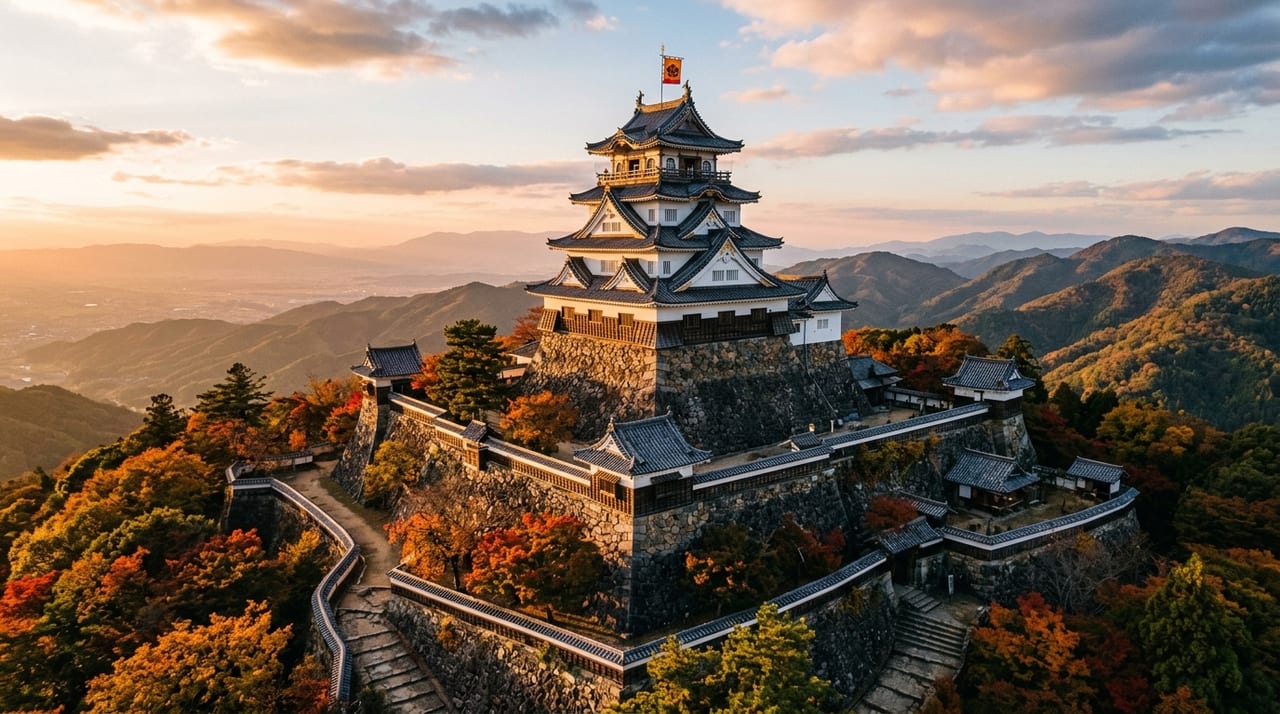
 * Image is for illustrative purposes only.
Shigisan Castle
信貴山城
Shigisan Castle is a historic castle in the Kansai region (Built circa 1532–1555 (Tenbun era), expanded through the 1570s). Its lord was Matsunaga Hisahide.
Overview
The Castle and Its Lord
Shigisan Castle is a mountain castle built on Mt. Shigi (433 m), at the southern tip of the Ikoma mountain range in northwestern Nara Prefecture. It is remembered in history as the stronghold of Matsunaga Hisahide, who effectively controlled Yamato Province (Nara) during the Sengoku period. Linked enclosures (renkaku-shiki) spread across the steep mountaintop. The castle combines outstanding views over the Yamato Basin and Kawachi Plain with military advantage, making it a famous castle. On the mountainside of Mt. Shigi stands Shigisan Chōgosonshi-ji, associated with Prince Shōtoku.
The Man Matsunaga Hisahide
Matsunaga Hisahide (c. 1508–1577) has been passed down to posterity as one of the Sengoku period's representative 'kyōyū' (notorious warlords). He rose to prominence as a senior retainer of Miyoshi Chōkei and seized actual control of Yamato Province. He is said to have assassinated the 13th Muromachi shogun, Ashikaga Yoshiteru. Tradition also says he set fire to the Great Buddha Hall of Tōdai-ji, and his figure was portrayed as an archetype of wickedness that trampled on moral duty. However, recent research has produced many alternative views on these traditions, and Hisahide is being reassessed as a complex figure who also had the practical side of a pragmatic administrator, contributing to the restoration of order in Yamato. After repeatedly submitting to and rebelling against Oda Nobunaga, he was surrounded by Nobunaga's forces in the Second Battle of Shigisan Castle in Tenshō 5 (1577). Shut up in the keep, he met a heroic end.
The Hiragumo Tea Kettle and the Legend of His End
The most famous anecdote associated with Matsunaga Hisahide is the 'Hiragumo tea kettle' (Hiragumo no chagama). As a condition of surrender, Nobunaga demanded that Hisahide hand over the famed tea utensil 'Hiragumo,' renowned throughout the realm. Hisahide refused. It is said that he declared 'I will not give this famed treasure to Nobunaga,' blew up the tea kettle along with the keep, and died. There are various theories about the truth of this tale. Still, it is widely known as an episode that clearly shows Hisahide's image as a cultured warlord who combined the tea ceremony with military power, and it has remained a motif of many works of literature, theater, and film up to the present day. As a place where Hisahide's way of life and his end are concentrated, Shigisan Castle shines with a special glow even within Sengoku history.
The Castle Ruins and Mt. Shigi Today
The Shigisan Castle ruins are now designated as a historic site of Nara Prefecture, and remains such as enclosures (kuruwa), earthen ramparts, and dry ditches (horikiri) survive on the mountaintop. On the mountainside, Shigisan Chōgosonshi-ji still presents an imposing appearance. It is the head temple of the Shigisan Shingon sect, with Bishamonten as its principal image, and worshippers never stop coming. Within the grounds, many tiger statues are placed, led by a giant papier-mâché tiger, and a distinctive religious atmosphere pervades the site. It is also known as a noted spot for cherry blossoms in spring and autumn foliage, and it is popular as a hiking route from Osaka and Nara.
Connection to Swords
Matsunaga Hisahide and the Aesthetics of Swords and Tea Utensils
In the tea ceremony, Matsunaga Hisahide was a warlord with a discerning eye that stood out even in the Sengoku period. Hisahide possessed many famed utensils, including the Kotenmyō Hiragumo and the Tsukumogami Nasu tea caddy, and his standing as a tea practitioner was also high.
The Yamato Tradition and Sword Culture around Mt. Shigi
Yamato Province (Nara), where Shigisan Castle is located, is also an important region in the long history of the Japanese sword. The Yamato tradition (Yamato-den) is counted as one of the Five Major Traditions (Gokaden). Five schools, Senjuin, Tegai, Taima, Shikkake, and Hoshō, were active throughout the medieval period. These swordsmiths had deep relationships with Nara's great temples, such as Tōdai-ji and Kōfuku-ji, and polished their own distinctive forging techniques while responding to the demands of temples and shrines.
Famed Treasures and the Spirit of the Sword
When Matsunaga Hisahide submitted to Oda Nobunaga, a record remains that Hisahide offered the Tsukumogami Nasu tea caddy, and then presented famed treasures such as the sword Fudō Kuniyuki. As diplomatic ritual among Sengoku daimyō, the exchange of swords and tea utensils was indispensable. Even a 'kyōyū' like Hisahide deeply recognized the value of swords as tools of cultural negotiation. The Hiragumo tea kettle that Nobunaga demanded differs from a sword. Still, Hisahide's attachment to the 'famed treasures' that he kept to the end is an aesthetic that shares a common thread with the way true warriors pour their spirit into swords. By visiting Shigisan Castle, one can experience in the most dramatic form the Sengoku aesthetic sense, where military force and culture intersected.
Highlights
- The Final Stronghold of Matsunaga Hisahide — The castle of this Sengoku-period kyōyū, who met a heroic end in the keep together with the Hiragumo tea kettle
- Mountaintop Enclosures and Earthen Ramparts — Remains of enclosures and earthen ramparts at a castle ruin designated as a historic site by Nara Prefecture
- Shigisan Chōgosonshi-ji — Head temple of the Shigisan Shingon sect with Bishamonten as its principal image, an ancient temple welcomed by a giant papier-mâché tiger
- Views over the Yamato Basin and Kawachi Plain — A panoramic view of the mountains and rivers of Osaka and Nara from 433 m elevation
- A Place Connected to the Yamato Tradition — Near the center of Nara's sword culture, where the Yamato tradition, one of the Five Major Traditions of Japanese swords, flourished
* Opening hours and admission fees are subject to change. Please check the official website before visiting.