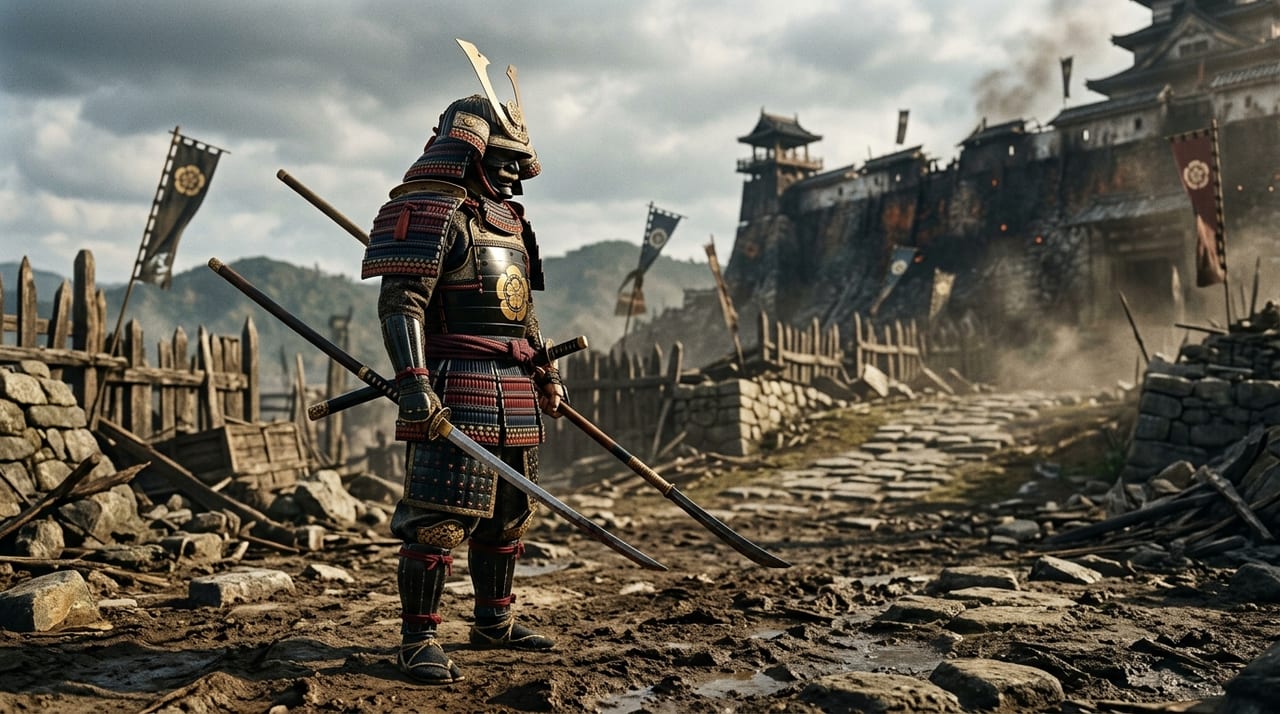
 * Image is for illustrative purposes only.
Matsunaga Hisahide
松永久秀
The Aesthetics of a Ruthless Warlord: The Story of Sengoku's Greatest Villain and His Renowned Treasure, Who Bore the Infamy of Shogun-Killing and the Burning of the Great Buddha Hall and Met His End at Shigisan Castle Along with the Ko-Tenmyō Hiragumo Tea Kettle
Description
The Ruthless Warlord's Rise: From Miyoshi Nagayoshi's Confidant to Master of Yamato
Matsunaga Hisahide is said to have been born in Eishō 5 (1508), though there are various theories about his origins, and they have not been established. Hisahide, who rose to prominence in the service of Miyoshi Nagayoshi, rapidly gained power through his outstanding political talent and cold-headed judgment. After Nagayoshi's death (1564), Hisahide, who took real power within the Miyoshi house, had long been portrayed as the mastermind of the Eiroku Incident in Eiroku 8 (1565). In this event, Hisahide's son Matsunaga Hisamichi and the Miyoshi Triumvirate attacked the 13th shogun, Ashikaga Yoshiteru, at the Nijō Palace and forced him to take his own life (Hisahide himself was in Yamato). This Eiroku Incident shocked people of the time. The unprecedented event of a sitting shogun being killed by his own retainers showed that gekokujō in the Sengoku period had reached its extreme.
The Burning of the Great Buddha Hall of Tōdai-ji and the Assessment of His "Atrocity"
In Eiroku 10 (1567), the conflict between Matsunaga Hisahide and the Miyoshi Triumvirate escalated into a fierce battle fought at Tōdai-ji in Nara. In the course of this fighting, the Great Buddha Hall of Tōdai-ji was destroyed by fire. In later assessments, it is often said that Hisahide burned the Great Buddha Hall, but a close examination of the historical sources also gives rise to views that attribute the act to the side of the Miyoshi Triumvirate, and debate among historians over the degree of Hisahide's responsibility continues. In any case, Hisahide, who was held responsible for two grave crimes, the murder of a shogun and the burning of the Great Buddha Hall, gained wide notoriety as the embodiment of the "three evil deeds" (the usurpation of his lord's house, the Miyoshi family; the killing of a shogun; and the burning of the Great Buddha Hall) that Oda Nobunaga was said to have spoken of in the Jōzan Kidan.
Submission to Nobunaga and the Renowned Treasure "Ko-Tenmyō Hiragumo"
In Eiroku 11 (1568), when Oda Nobunaga gained control of the Kinai region, Hisahide submitted to Nobunaga. Nobunaga highly valued Hisahide's talent and entrusted him with control of Yamato. At this time, Hisahide presented the renowned tea caddy "Tsukumogami Nasu" to Nobunaga, along with a hostage. Meanwhile, the renowned tea kettle "Ko-Tenmyō Hiragumo" was never relinquished by Hisahide, even when Nobunaga's side later demanded that it be handed over. This tea kettle is known as a "treasure of the realm" and has become a symbol of Matsunaga Hisahide's refined cultural discernment and a kind of pride toward power.
Swords and the Tea Ceremony: The Aesthetics of the Sengoku Era
Matsunaga Hisahide was also renowned as a tea master, and in addition to Ko-Tenmyō Hiragumo he possessed many renowned tea utensils, including Tsukumogami Nasu. Hisahide's discerning eye, which he showed in collecting and appreciating renowned tea utensils for the tea ceremony, was also displayed in swords. He also possessed renowned swords, and in the 12th month of Eiroku 11 (1568) he traveled to Nobunaga in Gifu and presented renowned swords, including the sword Fudō Kuniyuki, to him. Hisahide's cultural attitude of equally valuing swords and tea wares as the same kind of "renowned treasures" represents the pinnacle of the aesthetics of a Sengoku warlord.
The Final Days at Shigisan Castle: The Tea Kettle Hiragumo and His Death
In Tenshō 5 (1577), Hisahide once again rose in revolt against Nobunaga. Surrounded at Shigisan Castle by Nobunaga's forces, Hisahide refused to surrender and chose a heroic end. It is said that Hisahide smashed Hiragumo to pieces, set fire to the main keep, and took his own life. The story that he packed the tea kettle with gunpowder and blew himself up along with it is considered a later fabrication, but as an episode symbolizing Hisahide's pride, "choosing death over handing over a treasure of the realm," it was widely retold in later generations. The ruthless warlord's valiant end is deeply engraved in Japanese culture as the ultimate expression of Sengoku aesthetics.
The Aesthetics of a Ruthless Warlord and Swords
Matsunaga Hisahide's life condenses into a single picture the relationship among power, beauty, and death in the Sengoku period. Although he bore the infamy of killing a shogun and burning a great temple, Hisahide's complex character, which on the other hand loved the tea ceremony and renowned treasures, has a richness that cannot be contained in a simple image of a "villain." For Hisahide, swords too were among his "renowned treasures," at once a symbol of power and the ultimate in beauty. The sword held in the hand of the ruthless warlord was not a mere weapon but embodied a fusion of the pursuit of beauty and the will to power in the chaos of the Sengoku era.
Notable Swords
- Fudō Kuniyuki (a renowned sword that Hisahide possessed, presented to Oda Nobunaga in Gifu in the 12th month of Eiroku 11 (1568))