New Arrivals — Browse our catalog for the latest authentic Japanese sword arrivals. Browse →
19th day, 5th month, Eiroku 8 (June 17, 1565)
Kyoto • Nijo Palace (residence of Ashikaga Yoshiteru)
Forces
Miyoshi Yoshitsugu, the Miyoshi Triumvirate and Matsunaga Hisamichi (attacking)
Ashikaga Yoshiteru (Defending)
About 19 min read
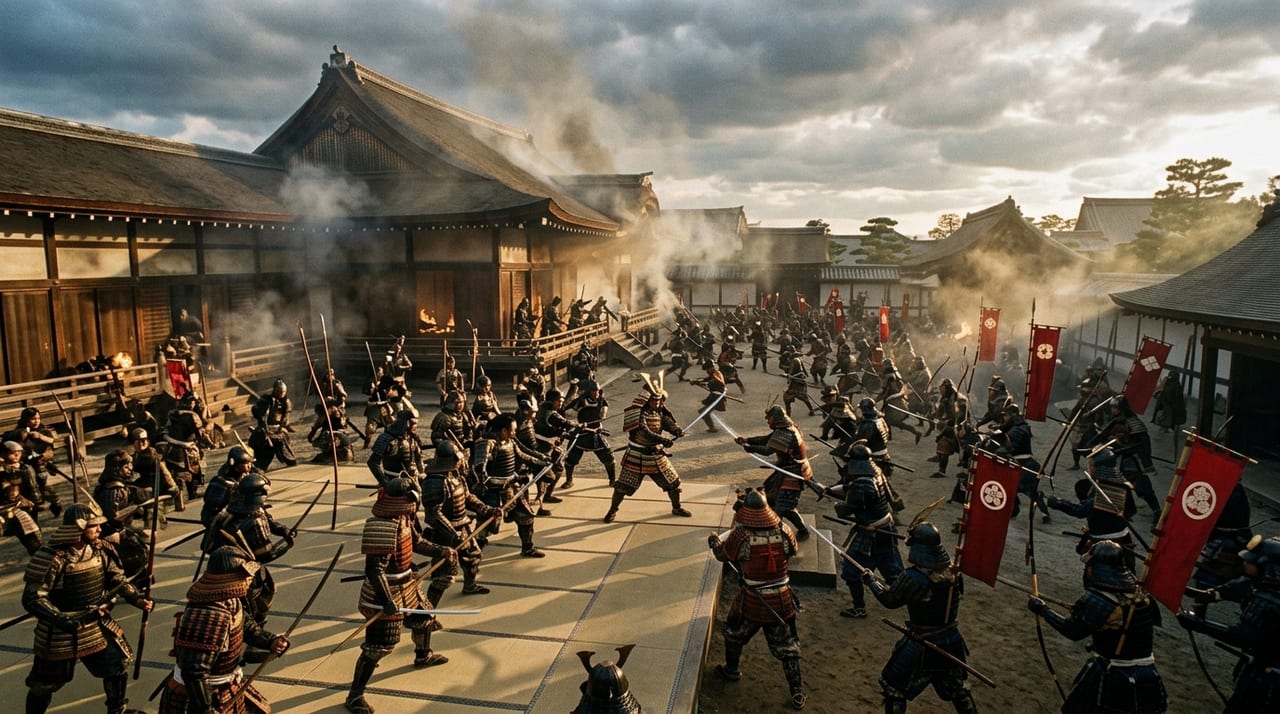
On the 19th day of the 5th month of Eiroku 8 (1565), roughly 10,000 soldiers suddenly descended upon Nijō Palace in Kyoto. Forces led by Miyoshi Yoshitsugu, the Miyoshi Sanningumi (Miyoshi Nagayasu, Miyoshi Sōi, and Iwanari Tomomichi), and Matsunaga Hisamichi and others surrounded the residence of Ashikaga Yoshiteru, the 13th shogun of the Muromachi shogunate, and launched a full assault. This was the “Eiroku Incident.”
What gives this incident special significance in the history of Japanese swords lies in the manner of Yoshiteru's final fight. The Nihon Gaishi of the late Edo period relates that Yoshiteru stuck several famous swords upright in the tatami of his own palace and, each time a blade was nicked, switched to the next, continuing to fight to the end against overwhelming numbers. A shogun who fought and died while cycling through swords as “consumables”—this scene has been passed down through the ages as the most dramatic “death with a sword” in Japanese history.
Ashikaga Yoshiteru (1536–1565) was born as the son of the 12th shogun, Yoshiharu. From childhood he was forced into exile, taking refuge in places such as Sakamoto in Ōmi and Kutsuki Valley (present-day Takashima City, Shiga Prefecture) while holding on to the shogunal position. He was one of the “wandering shoguns” characteristic of the late Muromachi shogunate.
What sets Yoshiteru apart from other Muromachi shoguns, however, was his strong determination in martial prowess. Yoshiteru was one of the direct disciples who received instruction from Tsukahara Bokuden, renowned as a swordsman, and there is also a theory that he was taught the secret technique “Ichi no Tachi.” The later nickname “Swordmaster Shogun” arose from such anecdotes and from his fighting at the Eiroku Incident.
In Yoshiteru's time, real power in the Kinai region was held by Miyoshi Nagayoshi, and Yoshiteru repeatedly alternated between confrontation and reconciliation with Nagayoshi. Yet Yoshiteru did not give up on restoring the authority of the shogunate. He repeatedly mediated peace among the daimyō and conducted diplomacy with powerful daimyō such as Takeda, Uesugi, Mōri, and Ōtomo. Yoshiteru had many famous swords in his possession—blades handed down in the Muromachi shogunal house and fine pieces presented by daimyō from various regions—so Nijō Palace was indeed a “house of famous swords.”
When Miyoshi Nagayoshi died in Eiroku 7 (1564), real power in the Miyoshi house passed to the Miyoshi Sanningumi (Nagayasu, Sōi, and Tomomichi). Matsunaga Hisahide had once dominated the Kinai as a senior retainer of Miyoshi Nagayoshi, but after Nagayoshi's death he began to pursue power of his own.
After Miyoshi Nagayoshi's death, Yoshiteru began moving toward restoring the authority of the shogun. Yoshiteru's increasingly active diplomacy, including sending shogunal envoys to daimyō, appeared as a threat to the Miyoshi Sanningumi. There are various theories about the cause of the decisive clash: one holds that it was to install Ashikaga Yoshihide, who was in Awa, as shogun; another holds that the “gosho-maki” (encircling the shogun's palace with a large force to force demands) escalated into the clash; and another holds that Miyoshi Yoshitsugu, who had succeeded to the family headship, sought to show his strength by killing the shogun. Note that the strike force was led by Hisahide's eldest son, Hisamichi, and the view that Hisahide himself was in Yamato on that day and was not directly involved is now the prevailing one.
On the morning of the 19th day of the 5th month of Eiroku 8 (1565), the forces of the Miyoshi Sanningumi suddenly surrounded Nijō Palace. Yoshiteru's guard was a small force suited to the scale of the palace, and it was impossible to resist head-on against the roughly 10,000 attackers.
But Yoshiteru did not flee. According to Frois's Nihonshi, when the attackers broke into the palace, Yoshiteru himself fought wielding a naginata, and after that he drew his sword and fought back. The late-Edo Nihon Gaishi also relates that Yoshiteru stuck several of the Ashikaga house's treasured swords upright in the tatami of the palace to prepare for battle.
According to the same work, Yoshiteru switched to a new sword each time a blade was nicked and fought on. However, the sources closest in time to the incident contain no account of him switching swords in battle, and this story is considered to have a strong element of invention. On the other hand, Frois's Nihonshi and the Shinchōkōki record that Yoshiteru fought bravely himself, and the core of this is considered to be historical fact. In the end, Yoshiteru was outnumbered, exhausted his strength, and was killed. He was 30 years old.
“What fate did Yoshiteru's mother, Keijuin, meet at the time of the Eiroku Incident?”—this question is indispensable when discussing the Eiroku Incident. Keijuin was the daughter of the kampaku Konoe Hisamichi; she became the principal wife of the 12th shogun, Ashikaga Yoshiharu, and bore Yoshiteru, Yoshiaki (later the 15th shogun), and others. As the shogun's mother she held great influence within the shogunate.
On the day of the Eiroku Incident, when Keijuin learned of Yoshiteru's death inside the burning palace, she took her own life (it is also said that she threw herself into the flames). Her death, choosing to die together with her son, is recorded in contemporary sources such as court nobles' diaries, and is passed down as an event symbolizing the tragedy of the incident.
Also, Shūkō, a younger brother of Yoshiteru who had been the abbot of Rokuon'in at Shōkokuji, was killed on the same day. Meanwhile, another younger brother, Kakukei (later the 15th shogun, Ashikaga Yoshiaki), who was monzeki of Ichijō-in at Kōfukuji, was confined. However, with the help of shogunal retainers such as Hosokawa Fujitaka, Wada Koremasa, and Mitsubuchi Fujihide, he escaped from Yamato to Ōmi. This led three years later to Oda Nobunaga's march on the capital and the establishment of Yoshiaki as shogun.
At the time of the incident, the shogunal retainer Ise Sadasuke secretly carried out of the palace the treasured heirlooms that symbolized the shogunal family's headship (such as the go-kosode no karabitsu chests) and entrusted them to the imperial court. There are two famous swords whose connection to Yoshiteru is recounted.
One is Mikazuki Munechika (National Treasure, held by the Tokyo National Museum), one of the Tenka Goken, the Five Famous Swords of the Realm. It is a masterpiece of the Heian-period smith Sanjō Munechika. Although the theory that Yoshiteru wielded it at the Eiroku Incident has spread, it does not appear in sources close to the incident, and its provenance before Kōdaiin is not certain. What is certain is that it came into the possession of Toyotomi Hideyoshi's principal wife, Kita no Mandokoro (Kōdaiin), and after her death in Kan'ei 1 (1624) it was presented to Tokugawa Hidetada as a memento, and passed down in the Tokugawa shogunal house.
The other is Daihannya Nagamitsu (National Treasure, held by the Tokyo National Museum). It is a masterpiece by the Kamakura-period Bizen Osafune smith Nagamitsu, and its extraordinary appraised value of 600 kan in zeni, linked to the 600 fascicles of the sutra Daihannya-kyō, gave rise to its name. It passed from Ashikaga Yoshiteru to Miyoshi Nagayoshi, then through Oda Nobunaga and Tokugawa Ieyasu, and was granted to Okudaira Nobumasa for his merit at the Battle of Nagashino. The transmission of these famous swords, which moved along with the authority of the shogunal house, conveys to the present day the bond between the Muromachi shogunal family and swords.
The Eiroku Incident is an event with symbolic meaning in the history of the Japanese sword.
First, the episode of Yoshiteru's last stand, in which he “fought using multiple swords,” demonstrates in the most dramatic form that the Japanese sword was both a “personal weapon of one-on-one killing” and a “symbol of power and authority.” The swords Yoshiteru stood on the floor were not mere weapons but the shogun's authority itself. The story of his dying while discarding those swords one after another can also be read as a metaphor for the process by which the authority of the Muromachi shogunate was “used up” together with each sword.
Second, that Yoshiteru studied strategy from Tsukahara Bokuden shows that the martial art of “swordsmanship” had been established as a cultural accomplishment for shoguns and daimyō. In the warrior society of the late Muromachi period, the position of the sword was shifting from “something to display” to “a technique for actual use (swordsmanship).” Yoshiteru's image as a swordsman embodies a turning point in the sword culture of this era.
Third, just as Yoshiteru gave Daihannya Nagamitsu to Miyoshi Nagayoshi, the bestowal of famous swords shows the political function of swords in the Sengoku period. Famous swords, through gifting, functioned as “political currency” that confirmed lord-vassal and alliance relationships.
After Yoshiteru's death, the Muromachi shogunate rapidly became a hollow shell. Yoshiteru's cousin, Ashikaga Yoshihide, became the 14th shogun, but he was merely a puppet of the Miyoshi Sanningumi and died of illness without ever entering the capital. Afterward, in Eiroku 11 (1568), Oda Nobunaga marched on the capital in support of Ashikaga Yoshiaki and installed Yoshiaki as the 15th shogun.
However, the relationship between Yoshiaki and Nobunaga also did not last, and in Tenshō 1 (1573) Nobunaga expelled Yoshiaki (the de facto fall of the Muromachi shogunate). Historically, Tenshō 1 is taken as the end of the Muromachi shogunate, but it can be said that the year Yoshiteru was assassinated, Eiroku 8 (1565), was the shogunate's de facto “death.”
The scene at Nijō Palace, in which the “Swordmaster Shogun” Yoshiteru is said to have fought and died after exhausting several famous swords, symbolizes the authority of the Muromachi shogunate having “ended together with the swords.” In that sense, the Eiroku Incident is one epoch in the history of the Japanese sword—an incident in which swords that embodied the authority of a warrior government were used most gloriously and most tragically at the moment of that government's collapse.
Ashikaga Yoshiteru
Ashikaga Yoshiteru — the 13th Ashikaga shogun killed in the Eiroku Incident; the 'sword-master shogun' who reportedly fought to his last breath changing between displayed blades.
Matsunaga Hisahide
Matsunaga Hisahide — alleged co-instigator of the Eiroku Incident; his role is attested in later sources but disputed in primary records.
Oda Nobunaga
Oda Nobunaga — entered Kyoto three years later with Ashikaga Yoshiaki to exploit the political vacuum created by the Eiroku Incident.