 * Image is for illustrative purposes only.
Late Muromachi to Sengoku (Sue-kotō)
室町後期〜戦国(末古刀)
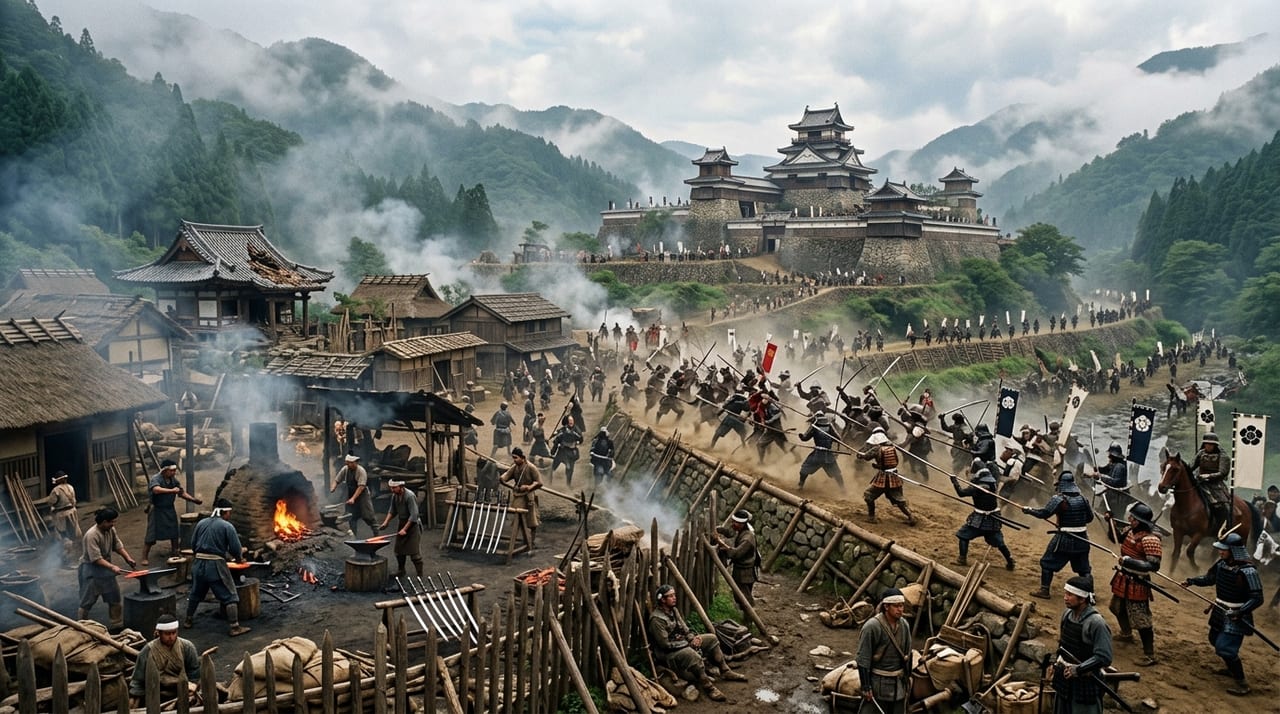
Sparked by the Ōnin War, the Sengoku period of warring states began, and the regularization of large-scale battles centered on ashigaru led to the full-scale mass production of swords. Uchigatana replaced tachi as the mainstream, establishing the form of the modern 'Japanese sword.' This was an era in which the ideal of the Japanese sword—'doesn't break, doesn't bend, cuts well'—was relentlessly pursued.
Description
The Ōnin War and Kyoto
In the first year of Ōnin (1467), the Ōnin War broke out, rooted in the confrontation between the Hosokawa clan, a Kanrei house of the Muromachi shogunate, and the Yamana clan, a powerful shugo. Kyoto was reduced to ashes. With this great war as the turning point, the authority of the Muromachi shogunate fell to the ground, and across the country shugo daimyō and kokujin lords contested for hegemony, opening the Sengoku period. As the spirit of gekokujō spread and ashigaru of peasant origin came to form the main force in battle, demand for practical blades issued to large numbers of soldiers, rather than the individual tachi of earlier samurai, exploded.
Mass Production in Sue-Bizen
It was Osafune in Bizen and Seki in Mino, the two great production centers, that answered this unprecedented demand. At Osafune, the Sukesada family worked as the largest group of smiths, forging blades of a wide range of quality, from mass-produced tabagatana bought and sold in bundles to meticulous chūmon-uchi made to the orders of daimyō and powerful warlords. Smiths signing as Sukesada were said to number several dozen active at the same time; among them, Yosozaemon-no-jō Sukesada and Hikobei-no-jō Sukesada left fine chūmon-uchi works. Katsumitsu was a master of Sue-Bizen on par with Sukesada, and works he signed and dated jointly with Munemitsu are also known. The period from the Eishō era (1504–1521) to the Tenbun era (1532–1555) was the peak of Sue-Bizen, and Bizen blades of this time showed an overwhelming presence in both quality and quantity.
Smith Groups
However, around the eighteenth year of Tenshō (1590), a great flood of the Yoshii River struck the Osafune area, and the forges of many smiths suffered devastating damage. Due to this natural disaster, Bizen forging declined rapidly, and the position of Japan's largest sword production center passed to Mino Seki. The decline of Osafune was a great turning point in the history of nihontō and was one of the remote causes prompting the transition from kotō to shintō.
Regional Characteristics
In the Mino tradition, the smith groups of Seki achieved remarkable growth throughout the Sengoku period. At their summit stood Magoroku Kanemoto, famed as “Seki no Magoroku.” Kanemoto originated the distinctive gunome-midare hamon in which three sharp points of yakiba continue in succession, called “sanbonsugi,” and he won the trust of warlords with his keen cutting edge. Izumi-no-kami Kanesada is known by the common name Nosada, and the name derives from cutting the part below the roof radical of the character for sada into the shape of the character for no. Nosada blades reached high standards in jigane forging, hamon brilliance, and balance of shape alike, and became widely known as the master smith representing Mino blades.
Technical Innovation
The most important change of this era was the complete transition from tachi to uchigatana. The tachi was hung from the waist with the edge facing down, whereas the uchigatana is thrust through the belt with the edge facing up. This change in the manner of wearing had the advantage of performing everything from drawing to striking in a single motion, and it suited the swift, decisive tactics centered on ashigaru. A practical blade length of about 2 shaku 2 sun (approximately 66 centimeters) became established, and a lightweight design that could be handled with one hand was demanded. Thus the uchigatana form established in the Sengoku period is precisely the shape that we today recognize as nihontō.
Transition to the Sengoku Period
In response to the demand of Sengoku daimyō, local smiths across the country also became active. In Satsuma, the Naminohira family forged official blades for the Shimazu clan; in Higo, Dōtanuki Masakuni, official smith to Katō Kiyomasa, mass-produced grand, practical battle blades. The emergence of distinctive smiths across various regions, such as Shimada Yoshisuke of Suruga, Chiyozuru Kuniyasu of Echizen, and Tanaka Kunihiro of Hyūga (later Horikawa Kunihiro), is also an important feature of the Sue-kotō period.
Sue-kotō blades vary enormously in quality, from kazuuchimono to chūmon-uchi. Kazuuchimono have crude signatures and simple construction, while jōsaku chūmon-uchi include many exquisite works grounded in the kotō tradition; in particular, custom-order blades by Magoroku Kanemoto, Izumi-no-kami Kanesada, and Sukesada enjoy enduring popularity among collectors. Many blades are tied to the anecdotes of Sengoku warlords, and Sue-kotō, which combines historical romance with practical beauty, is a field that offers the true pleasure of collecting nihontō.
Characteristics of This Era
- A groundbreaking era in which the uchigatana fully became the mainstream, replacing the tachi. Worn through the belt with the edge up, the uchigatana allowed striking immediately upon drawing, and it was optimized for the swift, decisive tactics centered on ashigaru
- A practical blade length of about 2 shaku 2 sun (approx. 66 cm) became standard. A lightweight design that could be handled with one hand was demanded, and the form that we today recognize as nihontō was established in this era
- Mass production of tabagatana (bundled blades) was carried out, centered on the two great production centers of Osafune in Bizen and Seki in Mino. A production system was organized in which blades were bought and sold in bundles
- The nihontō ideal of “neither breaking nor bending, cutting well” was pursued in actual combat. Sharpness of cut was valued extremely highly, and balancing sharpness with sturdiness was the skill that showcased a smith's ability
- The quality difference between tabagatana (kazuuchimono) and chūmon-uchi is extremely large. Kazuuchimono have short tangs with a single mekugi-ana and simple construction, while jōsaku chūmon-uchi include many exquisite masterpieces grounded in the kotō tradition
- The forges of Osafune were destroyed by the great flood of the Yoshii River in the eighteenth year of Tenshō (around 1590). Japan's largest sword production center declined in a single night, and Mino Seki became the new center of production
- Local smiths in Satsuma, Higo, Suruga, Echizen, and Hyūga became active in response to the demand of Sengoku daimyō. Distinctive blades reflecting the climate and demand of each production region were forged
- The Mino-tradition hamon style represented by Magoroku Kanemoto's sanbonsugi was established. The continuous sharp points of the gunome were loved by warlords as a symbol of cutting power in actual combat