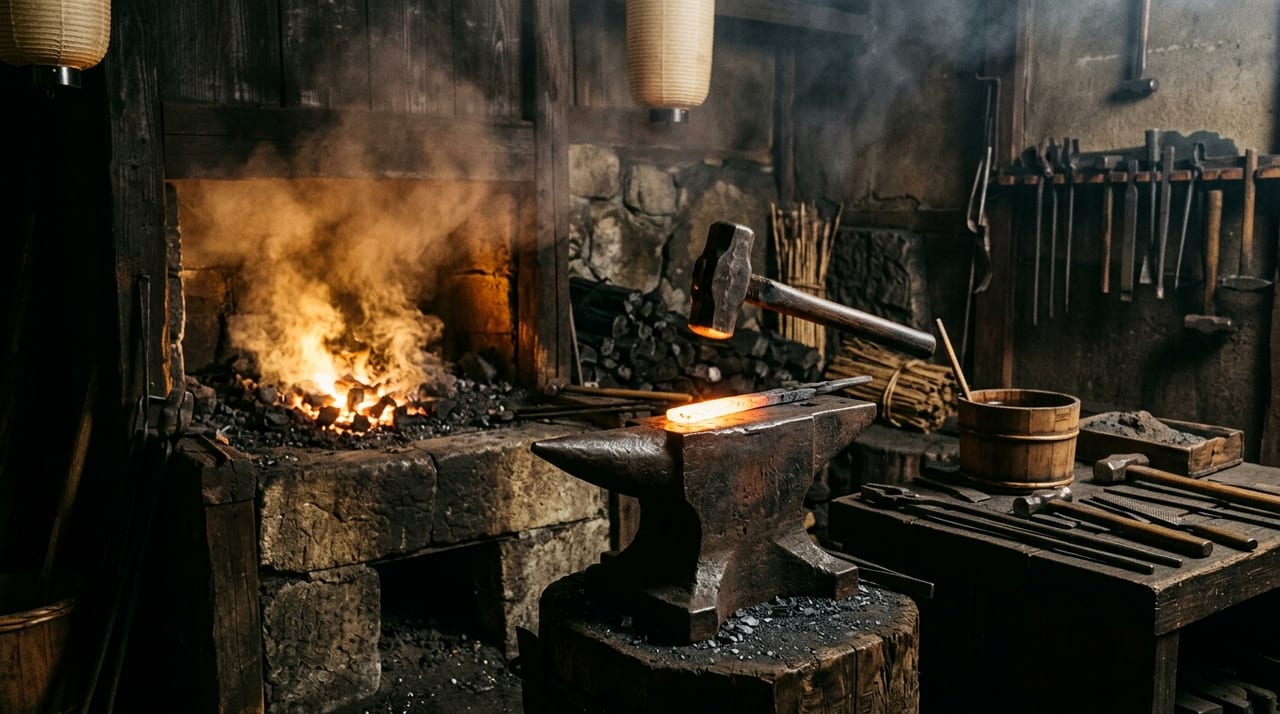
 * Image is for illustrative purposes only.
Bizen Katsumitsu
備前勝光
Description
Bizen Katsumitsu — the Sue-Bizen smith who upheld the Bizen tradition through the Sengoku age
Bizen Katsumitsu was a swordsmith active from the late Muromachi period through the Sengoku period in Osafune, Bizen Province (present-day Okayama Prefecture). He is a representative craftsman of the period known as “Sue-Bizen,” belonging to the Osafune school, and together with Osafune Norimitsu, Munemitsu, and Kiyomitsu he forms a prolific group of the late Osafune period. During the age of warfare of the late Muromachi and Sengoku periods, Katsumitsu's swords were in great demand as practical weapons, and he earned high trust as a smith who could meet mass production while maintaining quality.
Osafune was the largest sword-producing region in medieval Japan, and its scale and productivity far surpassed those of other regions. Especially in the Nanbokuchō, Muromachi, and Sengoku periods, when militarization advanced rapidly, Osafune smiths produced an astonishing quantity of swords under an organized division of labor. As a trusted craftsman who maintained technical standards at Osafune in this age of mass production, Katsumitsu took on the role of supplying swords to samurai across Japan.
Jigane and Hamon — The Aesthetics of Sue-Bizen
Katsumitsu's works, while showing the typical style of Sue-Bizen, are distinguished from other Sue-Bizen smiths by an individual manner. The jigane (ground steel) has the characteristic surface of Bizen steel, ranging from ko-itame (fine itame) to itame and at times mixed with nagare-mokume; the utsuri that stand out are often bō-utsuri or midare-utsuri. The quality and clarity of the utsuri do not reach the summit of Ko-Bizen, but among Sue-Bizen works there are pieces with comparatively beautiful utsuri, showing jigane of high appreciative value.
The hamon is centered on the complex gunome-midare typical of Osafune works of the Muromachi period, and Katsumitsu's works display this form at a high level. The nie along the hamon edge is ko-nie (small nie) and soft, and the scene where sunagashi and fine kinsuji appear is a typical finish that makes use of the characteristics of Bizen steel.
Signature and Dated Works — Abundant Dated Pieces
Many of Bizen Katsumitsu's extant works bear dates. In Chōkyō 2 (1488) he is known to have been invited to Ashikaga Yoshihisa's campaign into Ōmi, where he forged swords in the field at the head of Osafune smiths. The name Katsumitsu was passed down over several generations, and there were several smiths with the same signature.
The most typical signature is “Bizen no kuni jū Osafune Katsumitsu,” and forms such as “Bizen no kuni jūnin Katsumitsu” and “Osafune Katsumitsu” are also seen. Joint works in which Katsumitsu and Munemitsu cut their signatures together are known as a special form even within Sue-Bizen, and extant examples exist. This joint signature is also noted in research as a glimpse of collaboration within the Sue-Bizen production system.
Sengoku Daimyō and the Circulation of Sue-Bizen Swords
In the Sengoku period, as the frequency of battles rose dramatically, demand for swords surged as well. The Sue-Bizen smiths of Bizen Osafune organized mass production to meet this demand and supplied swords to daimyō, commanders, and soldiers across the country. Katsumitsu's swords are thought to have reached various regions through this distribution network and to have been used on the battlefield.
After the authority of the Muromachi shogunate collapsed, regional powerful warlords (later Sengoku daimyō) sometimes protected and supported swordsmiths. The Bizen smiths were active in relation to the Bizen rulers, the Urakami and Ukita clans, and it is inferred that Katsumitsu also continued forging within such regional relations of patronage.
Katsumitsu's Evaluation in the Present Day
In modern Japanese sword appraisal, Bizen Katsumitsu holds a firm position as one of the representative smiths of Sue-Bizen. Alongside Osafune Norimitsu, he is widely known among researchers and enthusiasts as a name representing Sue-Bizen, and his abundant extant works provide foundational material for the study and appraisal of Sue-Bizen.
At Tōken-za, Bizen Katsumitsu is introduced as a representative Sue-Bizen smith who, amid the turbulence of the Sengoku period, preserved the Bizen-den tradition while continuing to supply swords to samurai across Japan. Katsumitsu's swords are not one-of-a-kind works like those of the famous Ko-Bizen masters; they embody sound technique and Bizen beauty within mass production. As an example of the happy integration of practicality and artistry in the Japanese sword, they continue to hold value today.
Famous Works
- Katana (jointly signed Katsumitsu and Munemitsu)