New Arrivals — Browse our catalog for the latest authentic Japanese sword arrivals. Browse →
October 16, 1555 (Tenbun 24/10/1)
Itsukushima, Aki Province (present-day Miyajima, Hatsukaichi, Hiroshima Prefecture)
Forces
Mōri Forces
Sue Forces
About 13 min read
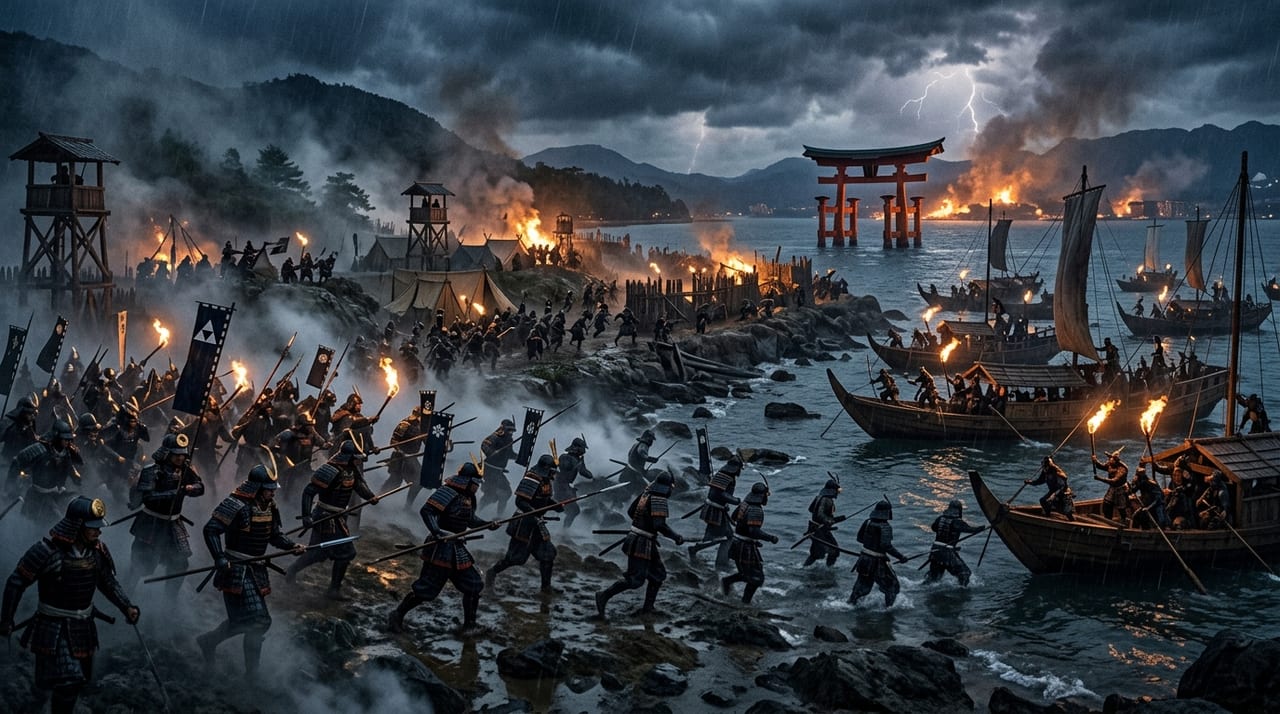
In the 10th month of Tenbun 24 (1555), on the sacred island of Itsukushima (present-day Miyajima, Hiroshima Prefecture) in the Seto Inland Sea, Mōri Motonari, a local lord of Aki, staged one of the most dramatic reversal victories in Japan's Sengoku history. With only a few thousand troops, he destroyed the great army of Sue Harukata, which was riding the momentum of having overthrown Ōuchi Yoshitaka. By the traditional account the army numbered 20,000 to 30,000, though some views hold it was fewer than 10,000. The battle, known to posterity as the “Battle of Itsukushima,” is still told today.
Ōuchi Yoshitaka, a major daimyo of western Japan, was driven to suicide in Tenbun 20 (1551) by a rebellion led by his senior retainer Sue Takafusa, later known as Harukata. Called the Tainei-ji Incident, this coup made Sue Harukata the most powerful man in western Japan.
Meanwhile, Mōri Motonari had been steadily building strength as a local lord in Aki. He had once belonged to the Ōuchi, and after Sue Harukata's rise he remained under Harukata's sway. Inwardly, however, Motonari did not tolerate Harukata's arbitrary rule, and he watched for a chance to bring him down. As symbolized by the tale of the three arrows, the “Lesson of the Three Arrows,” Motonari strengthened the unity of his sons and put in place the Mōri “Two Rivers” (Ryōsen) system of the Mōri, Kobayakawa and Kikkawa houses, while steadily preparing.
In Tenbun 23 (1554), Motonari finally resolved to confront Sue Harukata. However, Sue's forces outnumbered the Mōri several times over, and a head-on decisive battle offered no chance of victory. Motonari chose a stratagem that turned the disparity in numbers against the enemy.
The battlefield Motonari chose for the decisive fight was Itsukushima, a sacred place in the Seto Inland Sea. Itsukushima is a holy site known for its great torii and Itsukushima Shrine, which is built over the sea. Strategically, it carries the constraint of being an island.
Motonari first fortified Miyao Castle on Itsukushima to secure its defenses. Sue Harukata found it intolerable that the Mōri held a key point in the Inland Sea, and he set out with a large army to attack Miyao Castle. War chronicles describe this as Motonari's very trap, but in recent years the view that it was a later invention has become stronger.
According to war chronicles, Motonari went further, spinning two or three layers of schemes. He had his retainer Katsura Motozumi feign secret collusion with the Sue side and send false intelligence, giving Sue Harukata the illusion that the Mōri army was on the verge of internal collapse. Believing the false report, Harukata pushed ahead with a landing on the isolated island, which he should have avoided.
A large army is difficult to supply and deploy on an isolated island. In addition, Motonari brought the Kurushima Murakami clan of the Murakami navy onto his side, securing an advantage in control of the sea as well.
On the night of the 30th day of the 9th month of Tenbun 24 (1555), Motonari chose a stormy night to move. Crossing the water in a storm was dangerous, but conversely it relaxed the vigilance of the Sue forces. The Mōri army split into a main force under Motonari, Takamoto and Kikkawa Motoharu, and a separate force under Kobayakawa Takakage. Under cover of darkness and the storm, they landed on Itsukushima.
Before dawn, the Mōri army launched a surprise attack on the Sue main camp. Despite the numerical disparity, the narrow terrain of the island left the large army unable to use its mobility. Mōri's elite units split the Sue forces in several places and, taking advantage of the confusion, defeated them one by one.
Sue Harukata was forced to retreat and ultimately took his own life on Itsukushima. He was 35 years old. Harukata, who was known as a handsome man in his youth, is remembered as a warning against the arrogance of relying too heavily on troops.
Mōri Motonari is known as a “strategist” who valued wisdom and scheming over raw force. But for that very reason, his attitude toward swords is intriguing.
Sword production in the Chūgoku region was carried out mainly by smiths of Bizen (present-day Okayama Prefecture), and it is said that Mōri retainers also favored Bizen blades. In particular, works by Bizen smiths of the Sengoku period, such as Osafune Katsumitsu, were practical battle swords widely sought after by the warlords of the time.
The Mōri family also had a deep connection with Itsukushima Shrine. Since ancient times, the shrine has preserved many dedicated swords, including a group of famous blades from the Heian to Muromachi periods. When the Mōri became the patrons of Itsukushima Shrine in Motonari's era, the management and protection of these swords also became a duty of the Mōri house.
When the Mōri defeated the Sue army at the Battle of Itsukushima, many swords were left on the battlefield. Swords collected from the battlefield were proof of a warrior's military merit and became valuable treasures for the Mōri house as well.
The swords used by the Murakami navy also draw attention. The Murakami navy, a band of sea raiders of the Seto Inland Sea, is said to have favored carrying shorter blades, such as wakizashi and tantō, which suited naval combat. Long tachi were hard to handle in the cramped space aboard ship, and short blades that could be drawn quickly in close combat were prized in sea battles.
The Battle of Itsukushima is often cited as a prime example of a “battle in which the few defeated the many” in Japanese history. It is also frequently discussed alongside the Battle of Okehazama (1560). However, the Battle of Itsukushima was a victory of wit rather than force, since its key lay in more thorough advance scheming and the use of naval power.
This victory allowed Mōri Motonari to take control of Aki, Suō and Nagato, and eventually grow into a great daimyo who ruled nearly the whole Chūgoku region. The Mōri family then survived under the Toyotomi regime as a great daimyo with over 1.2 million koku. In the Battle of Sekigahara, they served as the core of the Western Army. Even after the defeat of the Western Army, which had Mōri Terumoto as its commander-in-chief, the house survived as the Chōshū Domain until the end of the Edo period, and ultimately appeared in history as a central player in the Meiji Restoration.
The strategy Motonari displayed at Itsukushima, “to make use of the terrain and manipulate the enemy's mind,” became an ideal model for later Sengoku warlords. The idea that the side inferior in numbers can defeat a large army by combining cunning with the advantage of terrain has been carried down in Japanese military treatises. It also connects to the philosophy of the sword arts that one wins “through skill, not force.”
Under the vermilion great torii reflected in the sea at Itsukushima, the Mōri's blades changed the course of history. That strategic wisdom and resolute courage still quietly live on in Miyajima, a place that many people visit today.