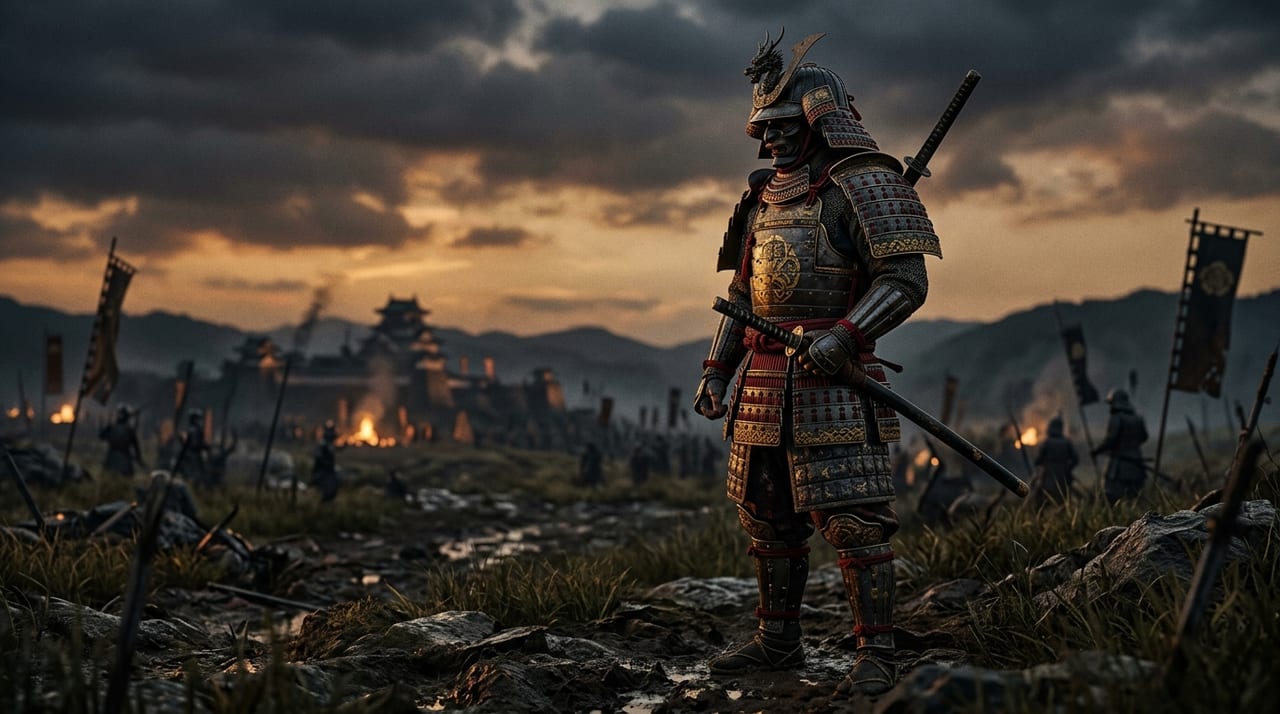
 * Image is for illustrative purposes only.
Oda Nobunaga
織田信長
The Demon King of the Sixth Heaven — Revolutionary visionary who shattered the old order and forged a new era under the banner of Tenka Fubu
Description
The Emergence of a Revolutionary
Born in 1534 (Tenbun 3) at Shobata Castle in Owari Province (or, according to another theory, Nagoya Castle), Oda Nobunaga raised the great ambition of 'Tenka Fubu' and embodied in himself the transition from medieval to early modern Japan. Nobunaga broke down existing authority and custom one after another, and achieved innovations ahead of their time in every field: the economic policy of rakuichi-rakuza (free markets and open guilds), the large-scale use of firearms, and the construction of Azuchi Castle. He is said to have called himself the 'Demon King of the Sixth Heaven' because of his severe temperament, but this epithet expressed his arrogant and self-assured self-image, in which he likened himself to the Sixth Heaven, the enemy of the Buddha and the most powerful demon king.
Swords and Control of Retainers
Nobunaga's relationship with swords goes beyond that of a mere collector; he is especially noted as the figure who most skillfully used swords as instruments of political power. Nobunaga used famous swords as rewards and gifts to his retainers, as a means of showing the bond between lord and vassal. This political use of swords was later inherited by Toyotomi Hideyoshi and Tokugawa Ieyasu.
Heshikiri Hasebe
'Heshikiri Hasebe' is the most famous of the anecdotes concerning Nobunaga's swords. Kannai, a tea attendant who had behaved rudely toward Nobunaga, fled and hid under the tray shelf in the kitchen. Nobunaga flew into a rage and is said to have pressed a blade against Kannai under the tray shelf and cut him down. The name 'Heshikiri' derives from this 'oshikiri' (pressing cut). This sword, said to be the work of Hasebe Kunishige, is characterized by the powerful hitatsura blade pattern of the Sōshū-den tradition, and possesses a dreadful beauty that seems to reflect Nobunaga's severe temperament exactly. The sword later passed to the Kuroda family (it is said either that Nobunaga gave it to Kuroda Yoshitaka, or that it was bestowed on Kuroda Nagamasa via Hideyoshi), and was transmitted as a treasure of the Kuroda family. It is currently housed at the Fukuoka City Museum as a National Treasure.
Sōza Samonji
'Sōza Samonji' is a spoil of war that Nobunaga took from Imagawa Yoshimoto at the Battle of Okehazama in 1560 (Eiroku 3). It is also called 'Yoshimoto Samonji' because Yoshimoto wore this sword. Samonji was a smith of Chikuzen Province who established a distinctive style in the Nanboku-chō period by adopting the techniques of the Sōshū-den. Nobunaga kept this sword close at hand throughout his life and cherished it, regarding it as a sword that symbolized the victory at Okehazama and the first step toward taking the realm. After Nobunaga's death, the sword passed to Hideyoshi and then to Ieyasu, and became a rare famous sword possessed by three hegemons as proof of being ruler of the realm.
Fudō Yukimitsu and Yagen Tōshirō
'Fudō Yukimitsu' is a work of Sōshū Yukimitsu, a short sword that Nobunaga especially loved. Nobunaga often showed off this sword at banquets, and when drunk he is said to have sung, 'Fudō Yukimitsu, Tsukumogami, hito ni wa Gorōza gozasōrō' (Fudō Yukimitsu, the Tsukumo tea caddy, and among men, Gorōza (Niwa Nagahide)). Yukimitsu's blades are characterized by fine nie and refined jigane, and the concentrated beauty of this short sword stands out. 'Yagen Tōshirō' is a work of Awataguchi Yoshimitsu. It is said that when Hatakeyama Masanaga attempted to commit seppuku, the blade did not pierce his belly, but when he threw it down it pierced a yagen (a druggist's grinding mortar), and this is how it got its name. It was presented to Nobunaga by Matsunaga Hisahide.
The Honnō-ji Incident
On 21 June 1582 (Tenshō 10/6/2), the Honnō-ji Incident occurred. Through the rebellion of Akechi Mitsuhide, Nobunaga died in the flames. At that time, many of the famous swords kept at Honnō-ji are said to have been lost, and Yagen Tōshirō is said to have burned down at Honnō-ji. Meanwhile, Sōza Samonji escaped the calamity and later passed into Hideyoshi's hands. Nobunaga's life was short, lasting forty-nine years, but his approach of collecting famous swords and using them as rewards and gifts also influenced the later handling of famous swords in the samurai society that followed.
Notable Swords
- Heshikiri Hasebe (work of Hasebe Kunishige, National Treasure. The hitatsura blade of the Sōshū-den radiates a dreadful beauty. Known for the anecdote of cutting down a tea attendant hiding under a tray shelf)
- Sōza Samonji (also called Yoshimoto Samonji. A spoil from Okehazama that Nobunaga cherished throughout his life. A masterpiece of the Chikuzen Samonji school)
- Fudō Yukimitsu (work of Sōshū Yukimitsu. A beloved sword that Nobunaga showed off at banquets and also celebrated in a song. A short sword with fine nie and refined jigane)
- Yagen Tōshirō (work of Awataguchi Yoshimitsu. A famous short sword with the anecdote of piercing a yagen instead of its owner's belly. Burned in the Honnō-ji Incident)