New Arrivals — Browse our catalog for the latest authentic Japanese sword arrivals. Browse →
September 27, 1556 (24th day, 8th month, Kōji 2)
Inō, Kasugai District, Owari Province (present-day Nishi Ward, Nagoya City, Aichi Prefecture)
Forces
Oda Nobunaga's Forces
Oda Nobuyuki / Shibata Katsuie's Forces
About 16 min read
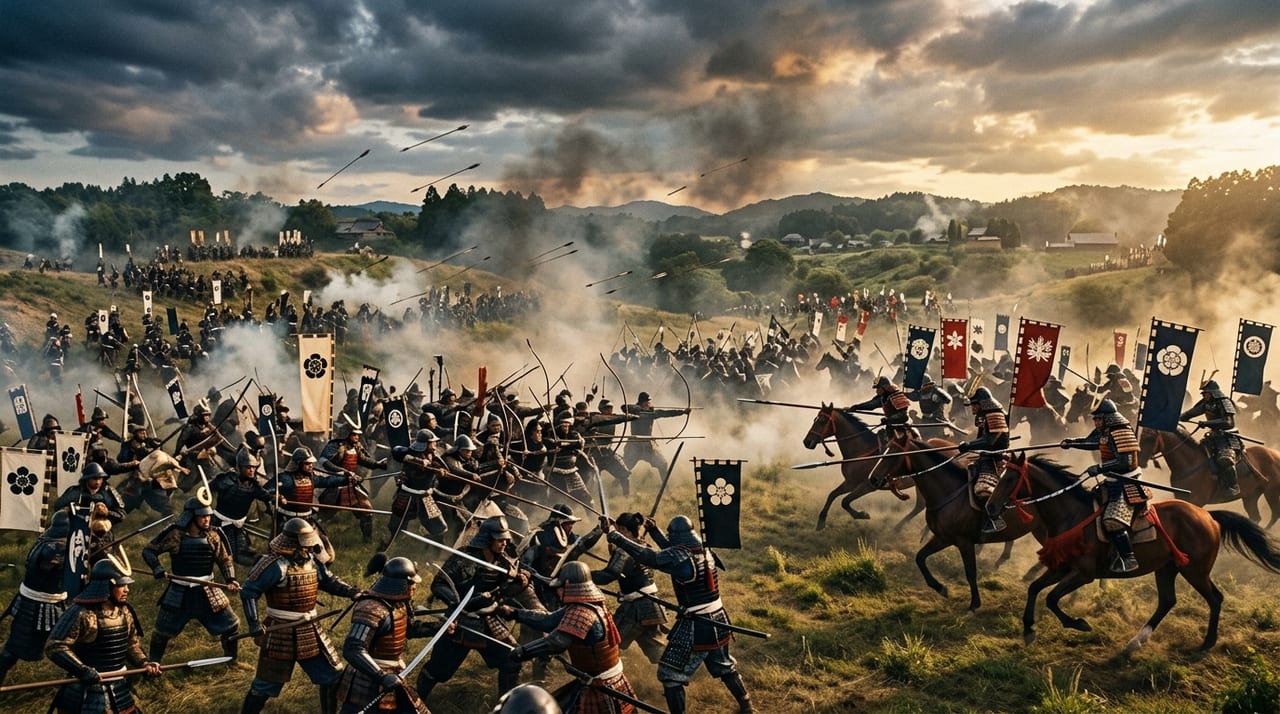
On September 27, 1556 (Kōji 2/8/24), at Inō in Owari Province (present-day Nishi Ward, Nagoya City, Aichi Prefecture), Oda Nobunaga clashed with the forces of his younger brother, Oda Nobuyuki (also called Nobukatsu). This Battle of Inō is known as the engagement that decided the outcome of the brothers' struggle over the headship of the Oda Danjō-no-chū house. According to the Shinchō Kōki, Nobunaga's side had fewer than 700 troops, while Nobuyuki's side had 1,000 under Shibata Katsuie and 700 from the Hayashi forces, for a total of 1,700. Numerically, Nobunaga was overwhelmingly disadvantaged. Yet the way Nobunaga fought his way out of this adversity became the starting point of his later bid for hegemony.
The background to the Battle of Inō lies in the sudden death of their father, Oda Nobuhide, in Tenbun 21 (1552). Oda Nobuhide was a powerful military leader in Owari who had expanded his influence both inside and outside Owari Province within a single generation. After his death, his eldest son, Nobunaga, succeeded to the headship of the family. However, Nobunaga was known for eccentric behavior that earned him the nickname "the great fool of Owari," and many retainers instead backed his younger brother Nobuyuki (Nobukatsu), who had received a formal education and was courteous.
Hayashi Hidesada (Michikatsu), Nobunaga's chief retainer; his younger brother Hayashi Mimasaka-no-kami (Michitomo); and Nobuyuki's senior vassal Shibata Katsuie concluded that Nobunaga could not unify the household, and they sought to install Nobuyuki as leader. As a result, the rift between the "Nobunaga faction" and the "Nobuyuki faction" deepened within Owari Province.
In Kōji 2 (1556), the rivalry between Nobunaga, who had become lord of Kiyosu Castle, and Nobuyuki, lord of Suemori Castle, finally escalated into armed conflict. Nobuyuki seized Shinoki and other territories under Nobunaga's direct control, built fortifications, and thereby signaled his defiance. Nobunaga had Sakuma Morishige build a fortification at Nazuka and set out with a force of fewer than 700 men.
The year of the Battle of Inō, Kōji 2 (1556), came 13 years after firearms were introduced to Japan (Tenbun 12, 1543). However, at this point firearms were still spreading, and in small-scale engagements such as Inō, the principal weapons remained bows and arrows, spears, and long swords.
In this period, smiths of Mino were very active in the Owari and Mino region. The area around present-day Seki, Gifu Prefecture, known as "Seki in Mino," flourished from the late Muromachi period into the Sengoku period as "a major center of battle-ready blades." The hallmark of the Mino tradition is its blades, produced by smiths such as "Kanemoto (Magoroku)," "Kanesada (Nosada)," and "Kanemichi," which combined keen cutting edges with durability. They were produced across a wide range, from the mass-produced practical blades called kazuuchi (mass-produced blades) to custom orders placed by daimyō, and they adorned the waists of Sengoku warriors.
As Nobunaga's own favored blades, the Heshikiri Hasebe, which came later, and the Yagen Tōshirō, presented to him by Matsunaga Hisahide in Genki 2 (1571), are well known. At the time of the Battle of Inō, Nobunaga was still a young warrior of 22.
What Nobunaga displayed at the Battle of Inō was an aggressive, daring attack amid overwhelming disadvantage. Nobunaga's side had fewer than 700 men against 1,700 on Nobuyuki's side. In ordinary tactics, this was a situation calling for a defense, but Nobunaga seized the initiative and struck head-on at Katsuie's army.
According to the Shinchō Kōki, Nobunaga's side was pressed by Shibata's forces and faced the danger of having its main camp overrun. However, when Nobunaga rebuked the enemy in a loud voice, Shibata's troops, who were also embroiled in a conflict among kin, broke and fled. Katsuie himself was wounded and fled in defeat. Regaining momentum, Nobunaga's side attacked the Hayashi forces, and Nobunaga himself cut down Hayashi Mimasaka-no-kami (Michitomo). Killing more than 450 of Nobuyuki's men, they won a decisive victory.
Shibata Katsuie later became the veteran general in whom Nobunaga placed the greatest trust. The fact that Shibata Katsuie, who would contend with Hideyoshi for supremacy in the Battle of Shizugatake (1583), had in fact fought against Nobunaga at the Battle of Inō reveals the complexity of relations among Sengoku warlords.
After his defeat at Inō, Nobuyuki escaped punishment thanks to a plea from his mother, Dota Gozen (the birth mother of Nobunaga and Nobuyuki). Nobunaga pardoned his younger brother, but when Nobuyuki plotted rebellion again, Nobunaga showed no mercy this time. Nobunaga feigned illness, summoned Nobuyuki to Kiyosu Castle, and ordered Kawajiri Hidetaka and others to have him killed (the 2nd day of the 11th month of Eiroku 1 (1558); some accounts give Kōji 3 (1557)). This "purge by stratagem" is passed down as an episode that gives a glimpse of the severe rule Nobunaga would display in later years.
In the process from the Battle of Inō to Nobunaga's full-scale unification of Owari, he gained control of an economic sphere centered on Nagoya and Kiyosu. This region was also strongly influenced by the sword-making culture of Mino (Gifu), and practical blades produced at "Seki in Mino" were supplied to warriors. In Seki, master smiths such as Kanemoto (Magoroku) and Kanesada (Nosada) had been active in the late Muromachi period before this, and battle-ready kazuuchi blades were also produced in large quantities.
The Battle of Inō was, in scale, merely a small-scale engagement. Yet its significance is immeasurable. First, it proved to both Nobunaga himself and others that he had the ability to overturn inferiority on the battlefield. Second, by nipping in the bud Nobuyuki, the greatest internal rebellion, Nobunaga's base of power was established. Third, Shibata Katsuie, who would later become one of Nobunaga's veteran generals, came to serve Nobunaga through this battle.
After Inō, in the Battle of Okehazama in Eiroku 3 (1560), Nobunaga defeated Imagawa Yoshimoto, taking the first step toward the unification of the realm. It may also be said that the bold surprise tactics at Okehazama drew on the experience of leading a small force to victory at Inō. In the history of the Japanese sword, Sengoku-period blades were symbols of "the soul and will of the warrior" that transcended mere weapons. Each blade wielded at Inō became the point of departure for the great current of history that would later lead to the unification of the realm.
The Tenbun era (1532–1555) corresponds, in the history of Japanese swords, to the late koto period known as sue-kotō (the era of shintō begins after Keichō). In this period, smiths of Mino Province (present-day Gifu Prefecture) were actively producing mass-produced practical blades known as kazuuchi.
A representative smith of Mino blades is Seki Magoroku Kanemoto. Magoroku Kanemoto (the 2nd Kanemoto) is a smith whose dated works survive from Daiei 3 (1523) to Tenbun 7 (1538), and he was renowned for blades with cutting edges and durability that could withstand battle. His blades bore a distinctive hamon (temper line) called "sanbonsugi," and they won high regard from warriors. The Magoroku name continued to be passed down afterward, and the lineage continues to the present day.
Also, Seki Kanesada (Nosada), a smith who combined practicality and beauty, received commissions from Sengoku daimyō. The Aizu Kanesada (Izumi-no-kami Kanesada), known later as the sword carried by Hijikata Toshizō, belongs to a line of smiths that began with a son of the 3rd Seki Kanesada. Nosada's blades were ranked among the saijō ō-wazamono (the highest cutting-ability rank), and they met the demand of Sengoku warriors who prized battlefield use.
It is thought that blades produced by these groups of Mino and Owari smiths were worn at the waists of warriors on both Nobunaga's and Nobuyuki's sides at the Battle of Inō. In the study of Japanese swords, knowing the places of production and the lineages of smiths provides a clue for concretely reconstructing the figures of warriors who lived through history on the ground. By viewing Inō, "the origin of Nobunaga," from the perspective of the Japanese sword, one can touch the essence of Sengoku-period warrior culture.
Oda Nobunaga
Oda Nobunaga — commander who crushed his brother's rebellion and established supremacy in Owari
Shibata Katsuie
Shibata Katsuie — commander of Nobuyuki's forces who surrendered to Nobunaga after defeat
Imagawa Yoshimoto
Imagawa Yoshimoto — Nobunaga's next major enemy, defeated at Okehazama five years after Ino