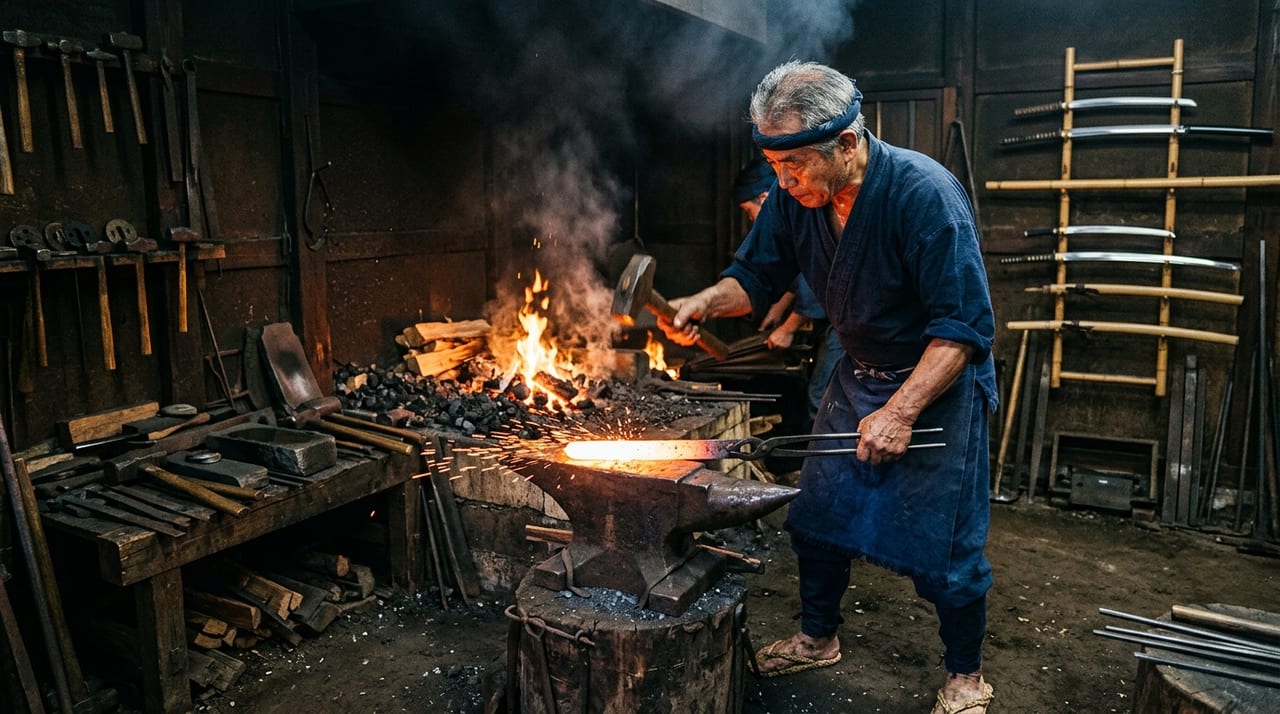
 * Image is for illustrative purposes only.
Seki Magoroku Kanemoto
関孫六兼元
Description
Magoroku Kanemoto is a smith of the Kanemoto line in Mino Province, widely known by the common name "Magoroku." The Kanemoto name is a prestigious name representing Mino swordsmithing, passed down from the Muromachi period through the Edo period to the present day. The first and second generations lived in Akasaka in Fuwa District, and later generations moved to Seki and forged swords there. Together with Izumi no Kami Kanesada (second-generation Kanesada), he is known as a master smith representative of the Sue-Seki works.
The Second-Generation Kanemoto and the Name "Magoroku"
The most renowned is the second-generation Kanemoto, whose dated works are confirmed from the 2nd month of Daiei 3 (1523) through the 2nd month of Tenbun 7 (1538), and who is counted among the master smiths representative of the Sue-Seki works. Favored by many Sengoku warlords, including Takeda Shingen and Toyotomi Hideyoshi, he established a reputation as a sword valued for practical battle use. Today, the name "Magoroku Kanemoto" as widely known refers mainly to the works of this second generation.
Style — Sanbon-Sugi and the Traditional Techniques of Seki
The jihada generally shows itame-hada flowing and rising in texture, with the shinogi-ji becoming masame and appearing whitish. Exceptionally, some examples show finely packed ko-itame-hada. The most distinctive feature is the hamon known as "Seki no Magoroku sanbon-sugi," in which pointed gunome recur at regular intervals. Whereas in first-generation works the arrangement was somewhat irregular, it is said to have been progressively regularized as generations passed. The sanbon-sugi of the first and second generations has a low yaki, and the nioiguchi has a soft quality. In an era when one-handed uchigatana had become the mainstream, he is also known for having made many relatively long two-handed blades.
Reputation and Surviving Works
In Edo-period sword evaluations, Magoroku Kanemoto was ranked among the Saijō Ō-wazamono, the highest grade denoting exceptional cutting performance, and has long received particularly high praise for its sharpness. In addition to Takeda Shingen and Toyotomi Hideyoshi, it was prized as a favored blade by a wide range of owners, from Sengoku daimyō such as Kuroda Nagamasa and Maeda Toshimasa to samurai families of the Edo period, and this reputation further enhanced its standing as a brand. Well-known famous blades include the "Aoki Kanemoto," held by Aoki Kazushige, which tradition says killed Magara Naotaka at the Battle of Anegawa, and the "Ninenbutsu Kanemoto," handed down in the Maeda family, whose name comes from the tradition that a person cut by it died after chanting the nenbutsu twice. As a representative example of wazamono that brought the Seki smithing tradition to completion, it still holds an extremely important place in the history of Japanese swords.
Famous Works
- katana, named Aoki Kanemoto (held by Aoki Kazushige)
- named Ninenbutsu Kanemoto (passed down in the Maeda family)