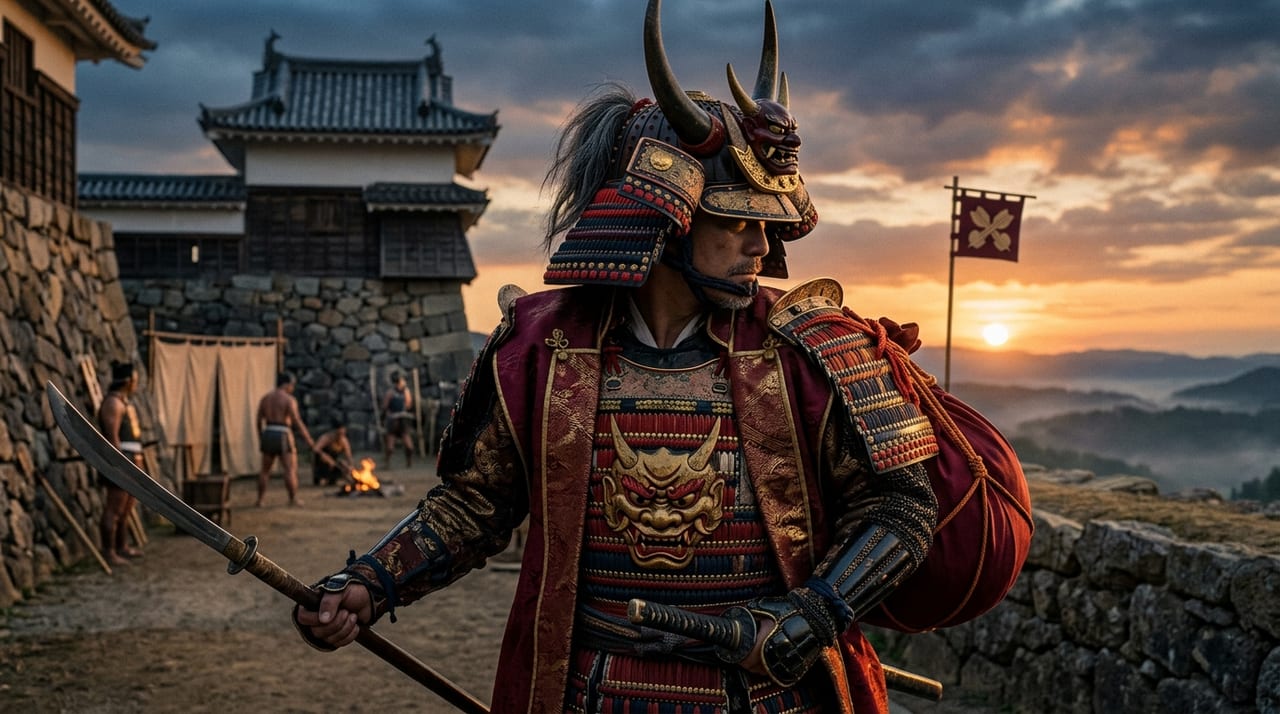
 * Image is for illustrative purposes only.
Shibata Katsuie
柴田勝家
One of Oda's Four Generals, Lord of Kitanosho Castle
Description
Life and Origins
Shibata Katsuie (birth year given as Daiei 2 (1522) in some accounts, among other theories; died 1583) was a senior retainer of the Oda family, born in Owari Province. He first served Nobunaga's younger brother, Oda Nobukatsu (Nobuyuki). At the Battle of Inō, where Nobukatsu clashed with Nobunaga, Katsuie fought on Nobukatsu's side. He later returned to Nobunaga's service and thereafter carried great weight as the foremost of the chief retainers. Known for his fierce bravery, he was feared under the nicknames 'Oni Shibata' and 'Kakare Shibata'.
Commander of the Hokuriku Army
As the commander who oversaw the Oda family's Hokuriku army, Katsuie took charge of pacifying the Ikkō-ikki in the Echizen and Kaga areas and of fighting against the Uesugi clan. Around Tenshō 3 (1575) he was granted Echizen, and he built Kitanoshō Castle (present-day Fukui City) as his base. He also showed skill in developing the castle town and administering his domain, and he played a key role as the linchpin of control over Hokuriku.
Katsuie is also known by the nickname 'Kamewari Shibata' (Jar-Breaker Shibata). The name derives from an anecdote of Genki 1 (1570). When Katsuie's water supply was cut off by Rokkaku Yoshikata's forces at Chōkōji Castle in Ōmi, he served the last remaining water to his officers and men. He then smashed the water jars to cut off any retreat and firm their resolve to fight to the death, and charged out of the castle to open a path to survival. It is a tale of breaking water jars, not of martial feats with a sword.
The Battle of Shizugatake and His Death
After the Honnō-ji Incident in Tenshō 10 (1582), Katsuie competed with Hashiba Hideyoshi for leadership of the Oda family at the Kiyosu Conference. He strengthened his unity by taking Lady Oichi, Nobunaga's younger sister, as his principal wife. However, the rift between him and Hideyoshi could not be avoided, and at the Battle of Shizugatake in Tenshō 11 (1583) he was defeated by Hideyoshi. Katsuie retreated to Kitanoshō Castle and, on the 24th day of the 4th month of that same year, took his own life together with Lady Oichi. It is said that Oichi had her three daughters (Chacha, Hatsu and Gō) escape the castle, while she herself shared Katsuie's fate. This final scene is widely known as a moment that symbolizes the resolve of a Sengoku warrior.
Swords and Armor
A famous blade associated with Katsuie is 'Nikkari Aoe.' It is a large wakizashi by Aoe Sadatsugu of the Bitchū Aoe school in the Nanboku-chō period, designated an Important Art Object. Its name is said to come from a legend in which, on a dark road at night, a woman's ghost grinning 'nikkari' was slashed, and the next morning a stone pagoda was found split in two. After Katsuie owned it, it passed to his son Katsutoshi, then to Niwa Nagahide, and was presented to Toyotomi Hideyoshi. It finally came to the Kyōgoku family of Marugame in Sanuki. It is a blade rich in anecdotes, fitting for a fierce warrior like Katsuie.
Later Reputation
Katsuie is recorded in history as an unmatched, loyal and valiant veteran retainer, and as a powerful figure who divided the Oda house with Hideyoshi after Nobunaga's death. His tragic end with Lady Oichi has been taken up repeatedly in later stories and performing arts, and it conveys to this day the image of a warrior of unbending resolve and warm-hearted humanity. Shibata Shrine, which stands on the site of Kitanoshō Castle, still enshrines Katsuie and his wife and is revered by the people of Fukui.
Notable Swords
- Nikkari Aoe (a large wakizashi traditionally attributed to Aoe Sadatsugu, an Important Art Object, held by the Marugame City Museum)