New Arrivals — Browse our catalog for the latest authentic Japanese sword arrivals. Browse →
1570–1574 CE (Genki 1 – Tenshō 2)
Nagashima, Ise Province (present-day Nagashima-chō area, Kuwana City, Mie Prefecture)
Forces
Nagashima Ikko-ikki Forces
Oda Nobunaga's Forces
About 11 min read
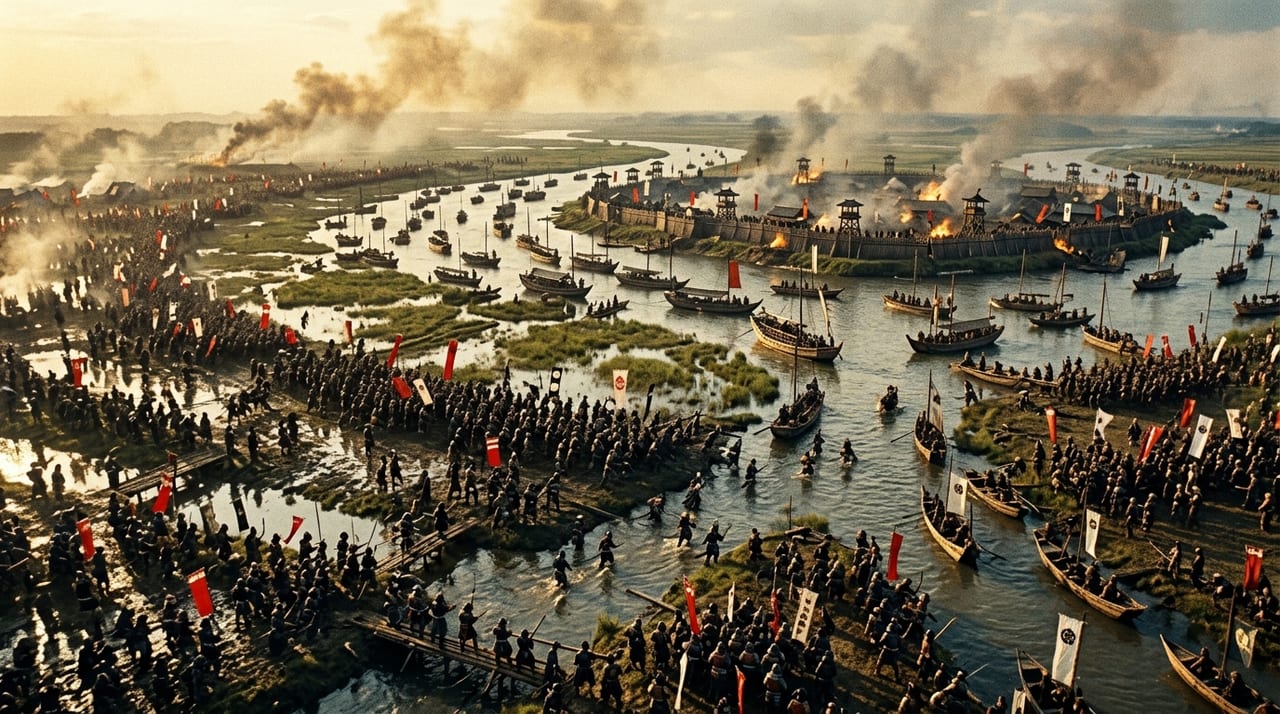
Nagashima in Ise Province (present-day Kuwana City, Mie Prefecture) lies in a complex water-country region where the Kiso, Nagara and Ibi Rivers converge. Followers of Jōdo Shinshū (Ikkō sect) in this area had formed tightly knit communities since the late medieval period, and centered on Ganshō-ji, they had organized an armed self-defense system. The Nagashima Ikkō-ikki, which lasted from Genki 1 (1570) to Tenshō 2 (1574), was one of the largest 'anti-Nobunaga forces' threatening Oda Nobunaga's control of Owari and Ise. It was an impregnable fortress that did not easily yield, even though Nobunaga attempted to take it three times.
'Ikkō-ikki' is the general term for the armed communities formed by followers of Jōdo Shinshū (Ikkō sect). 'Ikki' refers to collective action based on a covenant and does not necessarily mean 'rebellion.' In the Sengoku period, however, Ikkō-ikki of Ikkō sect followers functioned as political and military forces opposing the power of the daimyō.
The core of the Ikkō-ikki's strength lay in 'absolute unity founded on faith.' The fighting spirit of followers who did not shrink from dying for the Buddhist Law was qualitatively different from that of Sengoku daimyō armies, which were centered on mercenaries and ashigaru foot soldiers. A religious community that did not fear death exerted particularly strong resistance in siege defense.
The geography of Nagashima also raised the defensive power of the Ikkō-ikki. Nagashima, in the wajū (ring-levee districts) region where the Kiso, Nagara and Ibi Rivers intricately intertwine, was terrain in which advancing on foot was extremely difficult. One of the reasons Nobunaga repeatedly suffered bitter defeats in attempting to take Nagashima was precisely this water-country terrain.
In the 5th month of Genki 2 (1571), Nobunaga invaded Nagashima (the First Nagashima Campaign). However, fighting in the water-country region proved extremely difficult, and during the withdrawal he was ambushed by Nagashima forces and lost many soldiers. Earlier, in the 11th month of Genki 1 (1570), Nobunaga's younger brother Oda Nobuoki had been attacked by ikki forces at Kokie Castle in Owari and taken his own life, and Nobunaga had suffered a severe blow. His brother's death deepened Nobunaga's hatred of the Nagashima Ikkō-ikki and hardened his resolve toward 'thorough annihilation.'
In Tenshō 1 (1573), the Second Nagashima Campaign was carried out, but it too lacked a decisive blow. Amid Nagashima's complex waterways and firm defenses, Nobunaga's forces were unable to achieve significant results.
During this period, the Nagashima Ikkō-ikki worked in cooperation with Kennyo of Ishiyama Hongan-ji and formed one wing of the anti-Nobunaga coalition. Genki 3 (1572) was also the year Takeda Shingen launched his western campaign, and Nobunaga was indeed in a situation of being surrounded from the east, west and south. The Nagashima Ikkō-ikki formed an important part of that anti-Nobunaga coalition.
The Nagashima ikki forces skillfully used missile weapons, such as ambushing the retreating Oda army with bows and firearms, and swords were of course used as well. As for the swords used especially by the followers of the Nagashima Ikkō-ikki, works by swordsmiths from around Mie and Aichi Prefectures are thought to have been central. This region was under the influence of the Mino tradition (Mino-den) and was known as a producer of practical swords.
In the 7th month of Tenshō 2 (1574), Nobunaga led a large army (said to number about 80,000) and began the Third Nagashima Campaign. In this campaign he also mobilized naval forces and thoroughly blockaded the river routes. He surrounded the five castles into which the ikki forces had retreated, namely Nagashima Castle, Yanagashima, Nakae, Shinohashi and Ōtorii, and gradually tightened the noose through a siege aimed at starving them out.
After several months of siege, the defenders of Nagashima Castle ran out of food. On the 29th day of the 9th month, they offered to surrender and attempted to withdraw by boat.
However, Nobunaga did not permit this. He fired muskets at the followers withdrawing by boat and cut down many of them. Enraged by this, more than 800 ikki fighters drew their swords and charged, and many members of the Oda clan were killed in action, including Oda Nobuhiro, Nobunaga's elder half-brother, and Oda Hidenari, his younger brother. Nobunaga surrounded the two remaining castles, Nakae and Yanagashima, with multiple rows of palisades and set them on fire. It is said that 20,000 men and women inside the castles burned to death. The death toll is also said to have reached tens of thousands. Nobunaga literally carried out nekiri ('root-cutting', extermination) against the Ikkō-ikki forces across the Nagashima region.
This incident is also recorded with shock in contemporary historical sources. It was a moment in which Nobunaga's strategic rationality and severity reached their extreme, and it is one of the events that fixed the image of 'Nobunaga as a cruel dictator' in later generations.
The nekiri ('root-cutting', extermination) of the Nagashima Ikkō-ikki is an example that shows, in the most grisly form, what consequences followed when the 'armed faith' of the Sengoku period collided with the 'violence of secular power.'
Behind Nobunaga's thorough annihilation of the Nagashima Ikkō-ikki to this extent, it is thought that several factors combined: not only military rationality, but also personal hatred (the 'revenge for his brother'), recognition of the essential threat posed by a 'faith community that does not obey secular power,' and the political calculation of 'intimidating the other Ikkō-ikki forces through a public example.'
After the subjugation of Nagashima in Tenshō 2 (1574), Nobunaga also destroyed the Echizen Ikkō-ikki (Tenshō 3 (1575)). His full-scale confrontation with Ishiyama Hongan-ji continued until Tenshō 8 (1580), but the nekiri at Nagashima was a historical turning point that decisively accelerated that course.
Genki-Tenshō Transitional Era
Genki-Tenshō transitional era — the Nagashima Ikko-ikki was one of the most sustained internal resistances to Nobunaga's unification
Sengoku Mass Production and Custom Swords
Sengoku mass-production era — the functional swords consumed by both sides in the Nagashima campaigns