New Arrivals — Browse our catalog for the latest authentic Japanese sword arrivals. Browse →
Genki 4 (Tenshō 1), 1573, 7th month 18th day (old calendar)
Makishima Castle, Yamashiro Province (present-day Makishima, Uji City, Kyoto Prefecture)
Forces
Oda Nobunaga side
Ashikaga Yoshiaki side
About 13 min read
The Battle of Makishima Castle took place in the 7th month of Genki 4 (Tenshō 1, 1573). Ashikaga Yoshiaki, the 15th Muromachi shogun, raised troops against Oda Nobunaga at Makishima Castle in Uji, Yamashiro Province, surrendered after the Oda attack of the 18th day of the 7th month, and was driven out of Kyoto. Yoshiaki left the capital still holding the post of shogun, but the battle is often interpreted as the point at which the Muromachi shogunate effectively ended.
Yoshiaki had entered Kyoto under Nobunaga's escort and become shogun in 1568, and within five years the relationship broke down. All dates below are by the old calendar.
After the march on Kyoto in 1568, Nobunaga had Yoshiaki approve the nine articles of the Denchū Okite on the 14th day of the 1st month of Eiroku 12 (1569), and five more articles were added on the 23rd day of the 1st month of Genki 1 (1570). The rules placed Oda-side limits on the shogun's conduct, so tension was present in their relationship from early on.
In the latter part of the 4th month of 1570 Nobunaga sent troops into Wakasa and Echizen but withdrew after Azai Nagamasa turned against him (the Battle of Kanegasaki). At the Battle of Anegawa on the 28th of the 6th month, Nobunaga and Tokugawa Ieyasu's allied army defeated the Azai and Asakura. Nobunaga's situation nevertheless remained hard.
In the 9th month of Genki 3 (1572) Nobunaga sent Yoshiaki a written opinion, the "seventeen articles of admonition," and their conflict deepened. On the 22nd of the 12th month, Takeda Shingen beat the Oda-Tokugawa army at Mikatagahara. Such changes in the surrounding situation are likely to have formed the background to Yoshiaki's choice to part with Nobunaga.
On the 13th day of the 2nd month of Genki 4 (1573), Yoshiaki decided to take up arms against Nobunaga and sent letters to the Asakura, Azai, Takeda and others. On the 7th of the 3rd month he refused Nobunaga's hostages and broke off relations.
Nobunaga went up to Kyoto on the 29th and 30th of the 3rd month. Yoshiaki shut himself up in the Nijō residence and struck first. From the 2nd to the 4th of the 4th month Nobunaga burned the outskirts of the capital and the Kamigyō district, and Yoshiaki sought peace through the court. On the 7th, by order of Emperor Ōgimachi, peace was concluded.
That spring confrontation ended without a decisive result. Yoshiaki's standing was not damaged, but the fact that the shogun had to rely on the emperor's mediation reflects the balance of strength between the two.
Three months after the peace, on the 2nd day of the 7th month, Yoshiaki left the Nijō residence in his retainers' keeping and moved to Makishima Castle in Uji. On the 3rd he broke the peace and raised troops at Makishima.
Nobunaga entered Kyoto on the 7th and surrounded the Nijō residence. Its defenders surrendered one after another, and Mibuchi Fujihide yielded the residence on the 12th. Nobunaga then turned his forces toward Makishima Castle, where Yoshiaki was holed up. A great ship built at Sawayama is said to have been used for crossing Lake Biwa, about 30 ken (about 54 meters) long and 7 ken (about 12 meters) wide.
Makishima Castle stood at Gokashō in Uji, Yamashiro Province, on land facing the Uji River. The fact that the Oda army had to cross the Uji River in two columns on the 18th of the 7th month suggests that the castle's position was protected by the river. Yoshiaki left the Nijō residence in his retainers' keeping and moved to this castle away from the center of Kyoto, which means he chose to rely on the river and the castle's defenses rather than fight in the city streets.
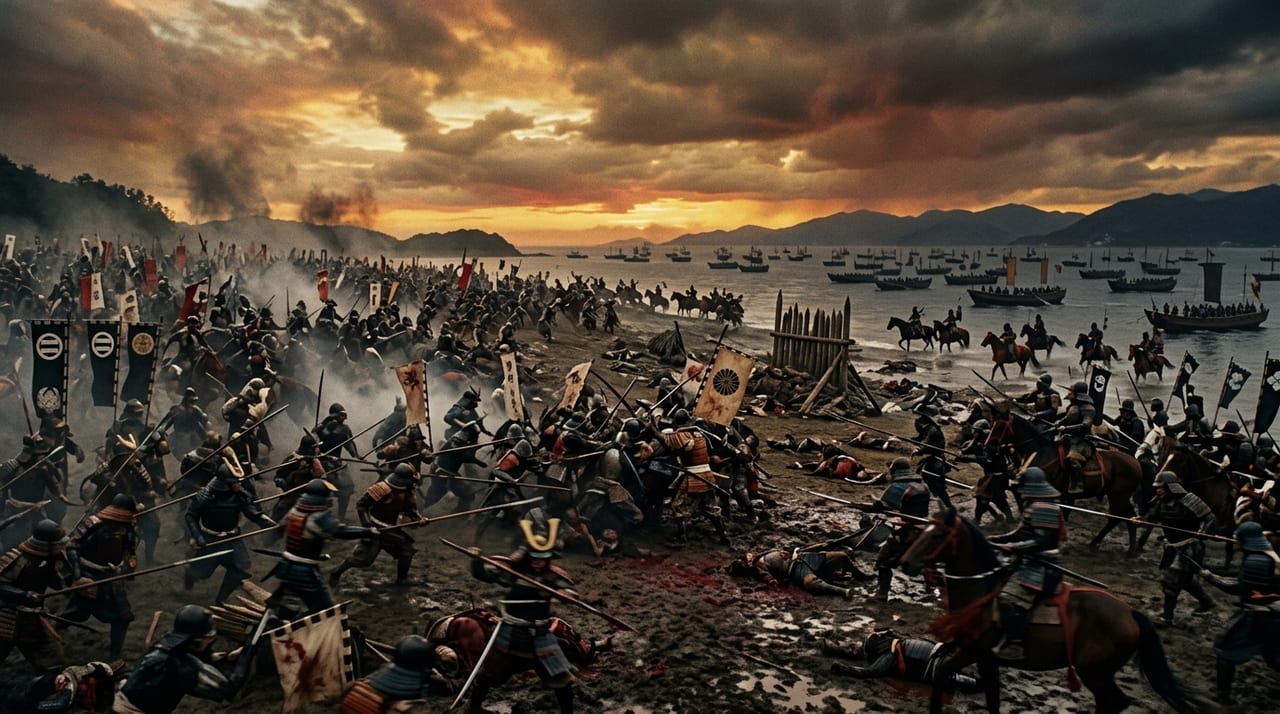
At the hour of the Snake (around 10 a.m.) on the 18th, the Oda army surrounded Makishima Castle. Splitting into two columns, it crossed the Uji River and attacked the castle from four sides. Oda commanders listed include Nobunaga himself, Hosokawa Fujitaka, Araki Murashige, Sakuma Nobumori and Hachiya Yoritaka. Some accounts put the Oda army at about 70,000 and Yoshiaki's at about 3,700, with Makishima Akimitsu, Mibuchi Fujihide and Ise Sadaoki on Yoshiaki's side. These numbers differ among sources and are not established.
Under attack, Yoshiaki asked for peace and surrendered. Nobunaga spared his life but, as a condition of peace, made him hand over his heir, the two-year-old Yoshihisa, as a hostage. From that point it was clear that the shogun had lost the military strength to hold Kyoto.
Yoshiaki left Makishima Castle on the 19th and, by way of Biwanosho, reached Tsuda in Kawachi on the 20th. He is said to have had his valuables taken by a peasant uprising on the way. On the 21st he entered Miyoshi Yoshitsugu's Wakae Castle under the guard of Hongan-ji troops. Nobunaga entrusted Makishima Castle to Hosokawa Akimoto and returned to Kyoto.
On the 28th of the 7th month the court, at Nobunaga's request, changed the era name from Genki to Tenshō. The change came right after Yoshiaki left the capital and marked a turning point toward a new age.
The Battle of Makishima Castle is often interpreted as the moment the Muromachi shogunate effectively perished. Yet Yoshiaki was not dismissed as seii taishōgun by the court, and he kept both the shogunal post and his rank of Junior Third Rank and Provisional Major Counselor. That is why the word "effectively" is attached: the shogunate as an institution did not vanish in a day. The end of his tenure as shogun is given as Tenshō 16 (1588), and the post itself remained with Yoshiaki until then.
Yoshiaki afterward went from Wakae by way of Sakai down to Kii and stayed at Kōkoku-ji in Yura. In the 2nd month of Tenshō 4 (1576) he moved to Tomo in Bingo, relying on Mōri Terumoto and receiving the Mōri's protection. Over a hundred former shogunal retainers and others are said to have gathered around him in this period, which is sometimes called the "Tomo shogunate." Yoshiaki named Terumoto deputy shogun and, in the 11th month of the same year, granted him the Ashikaga paulownia crest.
The Mōri family's circumstances also shaped how Yoshiaki came to Tomo. After Yoshiaki was driven out of Kyoto, Mōri Terumoto wavered in his alliance with Nobunaga. At first he chose to avoid full-scale war with Nobunaga and was involved in negotiations to mediate Yoshiaki's return to Kyoto. The Mōri were not told in advance of Yoshiaki's move to Tomo, and Terumoto is said to have struggled over how to respond. In the 5th month of Tenshō 4 (1576), the Mōri declared an anti-Nobunaga stance and the alliance with Nobunaga collapsed.
After the establishment of the Toyotomi regime Yoshiaki returned to Kyoto and was granted a 10,000-koku fief at Makishima. He took Buddhist orders under the name Shōzan Dōkyū and formally resigned as shogun. He died on the 28th day of the 8th month of Keichō 2 (1597). Makishima was thus both the last castle where he made a stand and, later, the site of his own domain.
Genki 4 and Tenshō 1 are the same year, 1573; the name of the year changed from Genki to Tenshō with the change of era on the 28th of the 7th month.
Asakura Yoshikage
One of those to whom Yoshiaki sent letters when he decided to take up arms
Ashikaga Yoshiaki
The 15th Muromachi shogun, who raised troops at Makishima Castle, surrendered and was driven from Kyoto
Hosokawa Yūsai
Hosokawa Fujitaka (Yūsai), who took part in the attack on Makishima as an Oda commander
Miyoshi Yoshitsugu
Miyoshi Yoshitsugu, who took the expelled Yoshiaki into Wakae Castle in Kawachi
Oda Nobunaga
Oda Nobunaga, who attacked Makishima Castle and expelled Yoshiaki from Kyoto
Sakuma Nobumori
Sakuma Nobumori, who took part in the attack on Makishima as an Oda commander