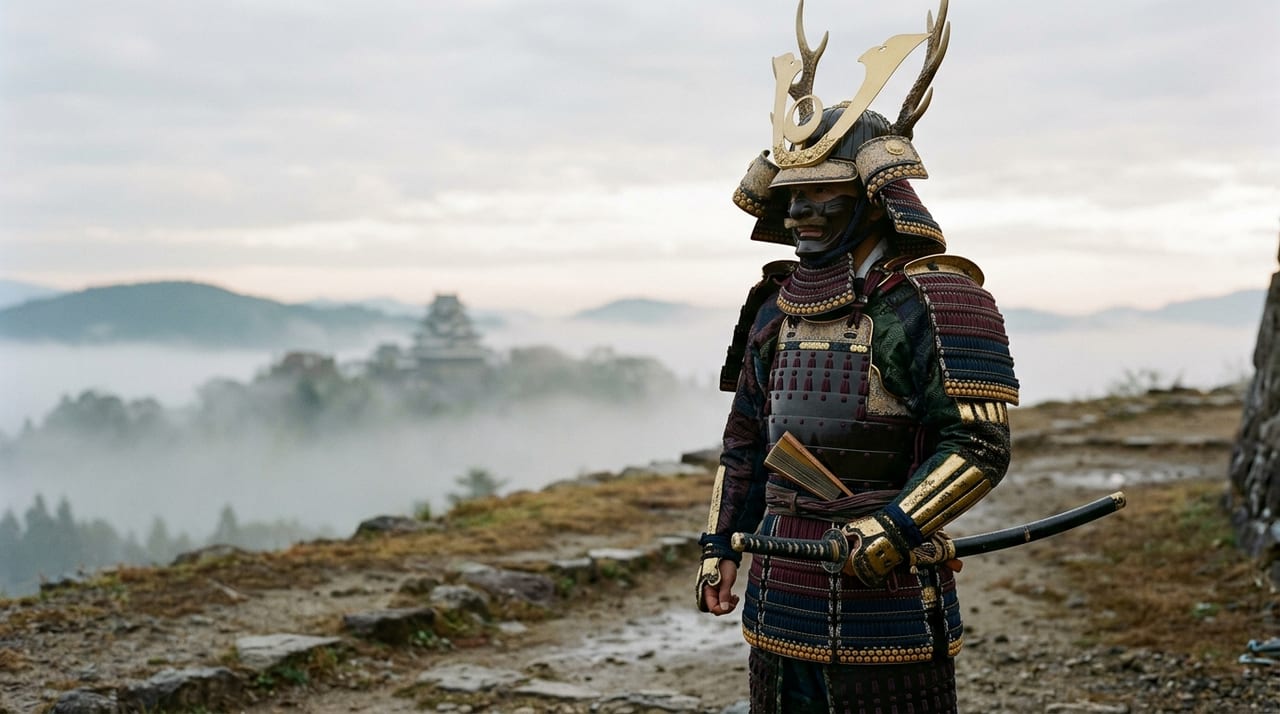
 * Image is for illustrative purposes only.
Hosokawa Yūsai
細川幽斎
The Pinnacle of Literary and Martial Arts: The Greatest Scholar-Warrior of the Sengoku Period Who Preserved the Kokin Denju
Description
Embodiment of Literary and Martial Arts
Born in Tenbun 3 (1534), Hosokawa Yūsai (Fujitaka) was the second son of Mitsubuchi Harukazu, a close retainer of the shogun Ashikaga Yoshiharu. He later succeeded the Hosokawa family and is remembered as the most accomplished "master of both literary and martial arts" from the Sengoku period into the early Edo period. He served the Ashikaga shogunate and had ties with all three great unifiers, Oda Nobunaga, Toyotomi Hideyoshi, and Tokugawa Ieyasu. He combined achievements as a warrior with outstanding scholarship as a researcher of waka poetry and classical literature. That his achievements are engraved in the name of the famed sword "Kokin Denju no Tachi" shows that Yūsai was not merely a warrior but a giant spanning both sword culture and literature.
Service to the Ashikaga Shogunate and Entry into Nobunaga's Service
At a young age, Yūsai served Ashikaga Yoshiteru, and as a shogunal attendant he studied both court culture and the martial arts. When Yoshiteru was killed by the Miyoshi Triumvirate and others in Eiroku 8 (1565), Yūsai continued to work tirelessly to install Ashikaga Yoshiaki. However, amid the political upheaval brought about by Oda Nobunaga, he eventually chose to enter Nobunaga's service. Under Nobunaga, he was granted the southern half of Tango Province, made Miyazu Castle his seat, and built up his record as a warrior. After the Honnō-ji Incident (1582), he shaved his head, handed the family headship to his son Hosokawa Tadaoki, and was valued as a cultural figure in Toyotomi Hideyoshi's inner circle.
Guardian of the Kokin Denju
Yūsai's greatest cultural achievement lies in his role as guardian of the "Kokin Denju." Kokin Denju was a secret system of poetic teaching in which difficult interpretations of the Kokin Wakashū were transmitted in secret from teacher to disciple, and it signified the highest literary authority in medieval Japan. Yūsai received this secret transmission from Sanjōnishi Saneki and was then the sole transmitter. Just before the Battle of Sekigahara, when he was holed up in Tanabe Castle, his cultural value was recognized to the point that Emperor Go-Yōzei, fearing the Kokin Denju would be lost, sent an imperial envoy. The anecdote that an imperial order for a ceasefire was issued because of the emperor's concern, and that Yūsai's life was saved as a result, clearly shows how culturally important he was.
Kasen Kanesada: Ties to a Famous Sword
Essential to any account of the Hosokawa family's ties to swords is Kasen Kanesada, the favorite sword of his son Hosokawa Tadaoki. Kasen Kanesada is an uchigatana forged by Nosada (Izumi-no-kami Kanesada), the renowned Seki smith of Mino Province. It is said that Hosokawa Tadaoki, son of Yūsai, cut down thirty-six of the attendants of his own son, Hosokawa Tadatoshi, with this sword, accusing them of disloyalty, and that the name "Kasen Kanesada" came from comparing that number to the Thirty-Six Immortals of Poetry. Kasen Kanesada is currently held by Eisei Bunko in Bunkyō, Tokyo. The Kokin Denju no Tachi (National Treasure), a sword Yūsai gave to Karasumaru Mitsuhiro, is also housed in the same collection.
Defense of Tanabe Castle and the Culmination of a Life
In the Battle of Sekigahara in Keichō 5 (1600), Yūsai holed up in Tanabe Castle (now in Maizuru, Kyoto Prefecture) and faced off against the large Western Army. Because his son Tadaoki joined the Eastern Army (Ieyasu's side), Yūsai defended Tanabe Castle to the death even while surrounded by the Western Army. The siege defense, with fewer than 500 troops holding out against 15,000, was a miraculous defense considering Yūsai's advanced age of 66. The ceasefire mediation by the imperial envoy of Emperor Go-Yōzei was proof that the emperor recognized Yūsai as a figure whose culture ought to be protected, and it was the very moment when his reputation saved his life.
Legacy
Yūsai's way of life, embodying literary and martial arts, had a great influence on the ideal image of the samurai from the Edo period onward. The samurai ideal of the "man of both letters and arms," who carries a sword while enjoying waka and the classics, cannot be discussed without Yūsai. His scholarship was passed on to his son Tadaoki and grandson Tadatoshi, blossomed as the cultural tradition of the Hosokawa family, and became established as the Higo-Kumamoto Domain under Tadatoshi's generation. The richness of the Hosokawa family's cultural properties held by Eisei Bunko today is the crystallization of the cultural accumulation dating back to Yūsai.
Notable Swords
- Kokin Denju no Tachi: a tachi forged by Yukihira, a swordsmith of Bungo Province (National Treasure; held by Eisei Bunko). It was Yūsai's worn sword, and it is called by this name because he presented it to Karasumaru Mitsuhiro when conferring the Kokin Denju after the peace settlement at Tanabe Castle
- Kasen Kanesada (favorite sword of his son Hosokawa Tadaoki): an uchigatana forged by Nosada (Izumi-no-kami Kanesada), the renowned Seki smith of Mino Province. It received its name from the anecdote that Tadaoki cut down thirty-six of the attendants of his son Tadatoshi with this sword. It is currently held by Eisei Bunko