New Arrivals — Browse our catalog for the latest authentic Japanese sword arrivals. Browse →
August 27 – October 19, 1600 (Keichō 5/7/19 – 9/13)
Tanabe Castle, Kasagun, Tango Province (present-day Maizuru, Kyoto Prefecture)
Forces
Western Army coalition
Hosokawa garrison (Tanabe Castle defenders)
About 16 min read
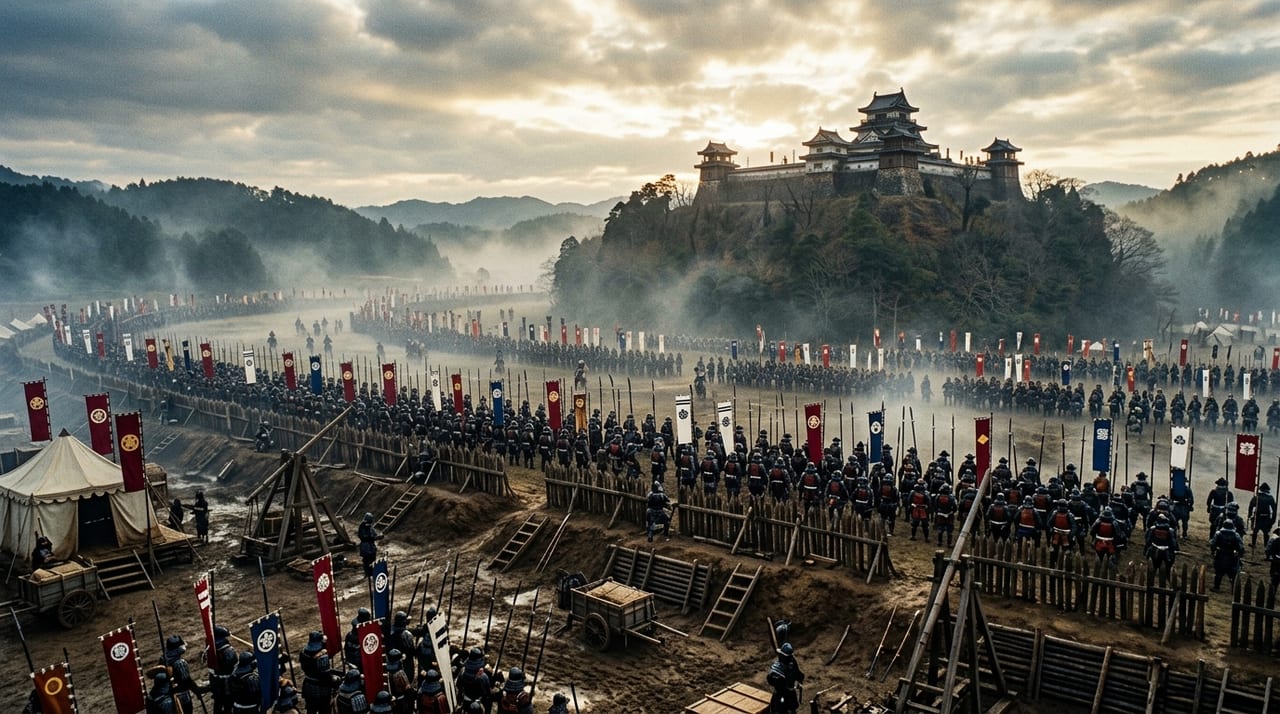
From the 7th to the 9th month of Keichō 5 (1600), the Battle of Tanabe Castle was fought at Tanabe Castle in Tango Province (present-day Maizuru, Kyoto Prefecture). It is one of the most unusual sieges in the history of Japanese warfare. The defending commander, Hosokawa Yūsai (also known as Fujitaka), held out for about two months with only 500 men against a Western army more than twenty times his size. The most remarkable feature of this siege is that peace was established by an imperial command from Emperor Go-Yōzei. The reason was the preservation of the Kokin Denju, the secret transmission of the Kokin Wakashū poetry anthology. The outcome was fitting for a commander who excelled at both the martial and the literary arts.
Hosokawa Yūsai (Tenbun 3 to Keichō 15, 1534–1610) lived from the Sengoku period into the early Edo period, and was an outstanding figure of his age in both his achievements as a warrior and his achievements as a man of culture.
Yūsai's given name was Hosokawa Fujitaka. He began his career as a retainer of the Ashikaga shogunate, and later served Oda Nobunaga, who entrusted him with the governance of Tango Province. After Nobunaga's death, he served Toyotomi Hideyoshi and took part in the Kishū campaign and the Kyūshū campaign. As a warrior, he was a rare figure who combined the military tactics of the Muromachi shogunate with the practical experience of the Sengoku wars.
What raised Yūsai's name even higher, however, was his outstanding cultural accomplishment. As a recipient of the Kokin Denju, Yūsai was a "master of poetry" who inherited the deepest interpretations and secret transmissions of the Kokin Wakashū. This Kokin Denju went beyond mere poetic technique. It was the core of Japan's spiritual culture, with a deep continuity with the imperial household and aristocratic culture, and its recipient held a special position.
Yūsai received the Kokin Denju from Sanjōnishi Saneki, and he had promised to pass it on later to Prince Hachijō-no-miya Toshihito, the younger brother of Emperor Go-Yōzei. Because the siege of Tanabe Castle took place before this transmission was complete, a crisis arose: if Yūsai died in battle, the line of the Kokin Denju would be cut off.
In the 7th month of Keichō 5 (1600), when Ishida Mitsunari raised troops to overthrow Tokugawa Ieyasu, Hosokawa Yūsai took the position of supporting the Eastern Army (the Tokugawa side). Yūsai's son, Hosokawa Tadaoki, was a powerful supporter of Ieyasu, and Tanabe Castle was a base that posed a threat to the rear of the Western Army.
The Western Army ordered daimyō from Tanba, Tajima and other provinces to capture Tanabe Castle, and a force of 15,000 men surrounded it. Inside the castle, meanwhile, there were only about 500 soldiers under Yūsai's command. Yūsai was already 67 years old, and if the siege were prolonged, there would be physical limits.
Yūsai nevertheless resolutely continued the defense. The reason was not simply a warrior's pride. It also included a strategic calculation: to keep the Western Army's forces tied down in Tango until the decisive battle of Sekigahara, where his son Tadaoki was fighting with the Eastern Army. In that sense, the siege of 500 defenders against 15,000 attackers had a strategic significance that went beyond tactics.
While the siege of Tanabe Castle stretched on for about two months, the crisis that "if Hosokawa Yūsai dies, the Kokin Denju will be cut off" was conveyed to Emperor Go-Yōzei. The emperor urgently dispatched an imperial envoy to Tanabe Castle and ordered both armies to halt the fighting and make peace.
The Western Army's commanders could not ignore the imperial command. On the 13th day of the 9th month of Keichō 5 (October 19, 1600), Tanabe Castle surrendered, and the lives of Hosokawa Yūsai and his garrison were preserved. This was about two months after Yūsai began the siege, and two days later, on the 15th day of the 9th month (October 21), the main battle of Sekigahara took place.
In other words, the siege of Tanabe Castle continued right up to the eve of the main battle of Sekigahara, and it kept about 15,000 Western Army troops pinned down in Tango. This contribution is assessed as having indirectly helped the Eastern Army's victory at Sekigahara.
Yūsai died in Kyoto in Keichō 15 (1610), ten years after the castle surrendered. The Kokin Denju was passed on to Prince Hachijō-no-miya Toshihito and others, and later from the Hachijō-no-miya to Emperor Go-Mizunoo, forming a line known as the Gosho Denju.
Hosokawa Yūsai is regarded as the supreme embodiment of the "dual mastery of the martial and literary arts" in Japan's cultural history, and he also had a deep relationship with the Japanese sword in his martial dimension.
Yūsai was also knowledgeable in swordsmanship, and is said to have studied under Tsukahara Bokuden. Many famous swords had been handed down to the Hosokawa family in Tango Province.
The Hosokawa family was known across the generations as a daimyō with a high level of skill in collecting and appraising famous swords. Yūsai's son, Hosokawa Tadaoki (Sansai) was especially knowledgeable about swords, and is also known for establishing a style of sword fittings called Higo-goshirae. Part of the Hosokawa family's sword collection is still kept at Eisei Bunko (Mejiro, Tokyo), and it holds a special meaning among Japanese sword enthusiasts.
Records are scarce regarding what sword Yūsai wore during the defense of Tanabe Castle. However, the single blade that the 67-year-old Yūsai wore at his belt in his final battle continues to shine in history as a symbol of the "spirit" of a warrior who lived by both the sword and the pen.
The greatest feature of the Battle of Tanabe Castle is that "culture" overcame "military force." The cultural value of Yūsai's Kokin Denju drew out the intervention of the emperor, and through an "imperial command of culture" it resolved a situation that could never have been overcome by force of arms.
This event has been passed down to later generations as the ultimate embodiment of the ideal of the "dual mastery of the martial and literary arts" in the Japanese warrior culture. The concept that a warrior is not merely a combatant, but a person who values both the "sword" and "poetry" equally, was most clearly shown in the Battle of Tanabe Castle.
In considering the cultural symbolism of the Japanese sword, the Battle of Tanabe Castle has a special meaning. The sword was both a weapon on the battlefield and a symbol of the warrior's "soul," "pride," and "cultural identity." Yūsai's defense was a rare historical scene in which the sword functioned as a "guardian of culture," and it is one of the examples that most eloquently speaks to the depth of the symbolic dimension of the Japanese sword.
The spirit of the martial and literary arts that Yūsai, the father, protected through the defense of Tanabe Castle was inherited by his son, Hosokawa Tadaoki (Sansai). Tadaoki, who won distinction on the Eastern side in the main battle of Sekigahara, became, after the war, a daimyō of the Kokura Domain in Buzen Province with 399,000 koku. Tadaoki was also known as a leading disciple of the great tea master Sen no Rikyū, and he was an embodiment of the "dual mastery of the martial and literary arts" in swords, tea utensils, and poetry alike. Some of the swords handed down to the Hosokawa family are still held by Eisei Bunko (Mejiro, Tokyo). The life that the father Yūsai preserved at Tanabe Castle, and the spirit of the Kokin Denju, have also been passed on to later generations in the form of the son's sword collection, and as an event that embodies the "family tradition of dual mastery of the martial and literary arts" of the Hosokawa family, they hold a special meaning in Japan's cultural history.
In the present-day city of Maizuru, Kyoto Prefecture, the ruins of Tanabe Castle have been developed as Maizuru Park. There is a mock reconstruction of a castle gate built in 1992 (Heisei 4), and Shōkokan, a two-story turret rebuilt in 1940 (Shōwa 15). Inside the castle gate, the Tanabe Castle Museum introduces the history of the successive lords of the castle, centered on Hosokawa Yūsai, and of the castle town of Tanabe.
Maizuru is still a port city with a base of the Japan Maritime Self-Defense Force, and it has a distinctive urban landscape where history and modern military culture coexist. From the land of Tanabe Castle, where Hosokawa Yūsai drew 15,000 troops toward himself with 500 men for about two months, feeling the ideals of the dual mastery of the martial and literary arts and the warrior spirit symbolized by the Japanese sword will be an exceptional experience for sword enthusiasts. This place, where you can feel both the weight of the single blade Yūsai wore last and the weight of the culture of the Kokin Denju at the same time, is one of the historic sites that best embodies both the "sword" and the "pen" of the Japanese sword.
Hosokawa Yūsai
Hosokawa Yūsai — the scholar-warrior who held Tanabe with 500 men for two months and was spared by imperial command as the sole transmitter of the Kokin-denju
Ishida Mitsunari
Ishida Mitsunari — Western Army commander who ordered the Tanabe siege, committing twenty thousand troops to Tango before Sekigahara
Tokugawa Ieyasu
Tokugawa Ieyasu — commander whose Eastern coalition Yūsai's son Tadaoki joined; the Tanabe siege indirectly benefited the Eastern cause at Sekigahara
Ōtani Yoshitsugu
Ōtani Yoshitsugu — a key Western Army commander whose strategic planning encompassed the Tanabe siege