New Arrivals — Browse our catalog for the latest authentic Japanese sword arrivals. Browse →
August 27 – September 8, 1600 (Keichō 5, 7th month, 19th day – 8th month, 1st day)
Fushimi, Yamashiro Province (present-day Fushimi Ward, Kyoto City, Kyoto Prefecture)
Forces
Eastern Army (Defenders)
Western Army (Besiegers)
About 13 min read
The Battle of Fushimi Castle, fought at Fushimi Castle (Fushimi, Yamashiro Province, present-day Fushimi Ward, Kyoto) from the 19th day of the 7th month of Keichō 5 (1600) to the 1st day of the 8th month, was a prelude to the Battle of Sekigahara in the 9th month of that same year and is one of the most dramatic siege defenses in Japanese history. Torii Mototada, a trusted confidant of Tokugawa Ieyasu, defended the castle for more than ten days with a small force of about 1,800 men against the Western Army of about 40,000 led by Ishida Mitsunari, and shared the castle's fate. This battle was not merely a military clash; it has been passed down through the ages as an event symbolizing the spirit of samurai loyalty and junshi (following one's lord in death).
Torii Mototada (Tenbun 8 (1539) – Keichō 5 (1600)) was a senior fudai retainer who had served the Matsudaira house from the time of his father, Torii Tadayoshi. From Tenbun 20 (1551), when Ieyasu was held at Sunpu as a hostage of the Imagawa clan, he served as a personal attendant, and for roughly the next fifty years he devoted his loyalty as the foremost of Ieyasu's close attendants. After the transfer to the Kantō region in Tenshō 18 (1590), he became lord of Yahagi in Shimōsa, with 40,000 koku.
In the 6th month of Keichō 5 (1600), when Ieyasu set out eastward to campaign against Uesugi Kagekatsu, he entrusted Fushimi Castle to Mototada. On the 16th day of the 6th month, Ieyasu stayed at Fushimi Castle, shared sake with Mototada, and apologized that he could leave only about 3,000 troops at Fushimi. Mototada is said to have answered that, if the castle were surrounded by the large Osaka-side army, he would have no choice but to set it on fire and die fighting, and so Ieyasu should take as many of his retainers with him as he could. The two drank together until late at night before parting; this was their last meeting in life.
Fushimi Castle was a fortress that Toyotomi Hideyoshi developed in his later years, and it was also the place where Hideyoshi died in Keichō 3 (1598). After Hideyoshi's death, Tokugawa Ieyasu, who took hold of real power, made Fushimi Castle the center of government. However, when he set out eastward to campaign against Uesugi in Keichō 5 (1600), he entrusted the defense of Fushimi Castle to Mototada. Fushimi Castle was a strategic stronghold guarding the south of Kyoto, and it was also a symbolic castle of the Toyotomi regime.
On the 17th day of the 7th month of Keichō 5, Ishida Mitsunari and others raised their forces, and the curtain rose on the opening act of the Battle of Sekigahara. Mitsunari gave priority to capturing Fushimi Castle. This was because Fushimi Castle controlled the Tōkaidō and San'yōdō routes leading to Sekigahara, and as a stronghold of the Tokugawa side it also posed a threat behind the Western Army.
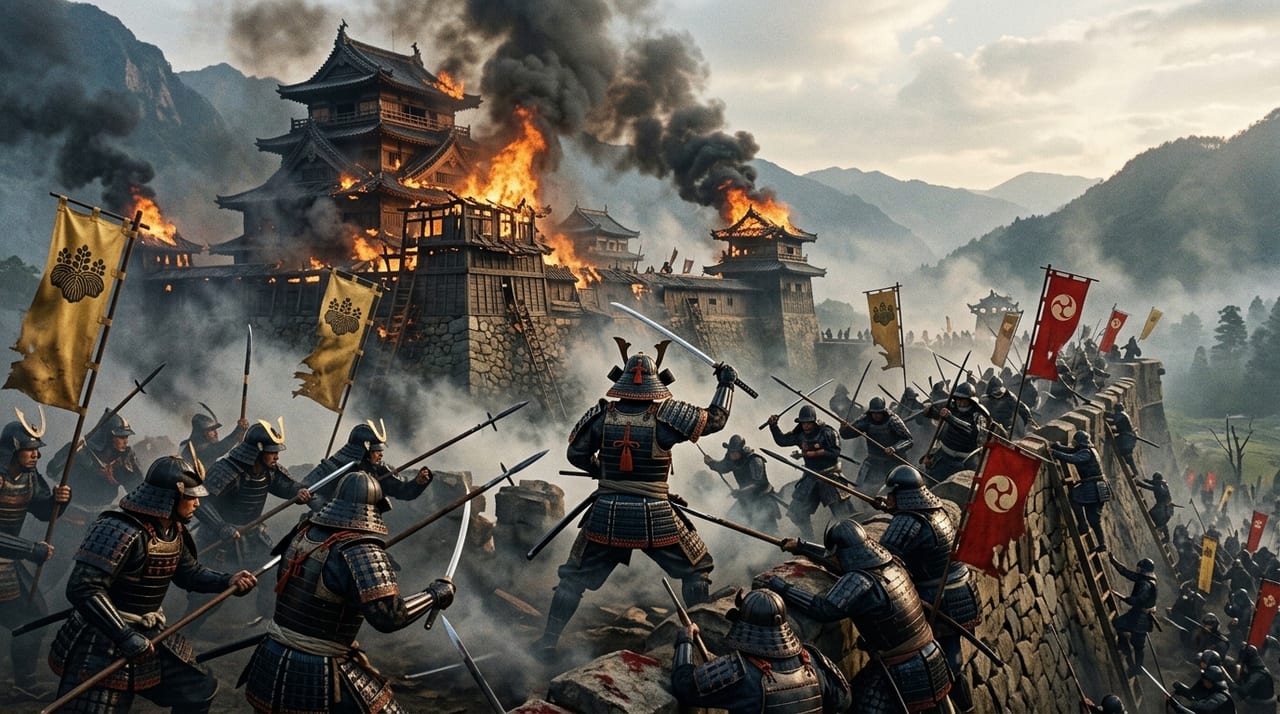
On the 19th day of the 7th month, about 40,000 Western Army troops began their attack on Fushimi Castle. Mototada held the castle with a small force of about 1,800 men (accounts vary) and resisted fiercely despite the overwhelming disparity in numbers. Hand-to-hand combat broke out in various parts of the castle, and the defenders kept holding it while suffering casualties one after another. The samurai of Fushimi Castle, armed with swords and spears, endured the fierce assault of the Western Army for more than ten days.
On the 1st day of the 8th month, fire was set inside the castle through the scheming of Western Army collaborators within the castle, and the Honmaru finally fell. Mototada is said to have been killed by Suzuki Shigetomo, a musket captain, or to have taken his own life. He was 62 years old at his death. Naitō Ienaga, Matsudaira Ietada, and many other soldiers who had held the castle fell in battle.
After the fall of Fushimi Castle, the bloodstained floorboards of the buildings where Mototada and the others met their end are said to have been installed as ceilings in temples in Kyoto and elsewhere, as offerings for the dead, and they are called "chi-tenjō (blood ceilings)." Fushimi Castle's blood ceilings have been handed down at Yōgen-in (Higashiyama Ward, Kyoto), Genkō-an (Kita Ward, Kyoto), Shōden-ji (Kita Ward, Kyoto), Hōsen-in (Ōhara), and other temples.
The blood ceilings are said to bear marks that look like hand and foot prints, and they convey to the present day the final moments of the samurai of Fushimi Castle. These blood ceilings carry the meaning of "chinkon" (consoling the spirits of the dead), arranged as part of the postwar settlement, and they were dedicated to temples to pray for the spirits of the samurai who died in battle.
In the Battle of Fushimi Castle, swords played an important role as the final means of defense. The roughly 1,800 samurai who held the castle carried swords, spears, and bows and arrows as they defended it. While the Western Army carried out a modern siege warfare centered on muskets, the samurai of Fushimi Castle fought with their swords in hand, engaging in close-quarters combat.
There is no detailed record of the sword Mototada used, but his family, as Mikawa samurai, had for generations valued the culture of wearing swords. Most of the swords of the samurai who lost their lives in the defense of the castle are thought to have either been distributed among Western Army officers and men after the fall of the castle, or to have been lost in the flames together with their owners.
Mototada's loyalty was later praised by Ōkubo Tadataka (Hikozaemon) as "a paragon of the Mikawa samurai."
The fall of Fushimi Castle brought great shock and anger to the commanders of the Eastern Army (Ieyasu's side). The fact that Torii Mototada, a senior figure of the Tokugawa house, shared the castle's fate raised the morale of the Eastern Army and provided an emotional motivation: "Avenge Mototada."
On the 15th day of the 9th month of Keichō 5, at the Battle of Sekigahara, the Eastern Army defeated the Western Army, and Tokugawa Ieyasu gained real power over the realm. This came about 45 days after the fierce fighting at Fushimi Castle. Historians are divided over whether Mototada's gyokusai directly contributed to the victory at Sekigahara, but it is certain that it at least strengthened the spiritual bond within the Eastern Army and raised its fighting spirit.
The Battle of Fushimi Castle and Torii Mototada's junshi, as events symbolizing the quintessence of Japanese bushidō, were passed down throughout the Edo period and became subjects of military chronicles, ukiyo-e prints, and kōdan storytelling. Even today, the fierce memory of Fushimi Castle lives on through the blood ceilings, reminding visitors anew of samurai loyalty and of the end of the age of the Japanese sword.
Torii Mototada
Commander of Fushimi Castle's defense, who died loyally holding it against the Western Army
Tokugawa Ieyasu
Eastern Army commander who entrusted Fushimi to Mototada before departing east
Ishida Mitsunari
Western Army commander who led the assault on Fushimi Castle
Konishi Yukinaga
Western Army commander who participated in the siege of Fushimi
Shimazu Yoshihiro
Participated in the siege of Fushimi Castle as a Western Army commander
Fukushima Masanori
Eastern Army general who fought at Sekigahara to avenge Mototada's death