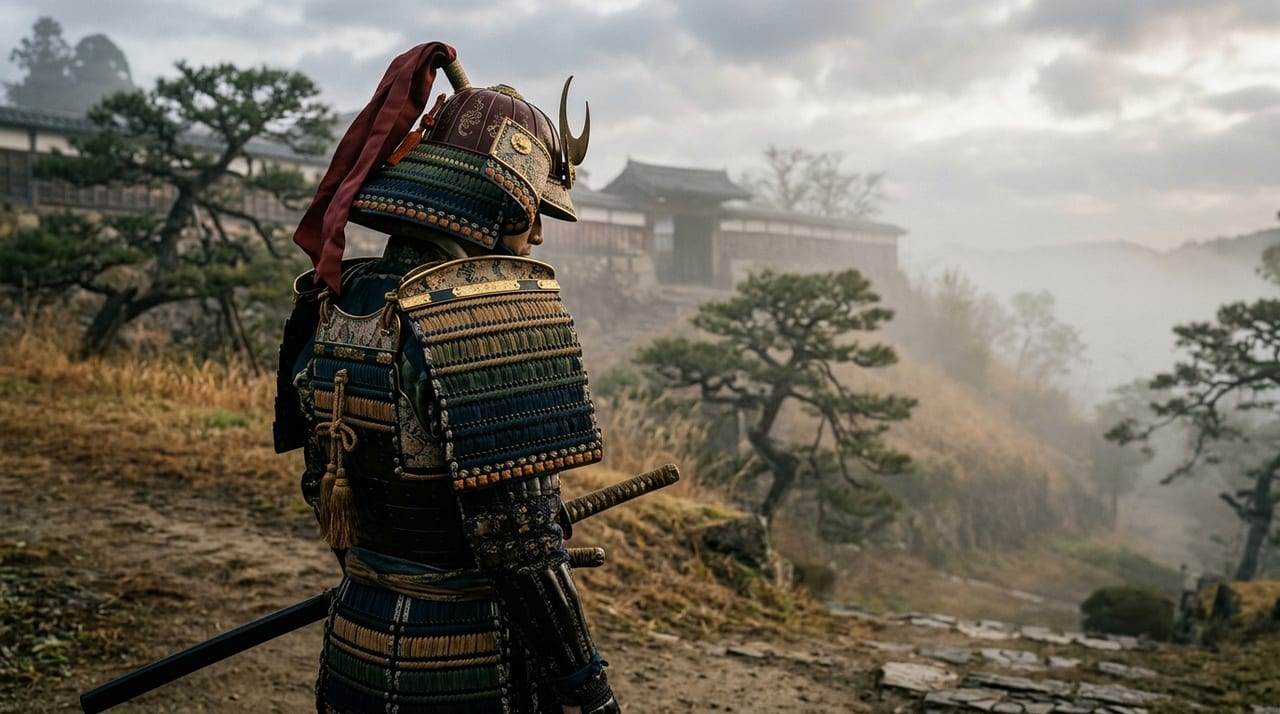
 * Image is for illustrative purposes only.
Shimazu Yoshihiro
島津義弘
Oni-Shimazu (The Demon Shimazu)
Description
The Birth of Oni-Shimazu
Born in Satsuma Province in Tenbun 4 (1535), Shimazu Yoshihiro was the fiercest warrior in Kyushu. His martial renown, together with the epithet "Oni-Shimazu," resounded both at home and abroad. Together with his elder brother Shimazu Yoshihisa, he built the zenith of the Shimazu house and expanded its power to the very brink of unifying Kyushu. Yoshihiro's martial prowess was not confined to Japan. On the Korean Peninsula, too, his name was spoken of with dread.
The Battle of Sacheon
One of the battles that decisively established Yoshihiro's martial reputation was the Battle of Sacheon in the Bunroku–Keichō campaigns (Keichō 3 (1598)). Against a massive Ming and Joseon allied army of tens of thousands, Yoshihiro met them with a force of only 7,000 troops. After a fierce melee, he crushed them. According to Japanese records, during the Korean campaigns Yoshihiro was feared by the Ming and Joseon forces, who called him "Gui Shimanzi."
Decision at Sekigahara
The Battle of Sekigahara in Keichō 5 (1600) was Yoshihiro's greatest moment in the spotlight. Fighting for the Western army, Yoshihiro chose an unprecedented tactic. After the outcome of the battle had been decided, and with his line of retreat cut off in a desperate situation, he forced a breakthrough through the enemy ranks, advancing forward. This retreat, known as the Shimazu no Nokiguchi, was carried out under pursuit by elite Eastern army troops including Ii Naomasa and Honda Tadakatsu. Yet through the desperate rearguard fighting of the Shimazu forces, it achieved Yoshihiro's return to Satsuma. The rearguard tactic unique to the Shimazu, known as sutegamari, involved several men remaining behind to take on the pursuit and fighting on until all of them died. It showed the fierce resolve of Satsuma samurai.
Satsuma Blades and Satsuma-goshirae
Yoshihiro and the sword culture of Satsuma are inseparably linked. Satsuma blades are known for the distinctive mounts called Satsuma-goshirae (sword fittings), which are characterized by a rugged style that eschews ornateness. Satsuma-goshirae have small guards and somewhat long hilts. This practical design makes them easy to handle one-handed or two-handed. It is said to be a shape optimized for the Jigen-ryū swordsmanship.
Jigen-ryū
Jigen-ryū is known as the swordsmanship of the Satsuma domain. It is an aggressive style epitomized by the teaching "Do not doubt the first strike; a second strike means defeat." The spirit of Jigen-ryū holds that one should pour one's whole body and soul into the first strike and defeat the enemy in a single blow. This spirit is directly tied to the pursuit of sharpness and sturdiness in Satsuma blades. Yoshihiro himself is also said to have fought so fiercely at the Battle of Nejirozaka in Tenshō 15 (1587) that he drew his sword and charged into the enemy ranks.
Swords and Martial Prowess
Satsuma blades are characterized by a shallow curvature, a broad blade width, and a thick blade (kasane). This construction is suited to what is called "Satsuma-goshirae." Satsuma blades embody a design philosophy that maximizes the destructive power of a single blow.
Shimazu's Legacy
Yoshihiro died at Kajiki in Satsuma Province in Genna 5 (1619) at the age of 85. For Yoshihiro, who spent his life immersed in actual combat, the sword was not an ornament. It was a tool that decided his life or death on battlefields where he staked his life. Along with the name Oni-Shimazu, Satsuma's sword culture was passed down unbroken until the late Tokugawa period and the Meiji Restoration. It became the spiritual pillar for Saigō Takamori and other Satsuma men of purpose.