New Arrivals — Browse our catalog for the latest authentic Japanese sword arrivals. Browse →
June 14, 1572 (Genki 3, 5th month, 4th day)
Kizakibaru, Masaki-in, Hyūga Province (present-day Ebino City, Miyazaki Prefecture)
Forces
Shimazu Forces
Itō Forces
About 13 min read
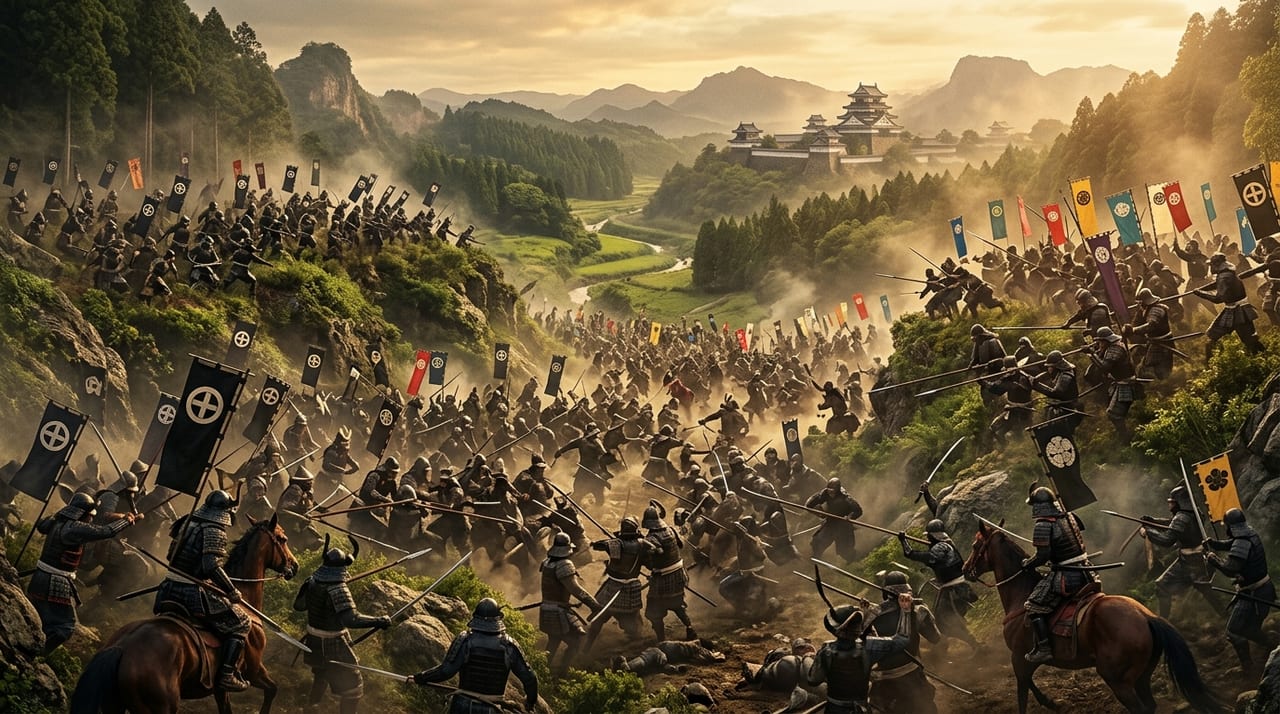
On June 14, 1572 (Genki 3/5/4), at Kizakibaru in Hyūga Province (present-day Miyazaki Prefecture), the Shimazu army led by Shimazu Yoshihiro won a miraculous victory over the Itō army led by Itō Yoshisuke. The Battle of Kizakibaru was a battle in which a Shimazu force of only 300 to 500 (according to various accounts) defeated an Itō army of 3,000, more than three times its size, in a decisive victory. The Shimazu won by using "tsuri-nobuse," an encirclement-and-annihilation tactic unique to the Shimazu. It is one of the most important battles in the Sengoku-period history of the three provinces of Satsuma, Ōsumi and Hyūga (Satsuma, Ōsumi, Hyūga), and it is also called "the Okehazama of Kyushu."
In this battle, Shimazu Yoshihiro established his reputation as a military commander. It became the origin of the legend of the "Oni-Shimazu" (Demon Shimazu), a legend that continued through the Battle of Mimikawa (1578), the Japanese invasions of Korea (from 1592), and the Battle of Sekigahara (1600).
Hyūga Province (present-day Miyazaki Prefecture) was an area where the Shimazu clan of Satsuma and Ōsumi and the Itō clan, whose base was in Hyūga, fiercely contested each other. The Itō clan was a prominent warrior house in Hyūga Province, and at its height it held power sufficient to control 48 castles within the province. The Shimazu clan, on the other hand, was based in Satsuma and Ōsumi and sought to expand into Hyūga.
Shimazu Yoshihiro was stationed on the Hyūga front as the younger brother who supported his elder brother Shimazu Yoshihisa, the eldest of the four brothers. At the time of the Battle of Kizakibaru, in Genki 3 (1572), Yoshihiro was a warrior in his late thirties, in the prime of his career. The advance of a large Itō army toward Iino Castle, a Shimazu stronghold in Hyūga Province, was the direct trigger for this battle.
"Tsuri-nobuse" is a tactic the Shimazu house developed on its own. A small unit meets the enemy's front line and then deliberately retreats to lure the enemy into pursuit. The pursuers are drawn into the encirclement of ambushers who have been hidden in wait, and they are surrounded and annihilated. The Shimazu, who were inferior in numbers, refined this tactic. It was an inventive response born of the geography of southern Kyushu (mountains, hills and narrow terrain) and of the need to split up a large enemy army.
At Kizakibaru, Shimazu Yoshihiro first put a small unit forward to draw in the Itō army and lured the pursuing enemy into narrow terrain. Then the ambushers hidden on the left, right and rear rose up at once and surrounded the Itō army. The Itō army, which had the advantage in numbers, was thrown into confusion by the sudden encirclement, lost its cohesion, and broke into flight in several places.
This tactic looks simple, but carrying it out required close coordination and a calm judgment. The front unit had to guide the enemy to the ambush position while appearing to be really fleeing, and the ambushers had to time their emergence precisely. Yoshihiro carried out this difficult tactic flawlessly and achieved a great victory that overturned a difference in troop strength of roughly six to ten times.
Satsuma Province (present-day Kagoshima Prefecture) had a sword culture of its own. A group of swordsmiths known as "Satsuma shintō" (Satsuma new swords) was active during the Edo period. Satsuma smiths, such as those of the Naminohira school, made swords with a practical and bold style, and Shimazu warriors widely favored them.
No detailed record survives of the sword Yoshihiro wore at the Battle of Kizakibaru, but as a Satsuma warrior he is thought to have favored the works of Satsuma smiths. Later, in the Japanese invasions of Korea (1592–1598), Yoshihiro defeated a large Ming and Chōsen force with a small army at the Battle of Sacheon (1598). At the Battle of Sekigahara (1600), he returned alive through the "Shimazu retreat," a breakthrough retreat through enemy lines.
A distinctive style of sword fittings, known as "Satsuma-koshirae," is a recognized feature of Satsuma swords. The rugged appearance, based mainly on black, symbolizes the plain, honest and sturdy spirit of the Satsuma warrior.
Early in the 5th month of Genki 3 (1572), the Itō army (according to one account, 3,000 men), acting on the orders of Itō Yoshisuke, advanced into the area of Iino Castle in Hyūga Province. Shimazu Yoshihiro, who was at Iino Castle, set out to relieve Kakutō Castle, but his force was small, about 300 to 500 men (according to various accounts).
As preparation for tsuri-nobuse, Yoshihiro first surveyed the terrain carefully and arranged his ambushers. He made the fullest use of the Kizakibaru terrain (valley lines and hills), placed the ambushers in suitable positions, and then put a small vanguard unit forward to make contact with the Itō army.
After skirmishing with the Itō army, the vanguard deliberately withdrew. When the Itō army pursued, the vanguard kept fleeing and drew the enemy into the valley lines. Here Yoshihiro judged the moment and gave the signal. The ambushers hidden on the left and right hills rushed out at once and surrounded the Itō army.
Thrown into a sudden encirclement, the Itō army fell into great confusion and could no longer offer organized resistance. Yoshihiro himself fought on the front line with a sword in hand and spurred on the Shimazu officers and soldiers. The Itō commander, Itō Sukeyasu, and many other Itō officers were killed, and the Itō army broke into flight.
Through the victory at Kizakibaru, the Shimazu clan decisively strengthened its control over Hyūga Province. The great victory made Yoshihiro's martial renown known throughout Kyushu, and the terror of the Shimazu's tsuri-nobuse became widely known.
The Itō clan declined rapidly after this defeat. In Tenshō 5 (1577), Itō Yoshisuke abandoned his home base and went into exile in Bungo under Ōtomo Sōrin. As a result, the Shimazu clan brought Hyūga Province fully under its control.
The Shimazu clan then continued its offensive toward the conquest of Kyushu. In Tenshō 6 (1578), it defeated the large Ōtomo army at the Battle of Mimikawa. In Tenshō 12 (1584), it killed Ryūzōji Takanobu at the Battle of Okitanawate, and it went on to subdue most of Kyushu. The Battle of Kizakibaru was the historic victory that marked the starting point of the Shimazu house's conquest of Kyushu.
Yoshihiro's martial renown, which came to be called "Oni-Shimazu," continued into his later great achievements: the great victory at Sacheon during the Bunroku and Keichō campaigns (1592–1598), his participation in the Western Army at the Battle of Sekigahara (1600), and his breakthrough through enemy lines in the "Shimazu retreat," a legendary feat. The Battle of Kizakibaru was the origin of that "Oni-Shimazu."
Shimazu Yoshihiro
Commanded the Shimazu forces and executed the tsuri-nobuse encirclement that destroyed the Itō army
Shimazu Yoshihisa
Head of the Shimazu clan who led the campaign for Kyūshū dominance alongside his brothers
Tachibana Dōsetsu
Distinguished Ōtomo general who later faced the Shimazu at Mimikawa; the Thunder God of Kyūshū
Ōtomo Sōrin
The Ōtomo lord who sheltered the defeated Itō, then clashed with Shimazu at Mimikawa
Ryūzōji Takanobu
Northern Kyūshū warlord later killed by Shimazu forces at Okita Nawate