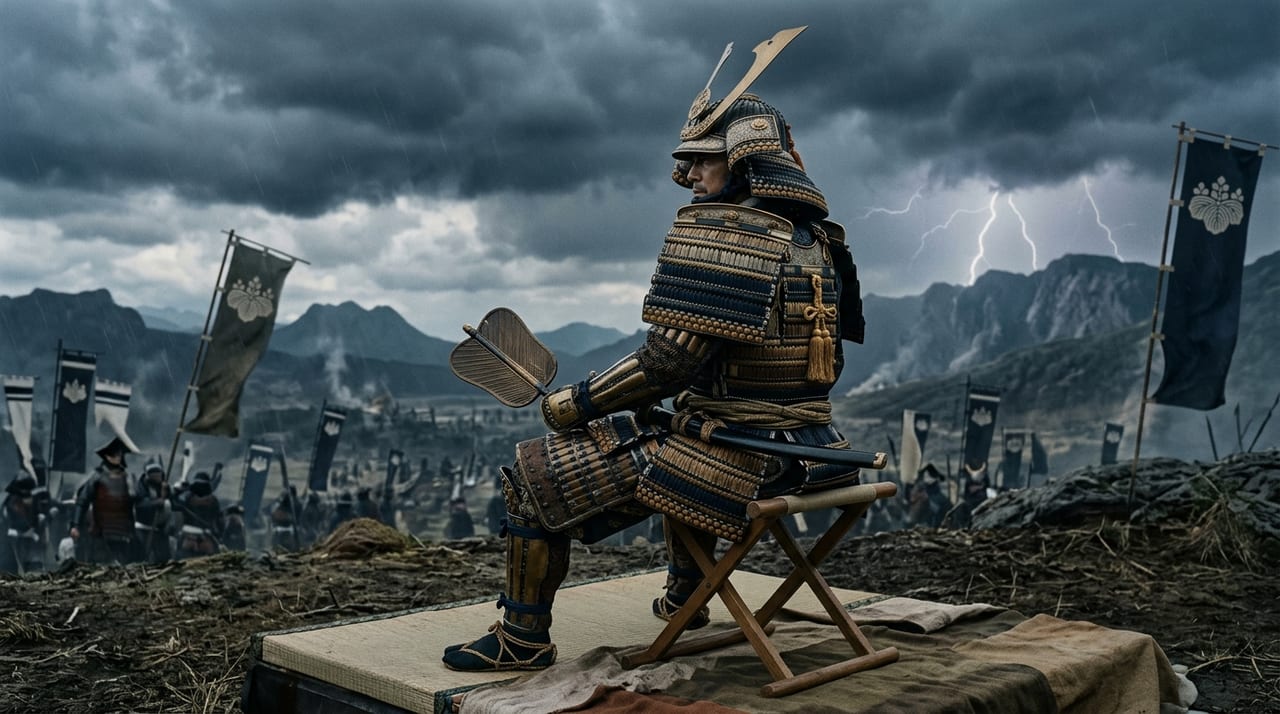
 * Image is for illustrative purposes only.
Tachibana Dōsetsu
立花道雪
Wielder of Raikiri — The "Thunder God" of the Ōtomo Who Commanded from His Palanquin
Description
A Warrior Known as the God of Thunder
Born in Eishō 10 (1513) as Bekki Akitsura, a senior retainer of the Ōtomo clan of Bungo Province (present-day Ōita Prefecture), Tachibana Dōsetsu became renowned as one of the most formidable warriors in Kyūshū, wielding the sword “Raikiri” with the valor of the god of thunder. Later Ōtomo Sōrin gave him Tachibanayama Castle, but he continued to use the surname Bekki for the rest of his life (he is later commonly known as Tachibana Dōsetsu). It is said that he lost the use of his left leg in his mid-thirties after being struck by lightning, yet in his later years he continued to command on the battlefield from a palanquin (koshi). That image is passed down as an embodiment of a warrior's spirit that transcended his disability.
The Birth of Raikiri: A Legendary Blade
No account of Tachibana Dōsetsu is complete without the legend of his beloved sword, Raikiri. According to the Ōtomo Kōhaiki, in summer around Tenbun 17 (1548), Dōsetsu was napping in the cool shade of a large tree when lightning was about to strike him. He drew the sword Chidori, which had been propped up beside his pillow, cut down the lightning, and leapt aside. It is said that Dōsetsu then renamed Chidori “Raikiri-maru” and always kept it close at hand. From that time his left leg is said to have become disabled, but this anecdote has been widely passed down as a legend illustrating Dōsetsu's superhuman courage and reflexes. The sword had been called Chidori because of the bird ornament on its hilt. It was later shortened from a tachi into a wakizashi (suriage), and as “Raikiri-maru” it is still preserved at the Tachibana Museum (Tachibana-ke Shiryōkan) in Yanagawa, Fukuoka Prefecture, as an important heirloom.
Undefeated God of War: Twin Pillars of the Ōtomo House
Tachibana Dōsetsu served Ōtomo Yoshiaki and his son Sōrin. As western guardian of the Bungo Ōtomo clan, he fought on against Kyūshū's powerful forces, including the Mōri, Ryūzōji, and Shimazu. His military record is said to comprise 37 major battles and over a hundred minor ones. Because he was nearly never defeated in battles he personally commanded, he gained fame as a god of war. In particular, in his struggles against Mōri Motonari he overcame many crises through strategy, and he also boldly faced the invasion of Ryūzōji Takanobu's massive army. Takahashi Jōun (a son of Yoshihiro Akimasa) was celebrated alongside Dōsetsu as the twin pillars of the Ōtomo house, and these two fierce generals formed the core of the Ōtomo clan's military strength.
The Palanquin General: Command Beyond Disability
Although he lived with a disability in his leg, Dōsetsu continued to stand on the battlefield throughout his life. In his later years he had his retainers carry a hand palanquin (te-koshi) while he himself sat in it, surrounded by about a hundred young men. When the enemy drew near, he struck the rim of the palanquin with hand poles to call out the rhythm and sent his men charging into the enemy ranks. His retainers fought at the risk of their lives to protect their lord's palanquin, and Dōsetsu's personal hardship in fact heightened the unity and loyalty of his retainer band. Dōsetsu's attitude left later generations with a profound question about what a warrior should truly be.
Tachibana Ginchiyo and the Question of Succession
Because Dōsetsu had no sons, he made the unusual decision to give his eldest daughter, Ginchiyo, the position of head of the Tachibana house. Later he adopted Munetora, a son of Takahashi Jōun (later known as Tachibana Muneshige), as an adopted son-in-law in order to secure the succession of the Tachibana house. Tachibana Muneshige served the Toyotomi and Tokugawa regimes as Kyūshū's foremost fierce general. After being stripped of his domain following Sekigahara, he regained the shogunate's trust and returned to his former domain, a remarkable revival. In this way, the Tachibana house that Dōsetsu left behind, with Muneshige as its successor, inscribed one of the most turbulent chapters in the history of a Sengoku warrior house.
Sword and Spirit: The Sword Culture of Kyūshū Warriors
Dōsetsu's “Raikiri (Chidori)” is more than a mere weapon. It is passed down as a sacred sword that symbolizes Dōsetsu's superhuman spirit and unyielding fortitude. While the warriors of Kyūshū maintained their own swordsmithing traditions in regions such as Bungo, Chikuzen, and Hizen, they also actively adopted masterpieces of the Bizen, Yamashiro, and Sōshū traditions. In Dōsetsu's era, the Ōtomo clan exchanged foreign goods and culture through the Nanban trade, so sword culture in Kyūshū may also have been subject to a distinctive international influence.
Death in Tenshō 13 (1585) and Legacy
In Tenshō 13 (1585), Dōsetsu fell ill while in the field attacking the Chikugo castles held on the Ryūzōji side, and he died in camp in Chikugo Province at the age of 73 (or 72). Dōsetsu's death, which came while he was still on the battlefield, brought deep grief to the warriors of Kyūshū. Yet the fact that Tachibana Muneshige, who received Dōsetsu's instruction, became active as Kyūshū's foremost valiant general means that Dōsetsu's legacy as a warrior survived in tangible form. Raikiri has been passed down in the Tachibana house since Dōsetsu's death, and today it is carefully preserved at the Tachibana Museum in Yanagawa, still transmitting the legend of the man who cut down lightning.
Notable Swords
- Raikiri (Chidori) — The legendary sword said to have been used by Dōsetsu to cut down lightning when it struck. It was originally a single blade called Chidori and is still held today by the Tachibana Museum (Yanagawa, Fukuoka Prefecture). It symbolizes Dōsetsu's unyielding spirit and superhuman fortitude as a sacred sword.