New Arrivals — Browse our catalog for the latest authentic Japanese sword arrivals. Browse →
January 25, 1573 (Genki 3/12/22)
Mikatagahara plain, Tōtōmi Province (present-day Chūō-ku, Hamamatsu, Shizuoka)
Forces
Takeda Forces
Tokugawa-Oda Allied Forces
About 9 min read
In the winter of Genki 3 (1572), Takeda Shingen launched the Seijō Sakusen (western campaign), the grandest ambition of his life. Shingen's army, marching toward Kyoto, numbered some 25,000–30,000 men. On the way south, it captured castles in Tōtōmi and Mikawa one after another. Facing this great army, Tokugawa Ieyasu had to decide whether to hold out in Hamamatsu Castle (Tōtōmi) or meet the enemy in the field.
Takeda Shingen's army marched under the banner of “Fūrinkazan” and was known as the strongest cavalry force of the Sengoku period. At its core were Yamagata Masakage, Baba Nobuharu, Naitō Masatoyo, and Kōsaka Masanobu, known as the “Four Great Retainers of the Takeda” (also called the Takeda Four Heavenly Kings).
Tokugawa Ieyasu, for his part, possessed the long sword “Daihannya Nagamitsu,” which Oda Nobunaga had given him for his part in the Battle of Anegawa. A masterpiece by the Kamakura-period master smith Osafune Nagamitsu, this sword was later given to Okudaira Nobumasa for his service at Nagashino and passed down to the Matsudaira family of the Oshi Domain. It is now a National Treasure held by the Tokyo National Museum.
Baba Nobuharu, known as “Oni Mino,” was renowned as the fiercest warrior in the Takeda army and also led the front lines at the Battle of Mikatagahara. Details of the sword he is said to have favored are not known. Nobuharu is described as a loyal retainer who held the rear guard to the very end when the Takeda army was defeated at the Battle of Nagashino (1575) and died in battle. His spirit as a warrior overlaps with the ethos of sword culture.
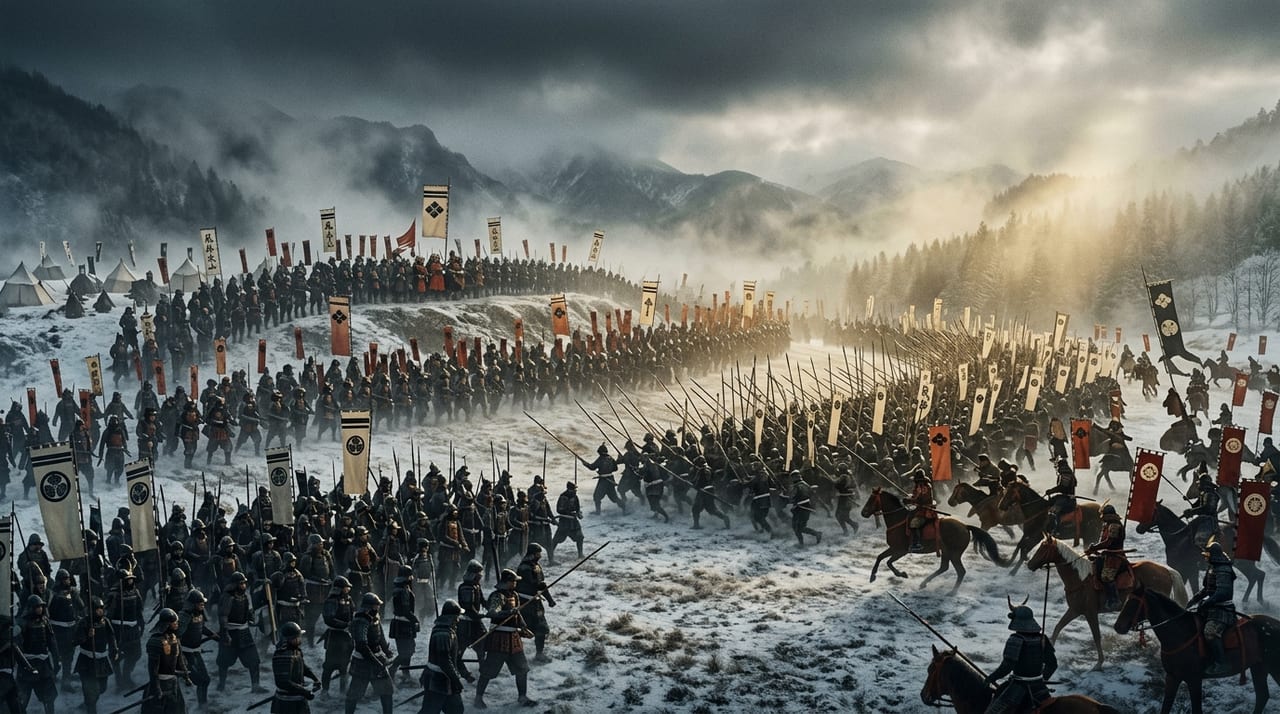
On January 25, 1573 (Genki 3/12/22), Takeda Shingen's army deployed onto the Mikatagahara plateau north of Hamamatsu Castle. Shingen made it appear that he would bypass Hamamatsu Castle and head west, using this ruse to draw Ieyasu out of the castle.
Ieyasu overrode the objections of his close advisers and set out in pursuit with only 11,000–13,000 troops. Sakuma Nobumori, a reinforcement sent by Nobunaga, rode with him, but the numerical inferiority was clear. When they reached the Mikatagahara plateau, the Takeda army turned about and, in a gyorin (fish-scale) formation, encircled and crushed Ieyasu's force.
The battle was decided in roughly two hours (about one koku), and the Tokugawa army suffered devastating losses. Ieyasu is said to have resolved himself to die, but he was protected by his retainers and fled on horseback back to Hamamatsu Castle. On his return, Ieyasu is said to have had a portrait made of himself as he looked in defeat, as a lasting reminder never to forget this humiliation. This is the “Shikami-zō” held by the Tokugawa Art Museum. The legend spread in the Shōwa period and has no basis in the historical record. It nonetheless shows how greatly the defeat at Mikatagahara shaped Ieyasu's political and military growth.
After Mikatagahara, Ieyasu endured in silence until Shingen died of illness in the field in the 4th month of Genki 4 (1573). Shingen's death was an irreplaceable loss for the Takeda house, and the western campaign collapsed.
Shingen's successor, Takeda Katsuyori, saw his cavalry destroyed by Oda Nobunaga's musket tactics at the Battle of Nagashino (1575). In Tenshō 10 (1582), the Takeda house itself was extinguished.
From this series of events, Ieyasu carved into his body the lesson to “endure and wait for the opportunity.” Without the defeat at Mikatagahara, the cautious Ieyasu of his later years might never have existed. His calm judgment at the Battle of Sekigahara (1600) and the Siege of Osaka (1615) can be said to have been backed by the painful experience at Mikatagahara.
The Genki and Tenshō eras (1570s–1580s) were a period in which “mass-produced swords of the Sengoku period” and “custom-ordered swords (premium made-to-order pieces)” coexisted in the history of the Japanese sword. Powerful daimyo such as the Takeda ordered a fixed number of military swords from smiths in Mino and Shinano, while also keeping famous swords from Kyoto and Kamakura as family treasures.
Records of the swords used at the Battle of Mikatagahara are scarce. However, the tachi and uchigatana carried by the commanders on both sides symbolize the culture of this era. The “Kyōhō Meibutsuchō,” compiled in Kyōhō 4 (1719) at the command of the eighth shogun, Tokugawa Yoshimune, records several famous swords associated with the age of Mikatagahara, showing the deep ties between the battlefield and famous blades.
The Battle of Mikatagahara is more often told as the story of the loser, Ieyasu. From the perspective of sword history, however, it is also an event worth remembering: the last great battle in which Takeda Shingen, a rare strategist, brought aesthetics to the battlefield, and the swords and valor of the commanders who took part in it.
Takeda Shingen
Takeda supreme commander, victor of Mikatagahara
Tokugawa Ieyasu
Tokugawa commander, suffered his worst battlefield defeat
Yamamoto Kansuke
Takeda strategist, said to have contributed to the western campaign planning
Honda Tadakatsu
Honda Tadakatsu, one of Ieyasu's top generals, accompanied him at Mikatagahara
Baba Nobuharu
One of the Four Generals of Takeda, front-line commander at Mikatagahara