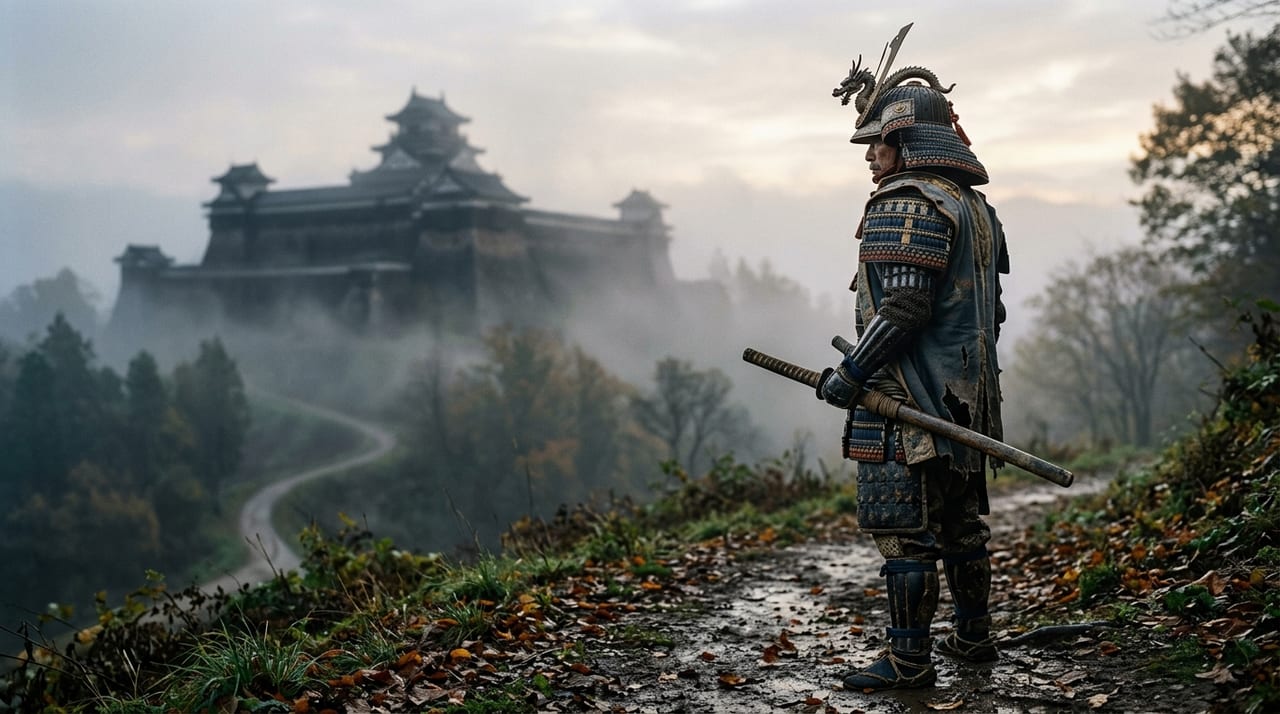
 * Image is for illustrative purposes only.
Yamamoto Kansuke
山本勘助
The One-Eyed Strategist of Kai
Description
A Disabled Strategist Discovered by Shingen
Yamamoto Kansuke, said to have been born around 1493 (Meiō 2) in Ushikubo, Mikawa Province (present-day Toyokawa City, Aichi Prefecture; some theories place his birthplace in Yamamoto, Fuji District, Suruga Province), is remembered by posterity as the greatest strategist of the Sengoku period. Though he was one-eyed and had disabilities affecting his fingers and feet, he served Takeda Shingen. Having traveled through various provinces and mastered the Kyō-ryū martial strategy, Kansuke was well versed in shiro-tori (castle construction) and jin-tori (deployment of troops). However, his appearance was disliked, and he was initially refused employment by Imagawa Yoshimoto. Takeda Shingen alone saw through Kansuke's outstanding strategic talent, and it is said that he took him into service with an extraordinary fief of 100 kan. Shingen made Kansuke a commander of foot soldiers (ashigaru-taishō) and valued him as the linchpin of the Takeda army's strategy in Kai.
Achievements at the Battle of Kawanakajima
The Battle of Kawanakajima (the fourth) in 1561 (Eiroku 4) was both the peak and the end of Kansuke's life. The 'woodpecker' stratagem (Kitsutsuki senpō), said to have been proposed by Kansuke together with Baba Nobuharu, was a plan in which the Takeda army would be split into two. A detached force would attack the Uesugi army on Mount Saijo under cover of night, and the main force at Hachimanbara would pincer the enemy as they descended the mountain. This stratagem was seen through by Uesugi Kenshin's brilliant foresight. The Uesugi army, having descended Mount Saijo during the late night, suddenly appeared out of the dawn mist and fiercely charged into the Takeda main camp.
A Heroic Death in Battle
Realizing the plan had failed, Kansuke, to take responsibility for the strategy he had proposed to his lord Shingen as a strategist, resolved to die and charged into the midst of the enemy. It is said that after fighting bravely, Kansuke was struck by spears from all sides and died in battle. His valiant death at the advanced age of sixty-nine was passed down to later generations as a death that fulfilled the true aspiration of a samurai.
Influence on Later Generations
Although there were once theories questioning whether Yamamoto Kansuke actually existed, the discovery in recent years of old documents bearing the name 'Yamamoto Kansuke (written with a different character)' (such as the Ichikawa family documents) has made his existence nearly certain. The image of Kansuke that has been repeatedly portrayed in novels, films, and taiga dramas strongly embodies the Japanese admiration for the 'wise man' (chiesha). Kansuke's life, in which he served as a superb strategist despite his physical disabilities and in the end took responsibility and charged into the enemy's midst, continues to shine today as an ideal embodiment of samurai sincerity, wisdom, and courage.