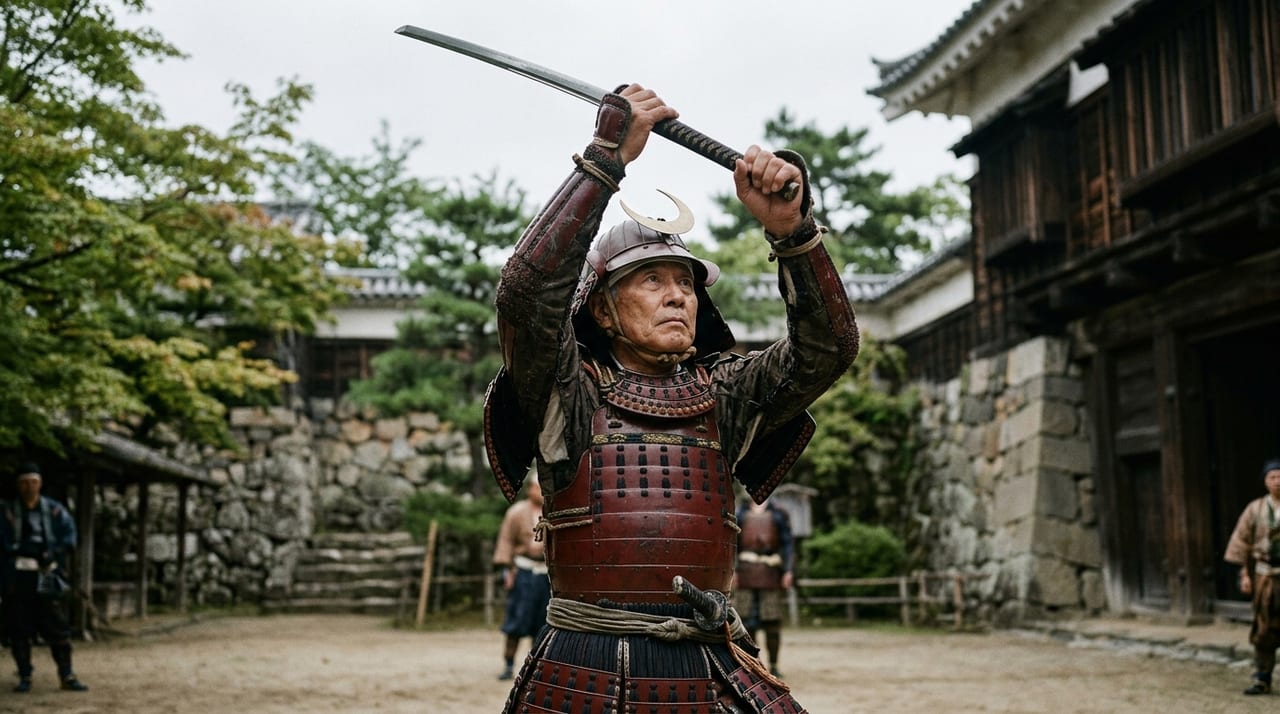
 * Image is for illustrative purposes only.
Tsutsui Junkei
筒井順慶
Daimyo
Description
From Kōfuku-ji Monk-Warrior to Master of Yamato
Tsutsui Junkei was born in 1549 (Tenbun 18), the son of Tsutsui Junshō of Yamato Province. The Tsutsui were a house of shuto — monk-retainers attached to the Ichijō-in cloister of Kōfuku-ji — who, through their role in administering the town of Nara, gradually became a warrior lineage; by his father's generation they had grown into the largest warrior band in Yamato. Junkei succeeded to the headship in 1550 at the age of only two. He later took Buddhist orders under the name Yōshunbō Junkei and was appointed Gon-shōsōzu. He embodied a form peculiar to Yamato: a man in clerical orders who nonetheless commanded the province's warrior houses.
The Struggle with Matsunaga Hisahide
The first half of Junkei's life was consumed by a fierce contest with Matsunaga Hisahide, who invaded Yamato. Hisahide's campaigns intensified from 1559 (Eiroku 2), and on the eighteenth day of the eleventh month of 1565 Junkei was driven out of his seat at Tsutsui Castle. He retook the castle on the eighth day of the sixth month of 1566, but suffered a heavy defeat at the Battle of the Tōdai-ji Great Buddha Hall on the tenth day of the tenth month of 1567 — a battle in which the Great Buddha Hall itself was destroyed by fire. At the Battle of Tatsuichi Castle on the fourth day of the eighth month of 1571 (Genki 2), however, he defeated the Matsunaga forces and recovered Tsutsui Castle once more. Through more than a decade of this struggle, Junkei came to hold the initiative in Yamato.
Submission to Oda Nobunaga and Rule over Yamato
On the twenty-fifth day of the tenth month of 1571, through the mediation of Akechi Mitsuhide, Junkei submitted to Oda Nobunaga. In 1577 (Tenshō 5) Nobunaga entrusted him with the government of the whole province under the formula that "the entirety of Yamato is in Tsutsui Junkei's charge." In 1580, under Nobunaga's order to reduce each province to a single castle, Tsutsui Castle and the other fortresses of Yamato were dismantled, and Junkei moved his seat to Kōriyama Castle, entering it on the twelfth day of the eleventh month of that year. Kōriyama thereafter became the administrative center of Yamato. Junkei was placed among Mitsuhide's subordinate commanders, and the two men, both cultivated, are said to have been on close terms.
Hora-ga-tōge: Legend and Fact
What made Junkei's name famous in later ages is the anecdote that, at the time of the Honnō-ji Incident in 1582, he encamped at the pass of Hora-ga-tōge and waited there to see whether Akechi or Hashiba would prevail. The story gave rise to a Japanese idiom for opportunistic fence-sitting — yet it cannot be confirmed in any reliable contemporary source, appearing only in later popular works such as the Taikōki and in the error-ridden Zōho Tsutsui Kaki. In fact Junkei had resolved to submit to Hashiba Hideyoshi by around the tenth day of the sixth month; he did not commit himself actively at the Battle of Yamazaki and sent out only a token force. When he presented himself to Hideyoshi on the fourteenth day, he was rebuked for his late arrival as having acted improperly, and on the eleventh day of the seventh month he confirmed his submission by surrendering his adopted son Sadatsugu as a hostage.
Points of Contact with the Sword Culture of Yamato
Yamato Province had long nurtured the groups of smiths known as the Five Schools of Yamato — Senjuin, Tegai, Shikkake, Hōshō, and Taima — sustained by demand from great religious institutions such as Tōdai-ji and Kōfuku-ji. The position of the Tsutsui, who emerged from the ranks of Kōfuku-ji's monk-retainers, exemplified precisely this Yamato structure in which religious authority and armed force were fused. There is, however, little reliable record that Junkei himself owned any particular famous blade; what is transmitted of his personal tastes belongs rather to the arts of Noh chant and the tea ceremony.
Death and the Fate of the Tsutsui House
Junkei died of illness at Kōriyama Castle on the eleventh day of the eighth month of 1584 (15 September), aged only thirty-six. He was succeeded by his adopted son Sadatsugu, who was later transferred to Iga-Ueno, stripped of his domain in 1608, and made to commit suicide in the third month of 1615, extinguishing the Tsutsui line. Junkei's career — sustaining for nearly four decades a province where temple power and local warrior houses were tangled together — is assessed as a representative case of the regional lord who preserved his homeland while being buffeted by the great unifiers at the center.