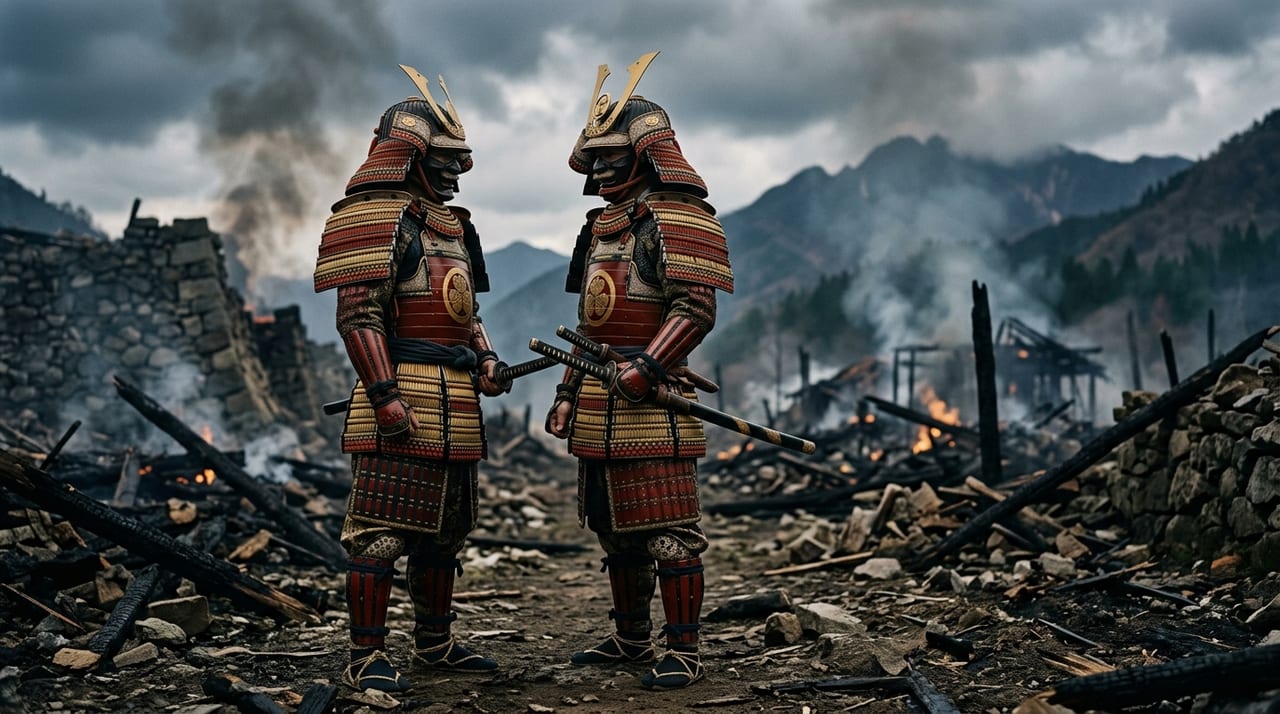
 * Image is for illustrative purposes only.
Asakura Yoshikage
朝倉義景
Lord of Echizen and Patron of Arts
Description
The Glory of the Asakura Clan
Asakura Yoshikage, born in 1533 in Echizen Province (present-day Fukui Prefecture), was the eleventh head of the Asakura family, a Sengoku daimyō house. As a Sengoku daimyō, he pursued governance that balanced learning and martial skill in Ichijōdani, a splendid cultural city. The Asakura family was a prestigious house that had gained control of Echizen Province after the Ōnin War. Many court nobles and cultural figures from Kyoto had settled in Ichijōdani, forming a cultural sphere of a sophistication rarely seen in an age of warfare. Yoshikage himself was a man of refined culture, well versed in renga, Nō, and the tea ceremony, and his cultural accomplishments made the arts bloom throughout his domain.
Deep Ties with the Shogunal House
Yoshikage's relationship with the shogunal house holds an important meaning in the political history of the Sengoku period. The fifteenth shogun, Ashikaga Yoshiaki, stayed for a time in Ichijōdani, relying on Yoshikage before Nobunaga took him up as a figurehead. Yoshikage treated this exiled shogun generously and sought to secure Echizen's standing by holding political influence backed by the authority of the shogunal house. However, Yoshikage was reluctant to take Yoshiaki up and march to the capital, and this prudence (or indecisiveness) became a distant cause of Yoshikage's undoing in his later confrontation with Nobunaga. His ties to the shogunal house brought Yoshikage honor, but they also became a shackle on his subsequent actions.
Confrontation with Nobunaga
In 1570 (Genki 1), Yoshikage and Azai Nagamasa of Ōmi allied to oppose Nobunaga. At the Battle of Anegawa, they were defeated by the combined forces of Nobunaga and Tokugawa, yet they continued to resist for several years afterward. Yoshikage's military talent was not necessarily great, but his tenacious resistance caused Nobunaga considerable distress. In 1572, an opportunity arose to drive Nobunaga into a situation of enemies on all sides, linked with Takeda Shingen's westward march. However, failing to make full use of this favorable chance was Yoshikage's greatest mistake.
A Tragic End
In 1573, when Nobunaga's great army invaded Echizen, Yoshikage's retainers defected one after another. Yoshikage tried to flee, abandoning Ichijōdani, but he was betrayed by his older cousin Asakura Kageakira and was driven into a corner at Kenshō-ji, where he took his own life. He was forty-one years old at the time of his death. With Yoshikage's death, Ichijōdani was burned by Nobunaga's forces, and the castle town that had enjoyed prosperity was reduced to ashes. The ruins of Ichijōdani are now designated as a Special Historic Site, and excavation research is gradually revealing the full picture of the city culture of the Sengoku period.
Cultural Legacy
The culture of Ichijōdani that Yoshikage nurtured lived on in the spirits of the people who lived there, even when the castle town was engulfed in flames. Court nobles, cultural figures, and craftsmen who were scattered from Ichijōdani spread the culture of Kyoto in the places they fled to. As a figure, Yoshikage may not have come close to Nobunaga in military strategy, but his deep affection for culture and the arts was genuine. The Ichijōdani culture that blossomed under his patronage is eternally inscribed in the history of Japan's Sengoku culture.