New Arrivals — Browse our catalog for the latest authentic Japanese sword arrivals. Browse →
30 September 1571 (Genki 2, 9th month, 12th day)
Enryakuji Temple Complex, Mount Hiei, Ōmi Province (present-day Ōtsu City, Shiga Prefecture); also Hiyoshi Taisha and Sakamoto at the mountain's base
Forces
Oda Nobunaga's Forces (Attacking)
Enryakuji Temple and Mount Hiei Inhabitants
About 13 min read
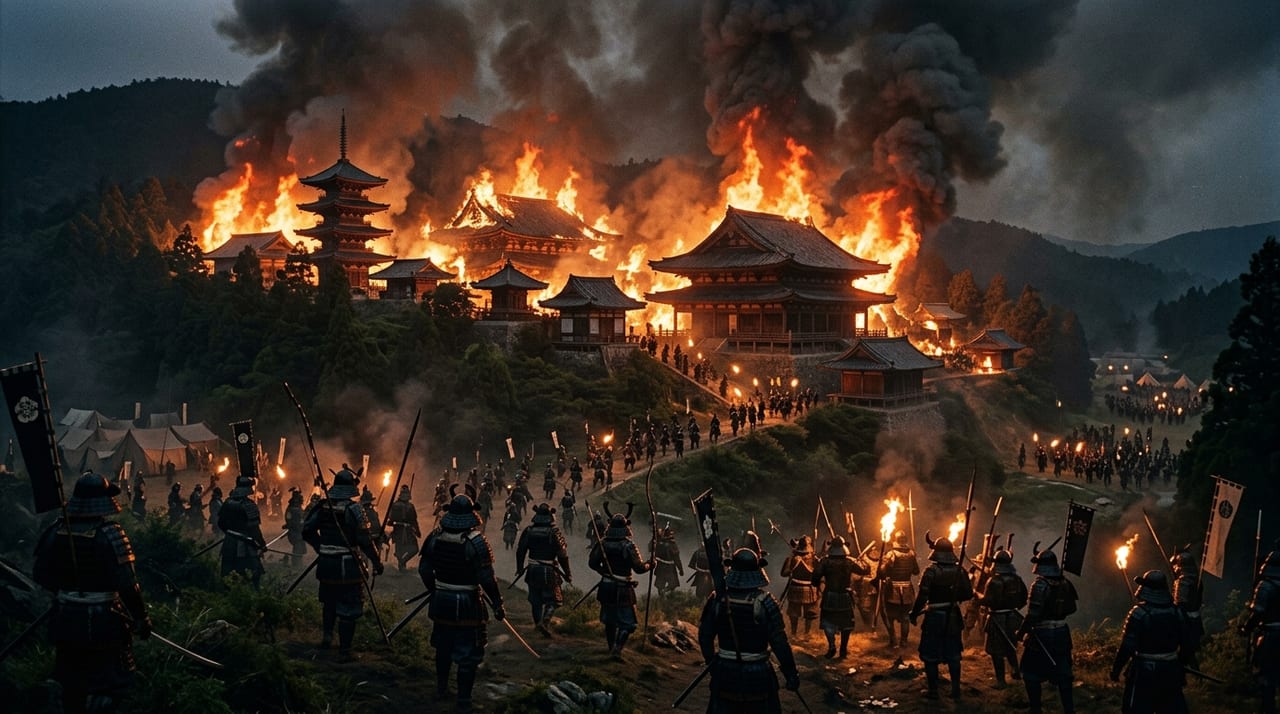
On the 12th day of the 9th month of Genki 2 (30 September 1571), Oda Nobunaga ordered a full-scale assault on Mount Hiei in Ōmi Province (present-day Ōtsu City, Shiga Prefecture). On that day, Enryakuji, the supreme seat of learning in Japanese Buddhism that was also called a “sacred precinct,” had its temple complex, including the Konpon Chūdō (Main Hall), set on fire. The halls, monks' quarters and the town at the foot of the mountain were reduced to ashes, and monks and laypeople who failed to escape were killed regardless of sex or age. The death toll is reportedly several thousand according to the Shinchō Kōki, and about 1,500 according to the letters of Luis Frois.
The burning of Mount Hiei fundamentally transformed the relationship between religion and power in Japanese history. It was also a historic moment in which the “logic of martial force,” symbolized by the Japanese sword, collided head-on with the concept of the “sacred precinct.”
Enryakuji on Mount Hiei was founded by Saichō (posthumously known as Dengyō Daishi) in Enryaku 7 (788), and later became the head temple of the Tendai school, a center of Japanese Buddhism. From the Heian period into the medieval period, Enryakuji enjoyed a privileged position as a “sacred precinct” that neither the imperial court nor the shogunate could easily touch.
However, this “sacred precinct” was not sustained by religious authority alone. Enryakuji had an armed monastic body known as the shuto (assembly monks) and dōshu (hall monks), often called sōhei (warrior monks) or yamabōshi (mountain monks). At times, they carried portable shrines (mikoshi) and made forceful petitions (gōso) to the imperial court and the shogunate, using force to get their demands accepted.
Even in the Sengoku period, Enryakuji was not entirely outside the secular world. When Asai Nagamasa and Asakura Yoshikage were resisting Nobunaga, Enryakuji admitted their forces onto the mountain and gave them protection. This amounted to a military confrontation with Nobunaga, and he demanded that Enryakuji “remain neutral, or else accept the consequences.” The temple refused.
Nobunaga's attitude toward Mount Hiei cannot be explained by military rationality alone. He was known in his own time as a man who “feared neither gods nor Buddhas,” and he fundamentally detested religious power interfering in secular politics and warfare.
In Genki 1 (1570), during the Shiga Campaign, the combined forces of Asai and Asakura took refuge on Mount Hiei, and Enryakuji was in effect treated as an enemy of Nobunaga. Nobunaga warned that he would “burn the mountain.” The temple, however, relied on the age-old intimidation that “if one attacks a sacred precinct, divine punishment will fall,” and did not take realistic measures.
This was a serious misjudgment. For Nobunaga, “divine punishment” did not serve as a deterrent.
On the 12th day of the 9th month of Genki 2 (30 September 1571), Nobunaga's forces first set fire to the areas around Sakamoto and Katata, and used that as a signal to advance up Mount Hiei. Akechi Mitsuhide made preparations for the attack, such as winning over local Ōmi samurai, and was also entrusted with postwar administration.
The Shinchō Kōki records the events of that day in detail. It states that, beginning with the Konpon Chūdō and the Sannō Nijūichisha (Twenty-One Shrines of Sannō), the halls and sutra scrolls were burned, leaving “not a single building left standing.” It also says that, without distinction among monks, laypeople, children, learned men or eminent priests, each person was beheaded and the heads were presented for Nobunaga's inspection. However, archaeological excavations have indicated that the only buildings that can clearly be said to have burned in this attack were the Konpon Chūdō and the Daikōdō (Great Lecture Hall), and there is also an argument that many of the other halls had already fallen into ruin before then.
The burning of Mount Hiei was also recorded with shock by Christian missionaries of the same era, such as Frois. The court noble Yamashina Tokitsugu wrote in his diary of “the destruction of the Buddhist Law,” and the court record Oyudono no Ue no Nikki also noted it as “something beyond the power of the brush to describe.”
Akechi Mitsuhide led the forces in the Ōmi area during the burning of Mount Hiei. He was one of the commanders who carried out the burning and massacre on the mountain in person.
What Mitsuhide felt about his role at Mount Hiei when he later attacked Nobunaga in the Honnō-ji Incident of Tenshō 10 (1582) is unknown. However, the duality of Mitsuhide as one who “carried out the burning of Enryakuji” and as one who “later killed his lord” has stirred the imagination of many historians and novelists.
From the perspective of swords, Mitsuhide's relationship with blades is also intriguing. Various theories exist about the swords Mitsuhide used in the Honnō-ji Incident, or that were involved when he struck down Nobunaga. In any case, a tense thread runs through Mitsuhide's life as a sword-bearing warrior, from the burning of Mount Hiei to the Honnō-ji Incident.
The impact of the burning of Mount Hiei on Japanese history goes beyond the mere “destruction of a religious facility.” The incident marked a turning point in the following respects.
First, the medieval premise that “religion transcends secular power” collapsed. For centuries, Enryakuji had exercised substantial political power while shielding itself behind the “authority of gods and Buddhas.” By nullifying that “shield,” Nobunaga forced Japan's religious power to accept a new subordinate relationship to secular power.
Second, “exemplary violence” was established as a political tool. Together with the extermination of the Nagashima Ikkō-ikki in 1574 (nekiri, or the massacre of the entire population), the burning of Mount Hiei embodies the methodology of Nobunaga's “rule by terror.” It became a precedent for the violent aspect of the “unification of the realm” later carried on by Toyotomi Hideyoshi and Tokugawa Ieyasu.
From the standpoint of sword culture, the burning of Mount Hiei is remembered as a symbolic incident in which “the sword invaded a sacred precinct.” The Japanese sword is also a symbol of “those who protect”: swords dedicated to shrines and temples also served to guard the sanctity of those places. When Nobunaga burned Enryakuji, there should have been dedicated swords on the mountain, but many of them were consumed by the flames. In this sense as well, the burning of Mount Hiei is a turning point in the history of the sword: the moment when the Japanese sword shifted from a symbol of “protecting the sacred” to a “tool of power that invades the sacred.”
Oda Nobunaga
Oda Nobunaga — ordered the burning of Mount Hiei, destroying over a thousand years of sacred history in one night
Akechi Mitsuhide
Akechi Mitsuhide — commanded the Ōmi sector of the Hiei operation; later killed Nobunaga at Honno-ji
Shibata Katsuie
Shibata Katsuie — Nobunaga's senior general who participated in the Hiei operation
Asai Nagamasa
Asai Nagamasa — Nobunaga's brother-in-law turned enemy, whose forces sheltered on Hiei and helped trigger the burning
Asakura Yoshikage
Asakura Yoshikage — allied with Asai, sheltered on Hiei, one of the causes of the burning