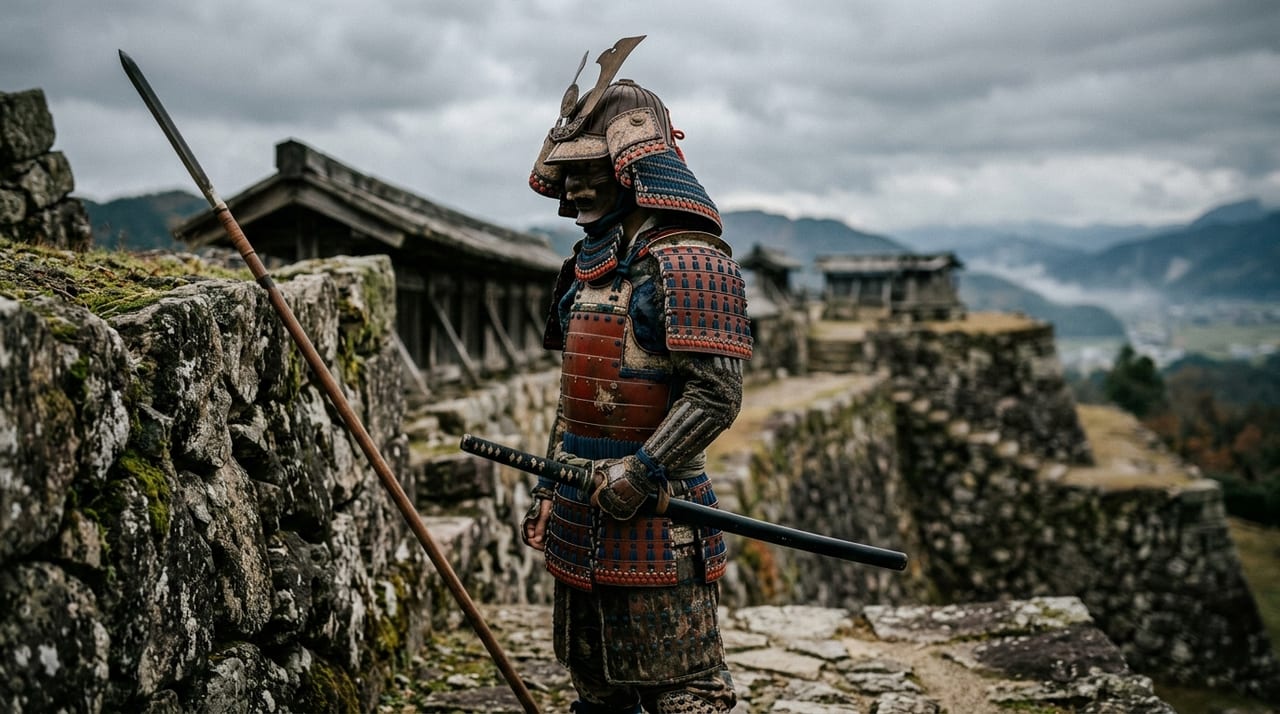
 * Image is for illustrative purposes only.
Asai Nagamasa
浅井長政
The Young Lord of North Ōmi Who Chose Honor Over Alliance — The Tragedy of Odani Castle
Description
The Young Warlord of Northern Ōmi
Born in Tenbun 14 (1545) as the eldest son of Asai Hisamasa, whose base was Ōmi Province (present-day Shiga Prefecture), Asai Nagamasa succeeded his father at a young age and rose to prominence as a brilliant lord who became the dominant power in northern Ōmi. Nagamasa succeeded to the headship in Eiroku 3 (1560), when he was around fifteen years old. Despite succeeding as a child, he quickly demonstrated leadership, showing early political boldness by forcing his father Hisamasa into retirement and seizing actual power.
Alliance with Nobunaga and Lady Oichi
The date varies according to different accounts, but Nagamasa took Oda Nobunaga's younger sister, Lady Oichi, as his principal wife, and an alliance between Nobunaga and Nagamasa was formed. This alliance held significant meaning on the political map of the time, and Nagamasa supported Nobunaga's march to Kyoto in Eiroku 11 (1568), contributing to Ashikaga Yoshiaki's installation as shogun. Although this marriage was a political arrangement, it is said that a deep affection grew between Nagamasa and Oichi. The couple had three daughters (Chacha, later Yodo-dono, Hatsu, and Gō), and these three sisters would leave a major mark on later Japanese history.
Loyalty to the Asakura and Break with Nobunaga
In Genki 1 (1570), when Nobunaga attacked Asakura Yoshikage of Echizen, Nagamasa put his long-standing alliance obligations to the Asakura first, betrayed Nobunaga, and struck at the rear of Nobunaga's forces together with the Asakura. This decision is highly praised by later generations as an act of “upholding righteousness,” while in practical terms it meant a break with Nobunaga and became a decision that greatly determined the fate of the Asai house. An anecdote recorded in the Asakura-kaki tells that when Nagamasa broke the alliance with Nobunaga, Lady Oichi sent Nobunaga a bag of azuki beans tied at both ends to his camp, warning him of the danger of a pincer attack. It is considered a later fabrication, but it has been passed down as a moving tale showing the bond between Oichi and her brother Nobunaga.
The Battle of Anegawa and Strategic Hardship
In the 6th month of Genki 1 (1570), the combined forces of Nobunaga and Tokugawa Ieyasu clashed with the combined forces of Nagamasa and the Asakura at the Anegawa River (near present-day Nagahama in Shiga Prefecture). In this battle Nagamasa's forces fought bravely against the Oda army and at first showed momentum that pressed toward Nobunaga's main camp, but in the end they could not break the core of Nobunaga's army, and the Nagamasa-Asakura alliance was defeated. After the Battle of Anegawa, Nagamasa, though suffering under the pincer attack of Nobunaga and Ieyasu, continued to resist Nobunaga's cruel strategies, including the burning of Mount Hiei. Even after the burning of Mount Hiei in Genki 2 (1571), Nagamasa continued to resist together with the Asakura.
Fall of Odani Castle and Final Days
In Tenshō 1 (1573), when Asakura Yoshikage was defeated by Nobunaga and took his own life, Nagamasa's isolation became complete. In the 8th month of the same year, when Nobunaga's great army surrounded Odani Castle, Nagamasa continued to defend the castle to the end, even as the garrison fell one after another in battle. On the 1st day of the 9th month, Nagamasa, exhausted before Nobunaga's all-out assault, took his own life at the young age of twenty-nine. At that time, Lady Oichi escaped the castle with her three daughters (Chacha, Hatsu, and Gō) and was sent to Nobunaga. In the 1st month of Tenshō 2 (1574), the skulls of Asakura Yoshikage, Asai Hisamasa, and Nagamasa, prepared as hakudami (lacquer applied with gold powder), were reportedly served at an intimate banquet of Nobunaga's, according to the Shinchō Kōki.
Favored Swords and the Weapons Culture of the Asai House
As for the swords Nagamasa owned, they are thought to have consisted mainly of works by Ōmi smiths handed down in the Asai house. Ōmi was a region with active exchange with smiths of the Yamashiro-den and Mino-den traditions, and in Nagamasa's era, practical uchigatana of the Mino-den tradition (the smiths of Seki) were widely favored among warlords. It is also thought that works by smiths of Owari and Mino, which came in during the period of the alliance with Nobunaga, were added to the Asai house's armory.
The Surviving Sisters and the Chain of History
After Nagamasa's death, the fates of Lady Oichi and her three daughters traced a historical course worthy of special mention even within Japanese history. Chacha became Toyotomi Hideyoshi's concubine, Yodo-dono, bore Toyotomi Hideyori, and was deeply involved in the fate of the Toyotomi house. Hatsu married Kyōgoku Takatsugu, Gō became the wife of Tokugawa Hidetada, and Gō's daughter, Masako (Tokugawa Masako), became the empress consort of Emperor Go-Mizunoo. In this way, the bloodline of Asai Nagamasa was woven into the histories of both the Toyotomi and Tokugawa houses, and it would appear again and again at important junctures of Japanese history. Nagamasa's life, which ended at twenty-nine after he upheld his principles, was tragic, yet in terms of legacy for later generations it possessed a richness second to none.