New Arrivals — Browse our catalog for the latest authentic Japanese sword arrivals. Browse →
September 4–26, 1573 (8th day of the 8th month – 1st day of the 9th month, Tenshō 1)
Odani, Azai-gun, Ōmi Province (present-day Kohoku-chō, Nagahama City, Shiga Prefecture)
Forces
Oda Forces
Azai Forces (defenders)
About 8 min read
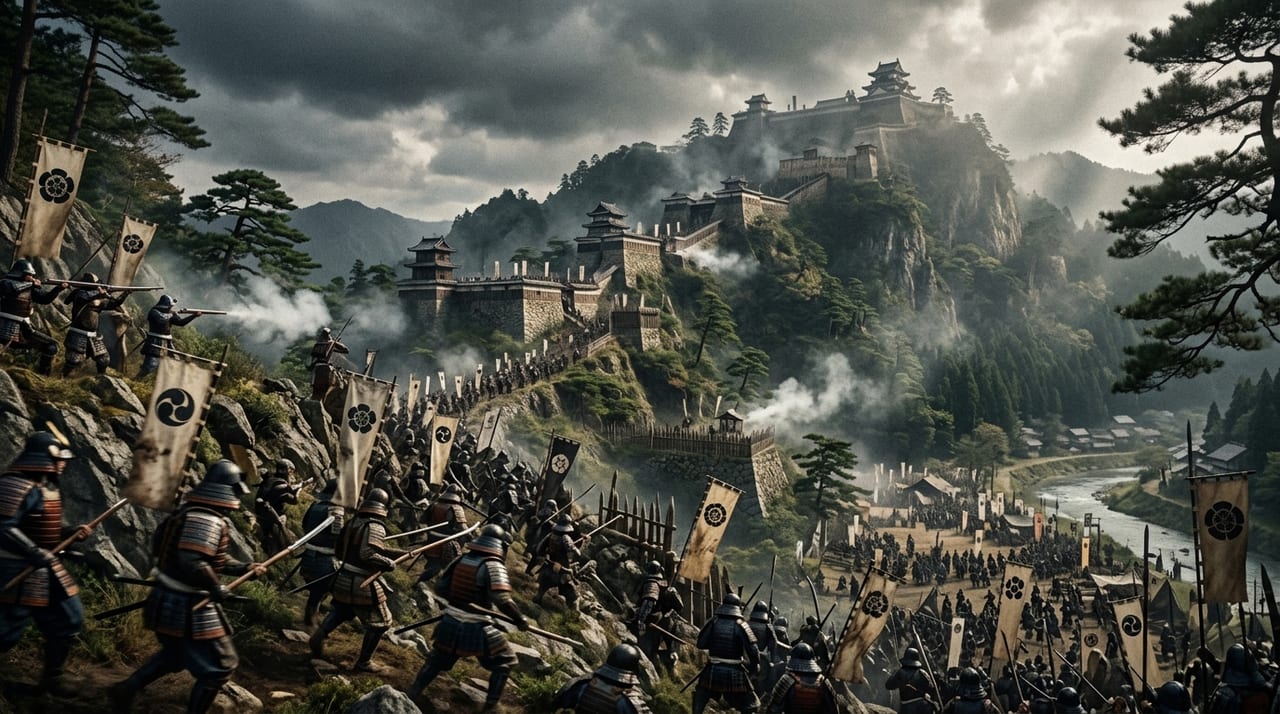
In the 8th month of Tenshō 1 (1573), Oda Nobunaga launched an all-out assault on Odani Castle, the seat of the Azai clan in northern Ōmi Province, forced Azai Nagamasa to take his own life, and destroyed the Azai clan. This 'Battle of Odani Castle' was a major turning point on Nobunaga's path to unifying the realm. By eliminating at once the Azai and Asakura clans, powerful forces in Ōmi and Echizen, it made Nobunaga's control of the Kinai firm and secure.
Odani Castle was a mountain castle built on Mount Odani (495 m in elevation) in present-day Kohoku-chō, Nagahama City, Shiga Prefecture. Making the fullest use of the natural steepness of the terrain, it was known as one of the strongest castles of the Sengoku period. The Azai clan had made this castle its base for three generations and had ruled northern Ōmi as its lord.
At first, the relationship between Azai Nagamasa and Oda Nobunaga was friendly. Nagamasa married Nobunaga's younger sister, Oichi (Oichi no Kata), and became Nobunaga's brother-in-law. But in Genki 1 (1570), when Nobunaga attacked Asakura Yoshikage of Echizen Province, Azai Nagamasa honored his old alliance with the Asakura clan and rose in revolt against Nobunaga. This led to the Battle of Anegawa in Genki 1 (1570), and from then on the combined Azai–Asakura forces and Oda forces clashed fiercely for three years.
After three years of fighting, in the 8th month of Tenshō 1 (1573), Nobunaga first defeated Asakura Yoshikage of Echizen Province (the Battle of Ichijōdani), and then turned to the all-out assault on Odani Castle. With the fall of the Asakura clan, Azai Nagamasa was completely isolated.
The one who played the central role in the capture of Odani Castle was Hashiba Hideyoshi, later known as Toyotomi Hideyoshi. Hideyoshi was entrusted by Nobunaga with the northern Ōmi area and commanded the encirclement and capture of Odani Castle. This achievement became the foundation for Hideyoshi later being granted northern Ōmi as his domain and building Nagahama Castle.
Odani Castle was a large mountain castle in which enclosures (kuruwa) such as the honmaru, Nakamaru, Kyōgoku-maru, Komaru, Sannō-maru, and Ōzuku extended along the ridgeline. On the 27th day of the 8th month, Hideyoshi made a surprise attack from the Shimizudani valley, seized Kyōgoku-maru, and cut off Nagamasa in the honmaru from Azai Hisamasa in Komaru. When Komaru, defended by his father Azai Hisamasa, was taken, Hisamasa took his own life. Nagamasa also continued to resist in the honmaru, but on the 1st day of the 9th month of Tenshō 1 (1573), he took his own life at the Akao residence (Akao-yashiki) in the sodeguruwa (wing enclosure) of the honmaru. He was 29 years old.
After the fall of Odani Castle, Nobunaga is said to have decorated the skulls of Azai Nagamasa, his father Azai Hisamasa, and Asakura Yoshikage with lacquer and gold leaf (hakudami), and displayed them at a drinking party with his umamawari (Nobunaga's mounted guards) the following year, in the first month of Tenshō 2 (1574), (the 'skull cup' (sharekōbe-sakazuki)). This act has long been described as a demonstration of Nobunaga's severity, but in recent years there has also been a reassessment holding that it had the meaning of mourning the enemy commanders.
The historical significance of the Battle of Odani Castle can be summarized in two points. First, with the simultaneous disappearance of the Azai and Asakura clans, powerful forces in the encirclement network against Nobunaga, Nobunaga's unification of the realm came within realistic reach. Second, Hideyoshi's achievements as administrator of northern Ōmi were recognized, and this became a 'stepping stone to advancement' for his later role as lord of Nagahama Castle.
Oda Nobunaga
Ordered and oversaw the siege, destroying his former brother-in-law Azai Nagamasa
Toyotomi Hideyoshi
Commanded the siege as northern Ōmi officer, launching his rise to Nagahama lordship
Akechi Mitsuhide
Served as Oda commander in Ōmi during the Azai-Asakura campaigns
Niwa Nagahide
Participated in the siege as one of Nobunaga's senior retainers
Asai Nagamasa
Lord of Odani Castle who died by suicide at the fall of his stronghold