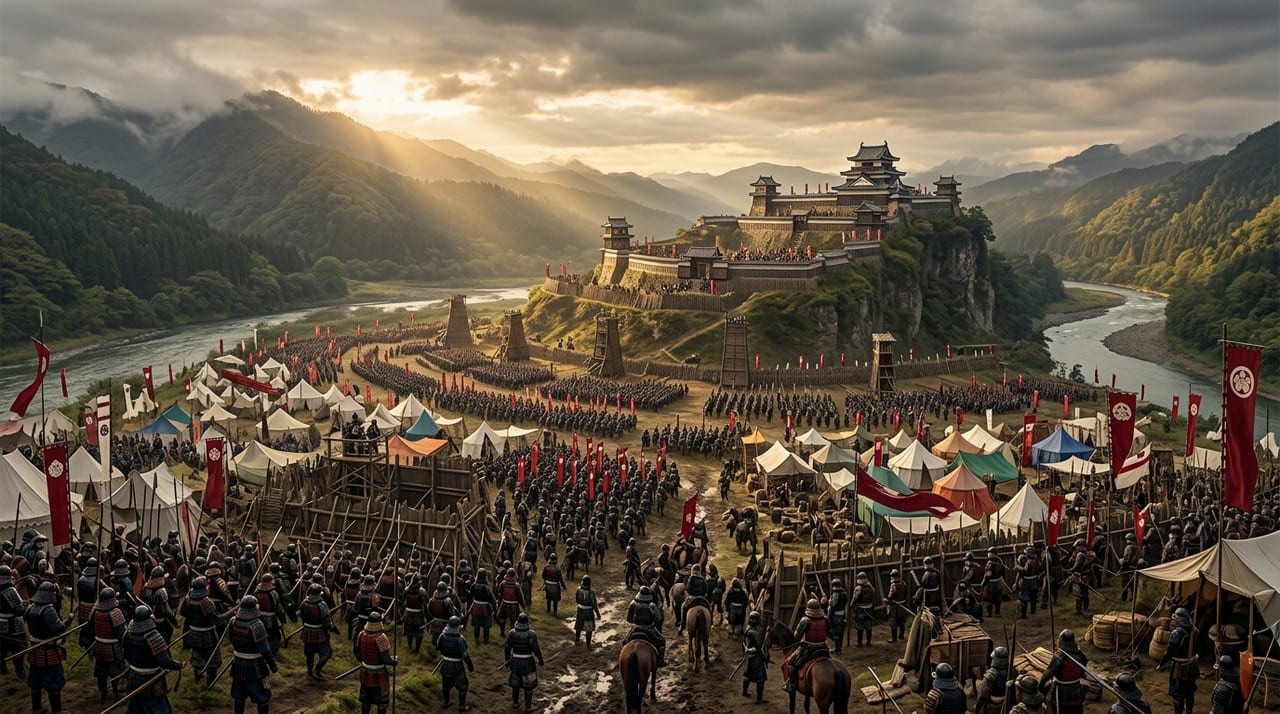
Battle of Ichijodani Castle — The Fall of the Asakura Clan
8th month, Tenshō 1 (1573)
Ichijodani, Echizen Province (present-day Kido-no-uchi, Fukui City, Fukui Prefecture)
- Date
- 8th month, Tenshō 1 (1573)
- Location
- Ichijodani, Echizen Province (present-day Kido-no-uchi, Fukui City, Fukui Prefecture)
- Result
- Overwhelming victory for the Oda forces. Asakura Yoshikage's seppuku and the extinction of the Asakura clan. The castle town of Ichijodani engulfed in flames.
Forces
Oda Forces
Asakura Forces
About 6 min read
The Battle of Ichijodani Castle was the final decisive battle between Oda Nobunaga and Asakura Yoshikage, fought in Echizen Province in the 8th month of Tenshō 1 (1573). This battle, which brought about the downfall of the Asakura clan that had ruled Echizen for over a century, marked the end of the Asakura family as a Sengoku daimyo.
Asakura Clan and Ichijodani
Since the Asakura clan established its seat at Ichijodani in Echizen (now Fukui Prefecture), its castle town developed into one of the leading cultural cities on the Sea of Japan coast. Successive Asakura heads, including Asakura Takakage and Yoshikage, placed importance on both martial arts and the arts of letters.
Collapse of the Anti-Nobunaga Coalition and the Asakura Clan's Plight
The anti-Nobunaga coalition, which had continued since Genki 1 (1570) — a broad alliance centered on the Azai and Asakura clans and joined by Hongan-ji, the Takeda, Mount Hiei and others — rapidly collapsed with the death of Takeda Shingen and the expulsion of Ashikaga Yoshiaki from Kyoto in Genki 4 (1573). Having lost the Takeda, its greatest backer, and with the authoritative backing of the Ashikaga shogunal house also gone, Asakura Yoshikage was driven into a desperate position alongside his ally Azai Nagamasa.
In the 8th month of Tenshō 1 (1573), Nobunaga invaded Ōmi and besieged Odani Castle, where Azai Nagamasa held out. Yoshikage marched out as a relief force and established camp on Mount Tagami, northwest of Odani Castle, where he defended by building the Ōzuku fort and other works. However, on the night of the 12th day of the 8th month, Nobunaga braved a storm and launched a surprise attack that captured the Ōzuku fort, and Yoshikage began his retreat to Echizen.
Defeat at Tonezaka and the Burning of Ichijodani
Yoshikage's retreat suffered a fatal blow at Tonezaka (now Tsuruga, Fukui Prefecture). Nobunaga personally led the pursuit, and in the Battle of Tonezaka on the 13th day of the 8th month, the Asakura army suffered a crushing defeat. Many of its officers and soldiers were killed. Yoshikage narrowly escaped with a handful of retainers and returned to Ichijodani, but he could no longer hold out, and on the advice of his clansman Asakura Kageakira, he fled to Ōno District.
The Oda forces attacked the abandoned Ichijodani on the 18th day of the 8th month. The castle town, which had boasted a century of prosperity, was turned into a sea of flames, and many buildings, from the lord's residence to temples and shrines, were burned to the ground. Remains excavated today as the Ichijodani Asakura Family Historic Ruins (a national Special Historic Site and Special Place of Scenic Beauty) have revealed traces of the advanced craftsmanship of the time, and its sudden end is especially regretted.
Yoshikage's Death
Cornered, Asakura Yoshikage was betrayed by his trusted clansman Asakura Kageakira, who revealed his whereabouts, and on the 20th day of the 8th month he took his own life at Rokubō Kenshō-ji. He was 41 years old. Many of Yoshikage's blood relatives, including his eldest son Aiōmaru, were also killed, and the Asakura clan as a Sengoku daimyo was destroyed.
Ichijodani Asakura Family Historic Ruins
Full-scale excavation of the Ichijodani Asakura Family Historic Ruins began in 1967, and research continues today to uncover the full picture of the castle town in its heyday.