New Arrivals — Browse our catalog for the latest authentic Japanese sword arrivals. Browse →
April 25, 1581 (22nd day, 3rd month, Tenshō 9)
Takatenjin Castle, Tōtōmi Province (present-day Hijikate, Kakegawa City, Shizuoka Prefecture)
Forces
Tokugawa Ieyasu's Forces (Besieging Army)
Takeda Katsuyori's Forces (Garrison)
About 20 min read
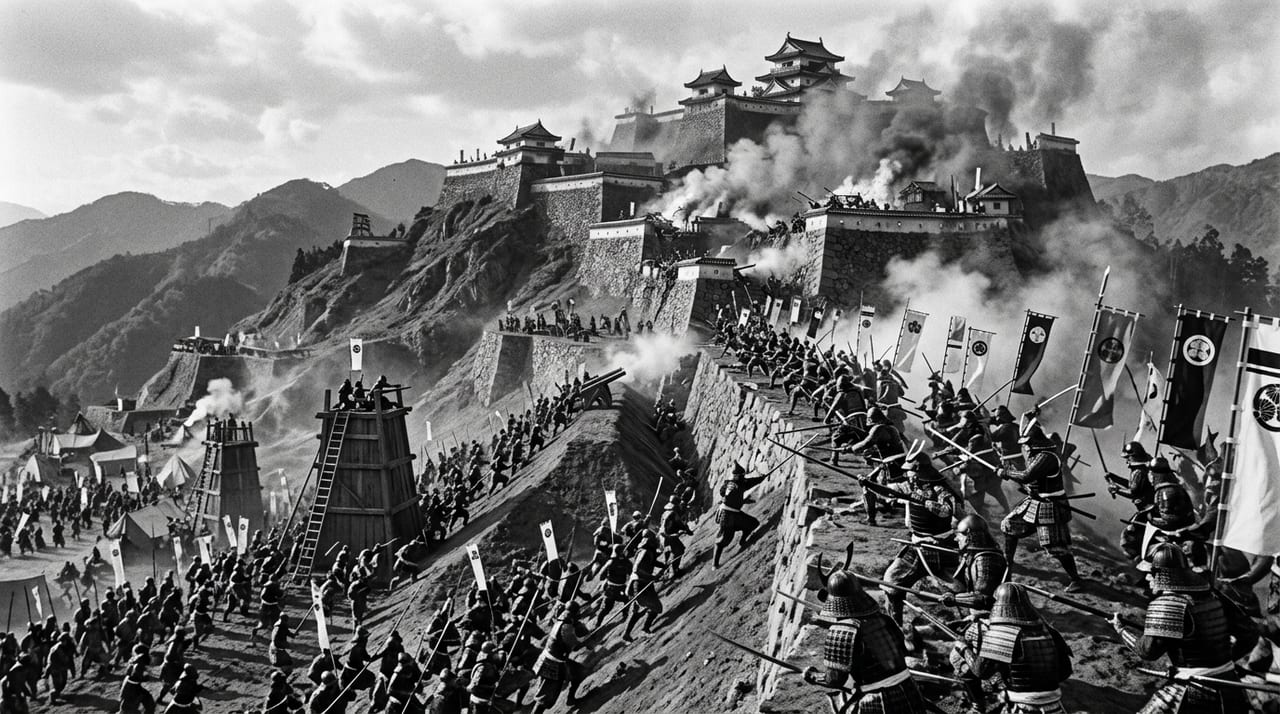
On the 22nd day of the third month of Tensho 9 (1581), Takatenjin Castle in Tōtōmi Province (present-day Kakegawa City, Shizuoka Prefecture) fell to the armies of Tokugawa Ieyasu. This "Siege of Takatenjin Castle" is inscribed in Japanese Sengoku history as a decisive turning point toward the extinction of the Takeda clan—the foremost daimyo dynasty trained under Takeda Shingen. The anguish of Takeda Katsuyori, unable to defend Takatenjin Castle, combined with the retainers' despair that relief forces never came—these accumulated grievances triggered the Takeda clan's total annihilation (Battle of Tenmokuzan) in the following year, Tensho 10 (1582).
Takatenjin Castle was a mountain fortress built atop the sheer cliffs of Tōtōmi Province (present-day Shizuoka), and from its forbidding terrain came the saying: "Whoever masters Takatenjin masters Tōtōmi." It was a strategic strongpoint of vital importance. The castle was centered on the main citadel built on Takatenjin Mountain (approximately 132 meters in elevation), with multiple baileys strung along steep ridges, making frontal assault virtually impossible.
In Tensho 2 (1574), Takeda Katsuyori, heir to Takeda Shingen, captured this castle. His defeat of the previous lord Ogasawara Nagatada and seizure of Takatenjin demonstrated the continuation of his father Shingen's hegemon's legacy. The garrison commander who later took charge of the castle was Okabe Motonobu, known as a former Imagawa retainer and a fierce warrior who carried with him an unwavering sense of mission to defend Takatenjin to the end.
For Takeda Katsuyori, the Takatenjin problem became acute due to the decisive defeat at the Battle of Nagashino in Tensho 3 (1575). At Nagashino, Katsuyori's forces suffered a catastrophic blow from the combined armies of Oda Nobunaga and Tokugawa Ieyasu, who deployed massed rifle positions at Shidaragahara. The loss of three of the "Takeda Four Heavenly Kings"—Baba Nobuharu, Naitō Masatoyo, and Yamagata Masakage—along with Hara Masatane and others in the Nagashino rout meant the decimation of the Takeda's elite forces and a decisive decline in their military power.
After Nagashino, the Takeda were forced into a defensive posture against Nobunaga and Ieyasu's offensive. From around Tensho 7 (1579), Tokugawa Ieyasu adopted a strategy of blockade, constructing multiple subsidiary forts around Takatenjin to sever supply lines. With Nobunaga's support, Ieyasu fortified siege camps on all sides of the castle, completely cutting off any transport of provisions from Takeda territory.
Tokugawa Ieyasu's strategic patience inflicted the cruelest suffering on Takeda Katsuyori. Rather than storm the castle, Ieyasu chose to methodically tighten the siege net. Around Takatenjin, the "Six Forts of Takatenjin"—Ogasayama Fort, Nogasaka Fort, Higamine Fort, Shishigahana Fort, Nakamura Fort, and Mitsuiyama Fort—and many other forts and subsidiary castles were constructed, and all transport of provisions into the castle was completely severed.
Katsuyori considered dispatching relief forces many times, but ultimately lacked the resolve to break through the combined might of Nobunaga and Ieyasu. By the third month of Tensho 9 (1581), provisions within the castle were exhausted, and the garrison was driven to the extremity of subsisting by chewing on grass and bark. Repeated envoys from Okabe Motonobu arrived begging Katsuyori for relief, but Katsuyori could not move.
In Takeda Shingen's time, there would have been absolute faith that "Lord Shingen will surely come to our aid." But confidence in Katsuyori, diminished after the great defeat at Nagashino, had already begun to waver. The reality that "relief will not come" accelerated the retainers' loss of faith, and this in turn created a vicious circle that rendered Katsuyori's decision-making even more impossible.
Earlier, in the first month of Tensho 9 (1581), Okabe Motonobu pleaded for the lives of the garrison in exchange for the surrender of Takisakai Castle and Koyama Castle, but the surrender was rejected on Nobunaga's orders. On the night of the 22nd day of the third month of Tensho 9 (1581), with provisions exhausted, the garrison under Motonobu broke out of the castle and charged into the encampment of Ishikawa Yasumichi of the Tokugawa army. Motonobu and most of the garrison were cut down, and Takatenjin Castle fell.
The final moments of Okabe Motonobu are recorded in the Mikawa Monogatari by Ōkubo Tadataka (Hikozaemon), a Tokugawa retainer, who writes that Tadataka himself struck the first blow and his retainer Honda Mondo took the head. The great sword that Motonobu wore at his side must have been a worthy blade befitting a senior Takeda retainer, but its fate was lost in the confusion of the castle's fall. Yet Motonobu's death—a death endured while waiting for relief that never came—became a symbol passed down in later generations as the epitome of "absolute loyalty to one's lord" and "an honorable death" as understood in the way of the warrior.
The katana is the warrior's final redoubt. With supplies exhausted and relief forces absent, the garrison's final reliance was upon the swords at their waists. The fall of Takatenjin Castle is, quite literally, the scene of samurai fighting to their deaths wielding their blades, and it stands as a symbol of the tragedies of the Sengoku age.
When news of Takatenjin's fall reached the Takeda domains, the retainers' consternation was immeasurable. The fall of Takatenjin Castle, and the fact that Katsuyori could not send relief—these made the decline of Takeda military power evident to all.
The prestige of the "Tiger of Kai," which Takeda Shingen had built, did not pass to Shingen's own son Katsuyori. Because Katsuyori's mother was of the Suwa clan, there were aspects in which he was not treated as the rightful heir. Layered upon this were the great defeat at Nagashino and the abandonment at Takatenjin—these accumulated to sever the hearts of the Takeda retainers completely.
Among the blades transmitted through the Takeda, the most famous were several great swords associated with Takeda Shingen. After the fall of Takatenjin, as the Takeda clan moved toward extinction, most of the Takeda's swords were scattered.
In the year following the fall of Takatenjin, Tensho 10 (1582), the great armies of Oda Nobunaga and Tokugawa Ieyasu invaded Takeda territory. Senior retainers including Kiso Yoshimasa and Anayama Baisetsu defected in succession, and strongholds throughout the realm surrendered or capitulated one after another. Takeda Katsuyori retreated to Tenmokuzan in Kai Province (present-day Yamato Town, Kōshū City, Yamanashi Prefecture), where he took his own life (Battle of Tenmokuzan). The final moments of Takeda Katsuyori are recorded in detail in the Kōyō Gunkan, describing how he met his end alongside the small number of retainers who remained loyal to the end.
The trust lost at the Battle of Takatenjin was the essential cause of the Takeda extinction. No matter how impregnable a castle or formidable an army, when retainers lose faith in their lord, the organization of a Sengoku daimyo collapses. When the bond of loyalty symbolized by the Japanese sword—the spiritual contract of "divine favor and retainer service"—is broken, even the mightiest Sengoku dynasty walks the path to destruction. This battle at Takatenjin is remembered today as the symbol of how the legacy built by Takeda Shingen, "the mightiest general in Japanese history," crumbled through a single decision—the abandonment of relief efforts.
In the history of the sword, the many blades transmitted through the Takeda were scattered with the extinction of the Takeda clan. Yet when we consider the circumstances of that dispersal, it seems as if the spirits of the Takeda retainers who fell at Takatenjin continue to dwell in those blades.
Kai Province (present-day Yamanashi), ruled by Takeda Shingen, was not a major center of sword production, yet the Takeda were renowned as collectors and connoisseurs of superior blades. Among the celebrated swords transmitted through the Takeda family, there were several great blades referred to as "Lord Shingen's treasured swords."
Yamamoto Kansuke, the military strategist of Shingen, is recorded in detail in the Kōyō Gunkan and is portrayed as an intellectual warrior who sustained the tactics of Shingen's armies. Few records survive of swords associated with Kansuke, but it is not difficult to imagine that as a strategist, he selected practical blades for his use.
Baba Nobuharu, one of the Takeda Four Heavenly Kings, was a tragic warrior who fell at the Battle of Nagashino. The beloved swords of Baba Nobuharu are transmitted through later legend, and the blades of this warrior, known as "the Immortal Demon of Mino," are remembered as symbols of the pride of Takeda warriors. Okabe Motonobu, who fell at Takatenjin Castle, must likewise have worn swords befitting his station as a senior retainer of the Takeda, yet the fate of those blades was lost in the darkness of history.
After the defeat at Nagashino, the Takeda's military power declined rapidly, yet the cultural tradition of collecting and maintaining celebrated blades was sustained. But with the Takeda extinction in Tensho 10 (1582), many of the celebrated blades of the Takeda were scattered. Today, the many blades transmitted as relics of the Takeda have been preserved to the present day through this complex historical progression.
After Takatenjin Castle fell and the Takeda clan was extinguished, Tokugawa Ieyasu actively recruited the former retainers of Takeda Shingen and Katsuyori to pacify the warriors of Kai and Shinano. The military tradition of the Takeda—the strategy known as "Kōshū School military science," Shingen's principles of warfare—was absorbed by the Tokugawa and applied to the military organization of the Edo shogunate.
From the perspective of the fate of Takeda blades, the swords worn by those who fell at Takatenjin were likely confiscated as spoils of war by Tokugawa soldiers after the castle's fall. Following the custom of the Sengoku age of "seizing the sword together with the head of the slain," Okabe Motonobu's beloved blade may well have passed into the hands of a Tokugawa general. The concept of "transmission" in the Japanese sword is formed through such complex history—including the transfer of ownership that occurs on the battlefield.
In the present day, Takatenjin Castle is selected as one of the "Continued Top 100 Japanese Castles" (Zoku Nihon 100 Meijō), and its ruins can be visited. When one stands upon this mountain fortress in Kakegawa City and gazes out at the vast plains of Tōtōmi below, the presence of the castle garrison who gave their lives there more than 440 years ago becomes vividly real. If the Japanese sword is truly the "soul of the warrior," then Takatenjin Castle is one of the historic stages where that soul was finally enshrined, a place to be long remembered.
Takeda Katsuyori
Takeda Katsuyori — unable to relieve Takatenjin, his failure led directly to the Takeda clan's destruction
Tokugawa Ieyasu
Tokugawa Ieyasu — constructed the encirclement that starved Takatenjin into submission
Oda Nobunaga
Oda Nobunaga — supported the siege and destroyed the Takeda clan the following year
Baba Nobuharu
Baba Nobuharu — veteran Takeda general killed at Nagashino, representing the Takeda retainers who fell at Takatenjin