 * Image is for illustrative purposes only.
Fudō Masamune
不動正宗
Also known as: Fudō; the sword of Fudō Myōō; heirloom of the Owari Tokugawa family
Description
Overview of the Blade
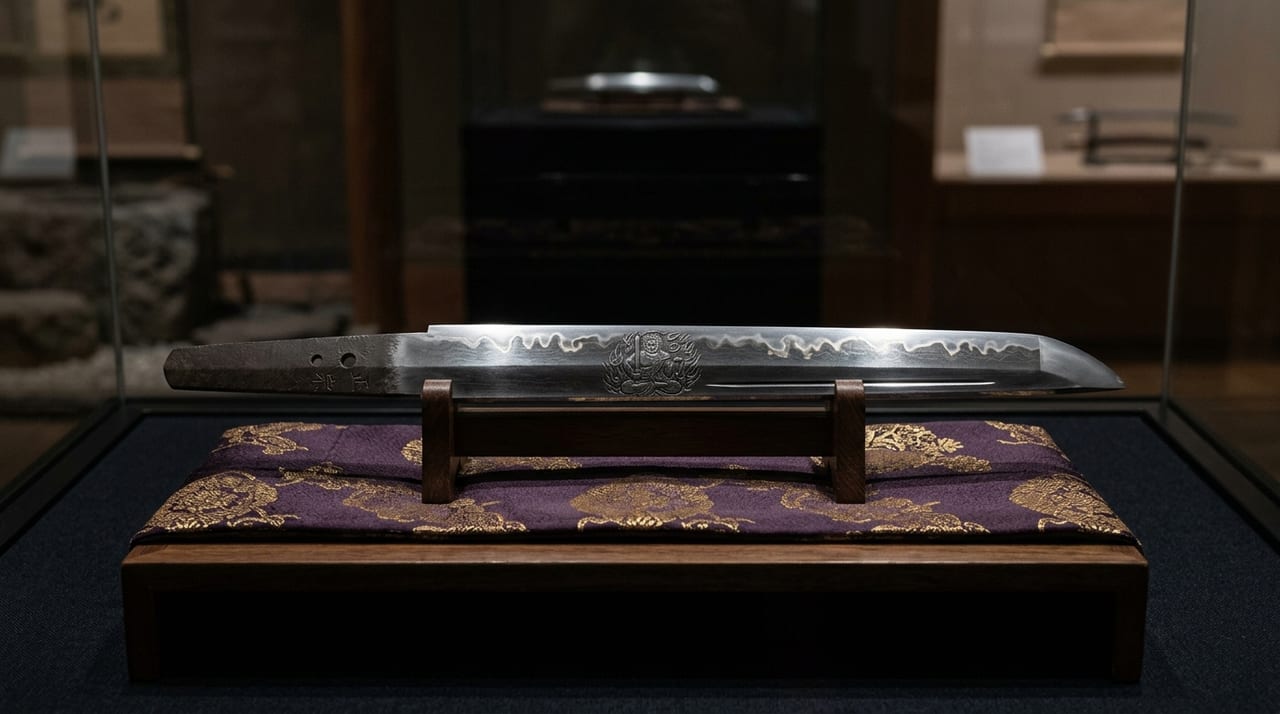
Fudō Masamune is a masterpiece tantō forged by Sōshū Masamune (Okazaki Gorō Nyūdō Masamune), who is regarded as the greatest swordsmith in the history of Japanese swords. It is a celebrated meibutsu (famous treasure) of the realm, passed down to the Owari Tokugawa family. Its name comes from the image of Fudō Myōō carved in relief on the front (omote) of the blade. Fudō Myōō is one of the most important Myōō in esoteric Buddhism, a wrathful deity who saves living beings by burning away all earthly desires and obstacles. Because the blade bears this carving, it carries a meaning beyond that of a mere weapon, that of a protector of the Dharma. Together with the designation 'Fudō Masamune,' it was placed among the foremost meibutsu in the world of swords.
The Smith and the Peak of Sōshū Masamune
Masamune (Okazaki Gorō Nyūdō Masamune) was a smith of Sōshū active in the late Kamakura period. He is an unrivaled master whom smiths of nearly every later era regard as the pinnacle of Japanese swordsmithing. Masamune achieved unprecedented technical innovation in both the jigane (steel base) and the hamon (temper line). His blades are known for the pinnacle of 'nie-deki,' in which a fine jigane is overlaid with intensely boiling hamon. Chikei (ground lines), kinsuji (gold lines), and sunagashi (sand-flow patterns) interweave in complex ways, unfolding a profound landscape across the blade, like a nebula in the universe. As the foremost of the Tenka Sansaku (the Three Great Masters of the realm: Masamune, Yoshimitsu, and Yoshihiro), Masamune's name has become synonymous with Japanese swords. Fudō Masamune has been valued as the supreme example among Masamune's works, in which a carving with protective meaning is united with the highest standard of forging.
The Significance of the Carving
The carving of Fudō Myōō on Fudō Masamune is not mere decoration but has deep religious and philosophical meaning. Achalanātha (Fudō Myōō in Sanskrit) means 'the Immovable One,' a being who protects without being swayed by any temptation or hostility. This resonates deeply with the ideal mental state in the bushidō tradition: the ability to keep one's composure in any crisis and to make the best judgment and take the best action without being shaken. Yamaoka Tesshū spoke of the spirit of 'Ken Zen Ichinyo' (the unity of sword and Zen). Miyamoto Musashi taught in the Gorin no Sho the strike of 'munen musō no uchi' (a strike without thought or form). Takuan Sōhō transmitted the Fudōchi Shinmyōroku to Yagyū Munenori. All of these correspond to the 'immovable wisdom' of Fudō Myōō. Carving Fudō Myōō on a sword expressed the wish that the person who wears it would embody the 'immovable spirit,' and it was also an expression of faith that sought to imbue the blade with the protective power of Fudō Myōō.
Transmission to the Tokugawa Family
Fudō Masamune is said to have been owned by Toyotomi Hidetsugu, Tokugawa Ieyasu, and Maeda Toshiie. Later it came into the possession of Tokugawa Yoshinao, the first lord of the Owari Tokugawa family and ninth son of Ieyasu, and it was passed down within that family. The name 'Fudō Masamune' is also recorded in the Kyōhō Meibutsuchō, confirming its status as a meibutsu of the realm. It is now held by the Tokugawa Art Museum in Nagoya and is designated an Important Cultural Property.
The Form of the Tantō
Fudō Masamune is a tantō with a hira-zukuri (flat-sided) form, and its cutting edge measures about 24.9 centimeters. The jigane is forged in ko-itame (small burl grain), and in places darker patches appear mixed in, with jinie (ground boiling) across the entire surface. The hamon is notare (undulating) mixed with gunome (choji-like waves). Nie is well formed, and from the monouchi (striking zone) upward, kinsuji, inazuma (lightning), and sunagashi appear with particular intensity. The 'nebula-like landscape' common to Masamune's blades unfolds magnificently on this Fudō Masamune as well. The nakago is ubu (unshortened tang), and the Masamune signature is cut clearly with a fine chisel. On the front, Fudō Myōō is carved in relief within the hi (groove) near the base, and on the reverse a goma-bashi (fire-ritual stick) is carved. These fine carvings, imbued with protective meaning, further elevate the spiritual dignity of the blade.
Legends & Stories
Fudō Myōō and the Spirit of the Blade
The image of Fudō Myōō carved on Fudō Masamune has a deep symbolism where the esoteric Buddhist worldview and the spirit of bushidō intersect. Its Sanskrit name is Achalanātha, meaning 'Immovable Protector.' In his right hand he holds a sword (kurikara-ken), in his left a rope (kensaku), and he is surrounded by flames (karura-en). This form represents a being who burns away all earthly desires and obstacles, yet never abandons compassion toward those he must protect.
There are several overlapping meanings in a warrior carving Fudō Myōō on a sword. First is the meaning as a talisman: a prayer for the protection of Fudō Myōō in battle. Second is the meaning as a spiritual teaching: a reminder to face battle with an 'immovable mind.' Third is the philosophical meaning: the ultimate of the sword is not 'defeating the enemy' but 'facing all things with an immovable mind,' an expression of the enlightenment about the sword shared by Zen and esoteric Buddhism.
Tokugawa Ieyasu and Masamune
Ieyasu kept several Masamune blades throughout his life. No words Ieyasu spoke when he first held Fudō Masamune have been transmitted. Fudō Masamune later came into the possession of Tokugawa Yoshinao, the first lord of the Owari Tokugawa family, and was passed down within that family.
Records in the Kyōhō Meibutsuchō
The Kyōhō Meibutsuchō, compiled during the Kyōhō era at the order of the eighth shogun Tokugawa Yoshimune, is a historical record that comprehensively documents the famous swords of the realm held by the Tokugawa shogunal family and the various daimyō houses at that time. That 'Fudō Masamune' is recorded in this register means that the tantō was firmly recognized as a 'famous treasure of the realm' throughout the Edo period. Swords recorded in the meibutsuchō are still valued today as evidence of the highest esteem, and the designation of Fudō Masamune as an Important Cultural Property extends from this historical recognition.