New Arrivals — Browse our catalog for the latest authentic Japanese sword arrivals. Browse →
September 29–30, 1600 (Keichō 5/8/22–23)
Gifu Castle, Atsumi District, Mino Province (present-day Kinkazan, Gifu City, Gifu Prefecture)
Forces
Eastern Army (Tokugawa faction)
Western Army (Ishida faction)
About 16 min read
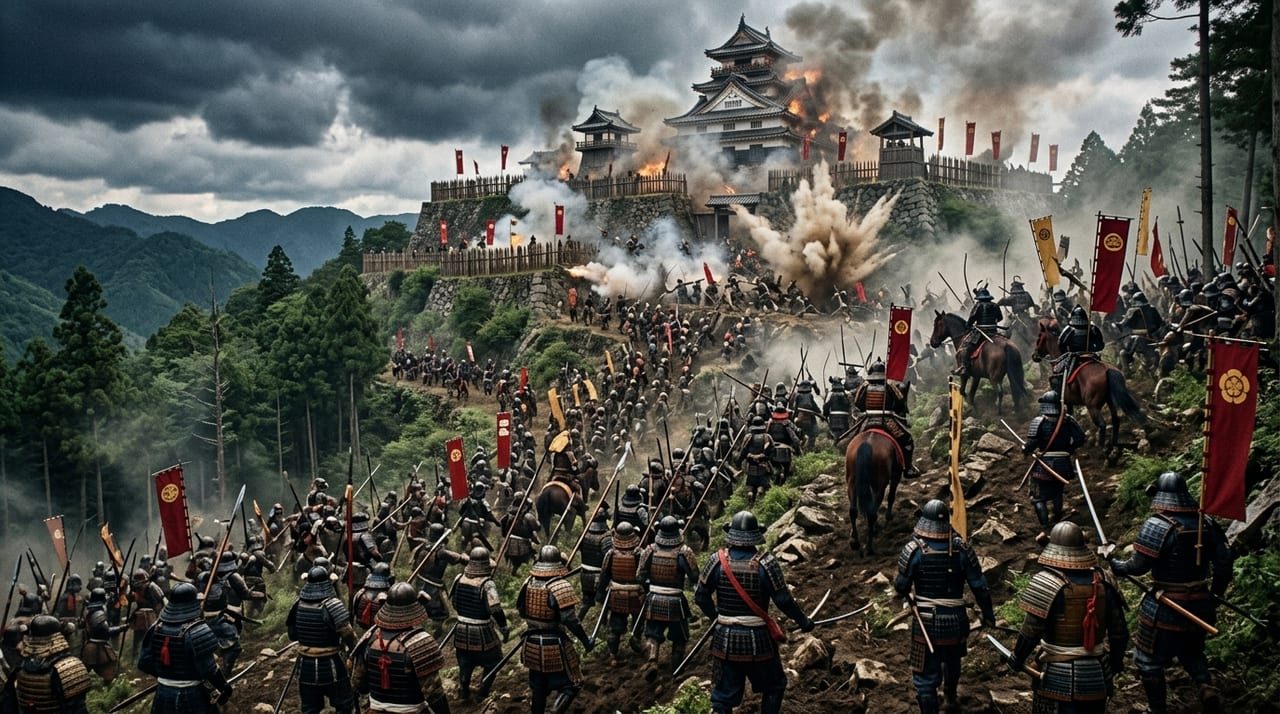
The Battle of Gifu Castle, fought at Gifu Castle in Mino Province (present-day Gifu City, Gifu Prefecture, on the summit of Mount Kinka) from the 22nd to the 23rd days of the 8th month of Keichō 5 (1600), was an important prelude to the decisive Battle of Sekigahara, which took place less than a month later. A large force led by Fukushima Masanori, Ikeda Terumasa and others of the Eastern Army (on the side of Tokugawa Ieyasu) attacked Gifu Castle, which had functioned as a base for the Western Army (on the side of Ishida Mitsunari), and captured it in just two days. This swift victory carried major strategic significance that would shape the course of the main Battle of Sekigahara. It is also a battle that epitomizes the late Sengoku period, because a famous castle that Oda Nobunaga built as the base of his "Tenka Fubu" became its final battlefield, a historical irony.
Oda Hidenobu, the commander of Gifu Castle, was placed in a particularly tragic position in Sengoku history. Hidenobu was known by the name "Sanbōshi," and he was the eldest grandson of Oda Nobunaga, who died a violent death in the Honnō-ji Incident (1582).
At the Kiyosu Conference in the 6th month of Tenshō 10 (1582), Sanbōshi was put forward as the successor of the Oda family. However, amid the power struggles that followed, Sanbōshi was gradually pushed out of politics. As Toyotomi Hideyoshi consolidated control over the realm, Sanbōshi, who had by then renamed himself Hidenobu, survived as the lord of Gifu Castle in Mino Province, but he was able to hold almost no real political influence.
On the eve of the Battle of Sekigahara in Keichō 5 (1600), Hidenobu chose to side with Ishida Mitsunari's Western Army. Behind this choice, it is said, lay resentment toward Tokugawa Ieyasu and the justification of "maintaining the Toyotomi regime" that the Western Army had put forward. However, that decision would lead to the fall of Gifu Castle and his own downfall. The historical irony that Gifu Castle, which his grandfather Nobunaga had developed as a base for seizing the realm, fell in his grandson's generation as a place symbolizing the end of "Nobunaga's realm" makes for a tragic conclusion fitting the close of the Sengoku era.
Gifu Castle is a mountain castle located on the summit of Mount Kinka (Kinkazan, 329 m above sea level), and it functioned as the political and military center of Mino Province. When Oda Nobunaga took this castle and renamed it "Gifu" (Eiroku 10, 1567), the name "Gifu" is said to derive from a Chinese classic and to mean "the starting point of national unification."
Amid the tension of Keichō 5, Gifu Castle was located near the Nakasendō, which linked east and west, and for the Eastern Army it was the most important obstacle blocking their westward advance. Capturing Gifu Castle meant, for the Eastern Army, subduing Mino Province, and it meant opening a route of advance westward from Owari and Mikawa.
On the other hand, for the Western Army as well, Gifu Castle was a forward base protecting the supply and communication routes to Ōgaki Castle (where Ishida Mitsunari's main force had entered). If Gifu Castle fell, Ōgaki Castle would be in danger of encirclement, and the Western Army might be forced to retreat to Sekigahara. In fact, events unfolded exactly that way.
On the 22nd day of the 8th month, the Eastern Army's commanders crossed the Kiso River and attacked into Mino. Ikeda Terumasa's forces crossed near Kawada and defeated the Oda forces at Komeno, while Fukushima Masanori's forces crossed downstream and captured Takegahana Castle. Oda Hidenobu's total strength is said to have been about 6,500, but against an Eastern Army of 30,000 to 40,000, his numerical inferiority was clear.
Hidenobu initially fought valiantly, but the defensive lines below the castle were broken through one after another, and by the 23rd day of the 8th month, the attackers had pushed up to the main citadel (honmaru) on the mountaintop. The fall of the castle within just two days shocked people of the time. About 33 years had passed since Nobunaga named it "Gifu," and a castle that had once symbolized national unification fell with startling ease.
Oda Hidenobu surrendered and had his life spared by an Eastern Army commander. Afterward, Hidenobu was ordered to retire to Mount Kōya, and he died young in Keichō 10 (1605).
The lightning fall of Gifu Castle greatly affected the outcome of the Battle of Sekigahara (the 15th day of the 9th month). The Western Army's commander, Ishida Mitsunari, had entered Ōgaki Castle, but he had not anticipated that Gifu Castle would fall in a siege lasting only a single day, and this ended up allowing the Eastern Army to advance westward quickly.
It cannot be denied that this news of defeat also caused psychological unease among the other Western Army commanders. One of the Western Army's justifications, "Sanbōshi = the bloodline of Oda Nobunaga," was lost, and this may have cast a shadow over the Western Army's morale.
Looking at the Battle of Gifu Castle as a prelude to Sekigahara, the hallmark of the Eastern Army's strategy lay in the thorough application of defeating the enemy in detail. The sequence in which generals indebted to the Toyotomi, such as Fukushima Masanori and Ikeda Terumasa, captured one Western Army outpost after another in Ieyasu's bid to seize the realm was also the process that decided the course of the realm after Hideyoshi's death.
Mino Province (present-day Gifu Prefecture), the stage of the Battle of Gifu Castle, was a land of special significance in the history of Japanese swords. "Mino-den" is one of the Gokaden (the Five Traditions), alongside Bizen-den, Sōshū-den, Yamashiro-den, and Yamato-den, and Seki and the area around Gifu were production centers where many swordsmiths gathered.
The swordsmiths of Seki supplied battle-ready swords from the Muromachi through the Sengoku periods, and blades by Magoroku Kanemoto (Seki no Magoroku), known for the "sanbonsugi" hamon (temper pattern), were loved by warlords across the country. It is highly likely that officers and soldiers of both the Eastern and Western armies who took part in the Battle of Gifu Castle wore Mino swords produced in this region at their waists.
Oda Nobunaga is known for possessing many famous swords, and the "Sōza Samonji" and "Yagen Tōshirō" were among his favorite blades.
Works by master smiths of the Yamashiro-den and the Rai school, such as "Fudō Kuniyuki," passed from hand to hand among warlords across the country throughout the Sengoku wars. The fall of Gifu Castle was also a symbolic scene in which one facet of the sword culture of Mino, accumulated in Nobunaga's era, was swept under by the waves of history.
Fukushima Masanori and Ikeda Terumasa, who led the capture of Gifu Castle as the main forces of the Eastern Army, were both fierce generals who became daimyō under Toyotomi Hideyoshi.
Fukushima Masanori was a warlord who made his name as one of the Seven Spears of Shizugatake, and his martial prowess was displayed with both spear and sword. There is a legend about a famous spear that Masanori favored.
Ikeda Terumasa was a capable general who was called the "Saigoku Shōgun (Shogun of the West)," and he is known for the major reconstruction of Himeji Castle.
The present Gifu Castle (on the summit of Mount Kinka) has a replica keep (mock tenshu) rebuilt in reinforced concrete in 1956 (Shōwa 31), and it has become a symbol of Gifu City. The original main keep was dismantled after the Battle of Sekigahara (1601), and its building materials were repurposed for the construction of Kanō Castle (in the southern part of Gifu City).
From the summit of Mount Kinka, which can be reached by ropeway, the Nagara River and the Nōbi Plain can be seen in full, and visitors can imagine the Sengoku landscape that Nobunaga and Hidenobu once looked down upon. Within the castle there are exhibits on Nobunaga, and at the Gifu City Museum of History (at the foot of Mount Kinka), the history of Gifu is introduced.
The Battle of Gifu Castle is one of the battles that most dramatically embodies the end of the Sengoku era, owing both to the grand meaning of the place name "Gifu," in which Nobunaga's dream was embedded, and to the tragic ending in which the castle fell in his grandson's generation. For sword enthusiasts as well, visiting the production regions where the Mino-den swordsmiths were active, and walking through "the homeland of Mino swords" while feeling the tension of Nobunaga's bid for the realm and the eve of Sekigahara, will be one of the best ways to understand the history of Japanese swords firsthand.
Fukushima Masanori
Fukushima Masanori — Eastern Army commander who led the assault on Gifu Castle
Ishida Mitsunari
Ishida Mitsunari — Western Army commander whose strategic line was broken by Gifu's fall
Tokugawa Ieyasu
Tokugawa Ieyasu — the Eastern Army's strategic mastermind whose plan culminated at Sekigahara
Kuroda Nagamasa
Kuroda Nagamasa — Eastern Army commander who participated in the Gifu Castle assault