New Arrivals — Browse our catalog for the latest authentic Japanese sword arrivals. Browse →
9th–10th months of Keichō 5 (1600)
Hasedo Castle, Dewa Province (present-day Yamagata City, Yamagata Prefecture)
Forces
Uesugi Forces
Mogami–Date Coalition
About 8 min read
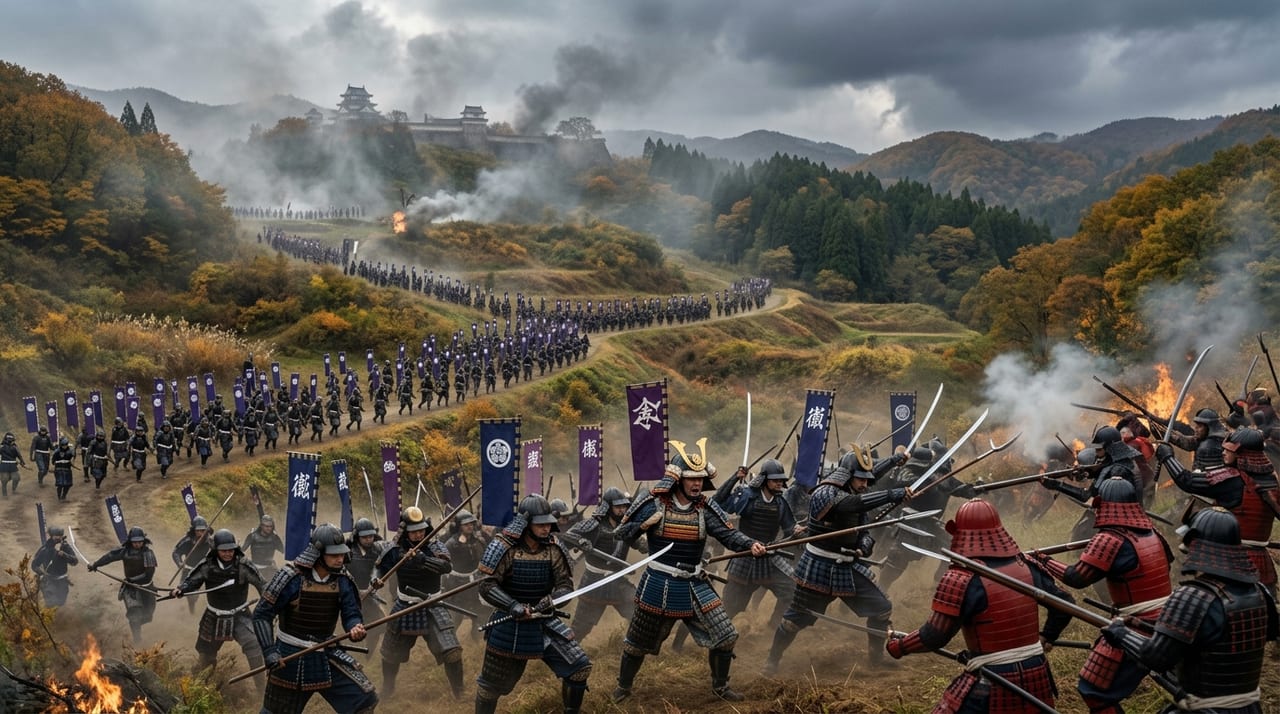
In the 9th month of Keichō 5 (1600), at the very moment the decisive Battle of Sekigahara, which would determine the fate of the realm, was being fought in Mino Province (present-day Gifu Prefecture), the forces of Uesugi Kagekatsu and the combined army of Mogami Yoshiaki and Date Masamune were engaged in fierce fighting over Hasedo Castle in the Ōu region. This is the Battle of Hasedo.
To understand the Battle of Hasedo, one must go back to the spring of the same year. In Keichō 5 (1600), the trigger was Uesugi Kagekatsu's refusal of Tokugawa Ieyasu's demand that he come up to Kyoto. Kagekatsu's chief retainer, Naoe Kanetsugu, responded to a letter from the monk Saishō Jōtai, who was acting on Ieyasu's intentions, with a scathing rebuttal known as the Naoe Letter (Naoe-jō), and it is said that he attacked Ieyasu in fierce language.
This Naoe Letter was a declaration that the Uesugi house was prepared to fight a full-scale confrontation with the Tokugawa. Kanetsugu was renowned as a commander of both literary and martial accomplishment, and the character ai ('love') on the front crest of his helmet is, according to the prevailing theory, derived from his devotion to Atago Gongen.
While the Uesugi house was making war preparations in Aizu, Ishida Mitsunari organized the Western Army and rose in revolt. Kagekatsu, in order to join the Western Army and play a part in the encirclement of the Tokugawa, ordered Naoe Kanetsugu to pacify the Ōu region, that is, to subjugate Mogami Yoshiaki, who had sided with the Tokugawa.
On the 8th day of the 9th month of Keichō 5 (1600), the Uesugi army of some 20,000 men under Naoe Kanetsugu invaded Dewa Province (present-day Yamagata Prefecture) and captured Hataya Castle and other fortresses. However, at Hasedo Castle, close to Mogami Yoshiaki's main stronghold of Yamagata Castle, the garrison under the castellan Shimura Akiyasu put up stubborn resistance.
Hasedo Castle was a formidable fortress built on a hill about 229 meters above sea level, and it was not easy to take by direct assault. The Uesugi army attacked with a large force from the 15th day of the 9th month, but could not take the castle, and the siege settled into a stalemate.
The news that the Western Army had suffered a crushing defeat at Sekigahara on the 15th day of the 9th month reached the Uesugi army on the 29th day of the 9th month. This news fundamentally overturned the course of the Battle of Hasedo, because with the defeat of the Western Army, the Uesugi house was left isolated and without help.
Naoe Kanetsugu decided to withdraw. But a retreat is even more difficult than an attack. If a force of 20,000 men withdraws in the face of the enemy and falls into disarray, it will bring about a catastrophic defeat. Here Kanetsugu's leadership showed its true worth.
On the 1st day of the 10th month, Kanetsugu personally commanded the rear guard (shingari) and, while holding back the pursuing combined Mogami and Date forces, carried out an orderly withdrawal. Later military historians have highly praised this Hasedo retreat as demonstrating Naoe Kanetsugu's true excellence as a commander.
In the rear guard, Maeda Toshimasu (Keijirō), Suibara Chikanori, and others also fought bravely. Kanetsugu held off the pursuers with musket units and returned to Yonezawa on the 4th day of the 10th month.
After Sekigahara, Uesugi Kagekatsu surrendered to Tokugawa Ieyasu and accepted a drastic reduction of his domain, from 1.2 million koku in Aizu to 300,000 koku in Yonezawa. However, Kagekatsu was not ordered to commit seppuku, and the Uesugi house survived. Naoe Kanetsugu also kept his position as chief retainer (karō) and devoted himself to developing the administration and industry of the Yonezawa domain.
The Battle of Hasedo tends to be overshadowed by Sekigahara, the decisive battle that determined the fate of the realm. Yet it was the last great battle of the Sengoku period in the Ōu region, and an historically important engagement in which the three great powers of the Tōhoku, the Uesugi, Mogami, and Date, crossed swords. And the dazzling retreat conducted by Naoe Kanetsugu, the commander of 'love', is still highly regarded today as proof of a warlord's true ability.
Naoe Kanetsugu
Uesugi supreme commander; led the celebrated fighting retreat
Uesugi Kagekatsu
Uesugi clan head; allied with the western coalition
Mogami Yoshiaki
Mogami Yoshiaki; defended Hasedo Castle for the eastern coalition
Date Masamune
Date Masamune; joined Mogami to pursue the retreating Uesugi
Ishida Mitsunari
Ishida Mitsunari; western coalition leader whose defeat at Sekigahara triggered the Uesugi withdrawal