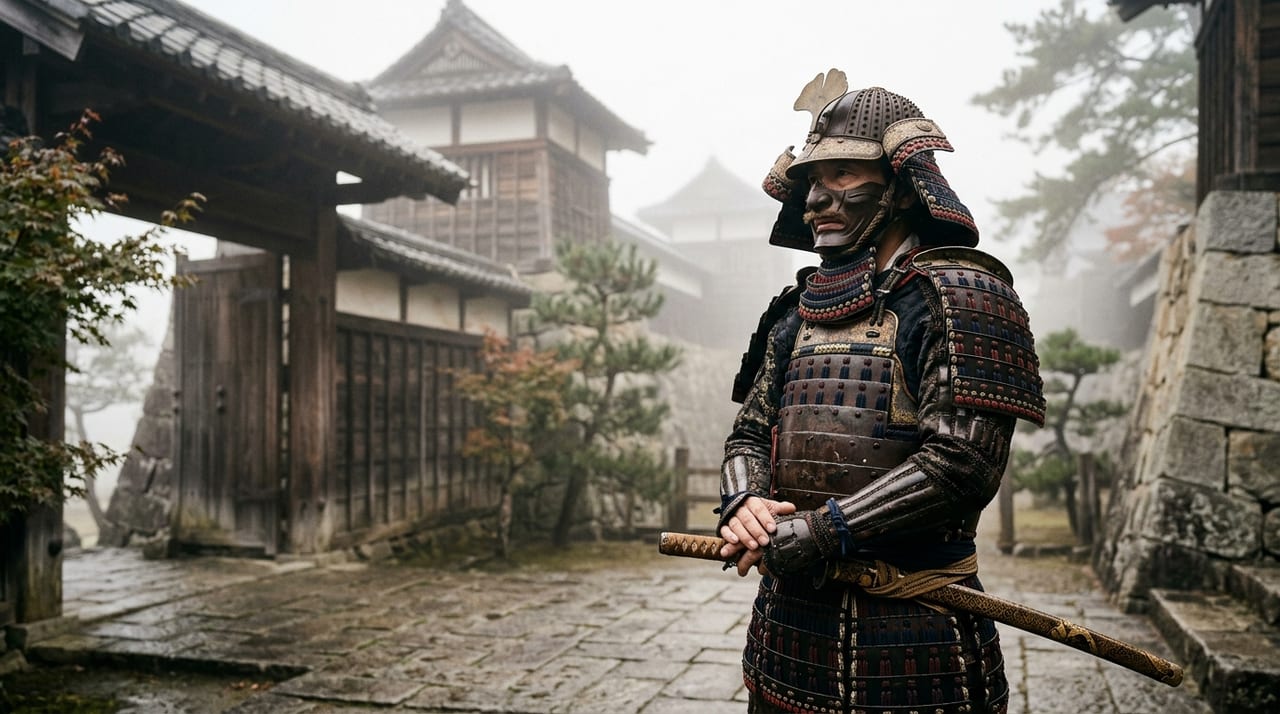
 * Image is for illustrative purposes only.
Mogami Yoshiaki
最上義光
The Fox of Ushū: Successor to the Ushū tandai Who Combined Strategy and Valor and Repelled the Uesugi Army in the Keichō Dewa campaign
Description
Mogami Yoshiaki, Master of Dewa
Born in Yamagata, Dewa Province, in Tenbun 15 (1546), Mogami Yoshiaki was an outstanding warrior who, as the 11th head of the Mogami family, unified Dewa Province and grew into the foremost daimyo of the Tōhoku region, with 570,000 koku. Also called "the Fox of Ushū" and "the Valiant General of Ōu," Yoshiaki was known both as a fierce warrior and as a skilled practitioner of diplomacy and intrigue, and he established his own sphere of power in Tōhoku at the end of the Sengoku period. His life, marked by his complex relationship with the powerful neighboring Date Masamune, his skillful survival strategies under the Toyotomi regime, and his contribution to the Eastern Army at Sekigahara, left a vivid mark on Sengoku history in both wisdom and martial prowess.
Feud and Intrigue with the Date
No account of Mogami Yoshiaki's life can omit his complex relationship with his nephew, Date Masamune. Masamune's mother, Yoshihime (Lady Higashi), was Yoshiaki's sister, and although by blood they stood in the relationship of uncle and nephew, the two kept clashing fiercely over territory. In Tenshō 16 (1588), in the Ōsaki campaign, Yoshiaki aided the Ōsaki clan and fought against the Date army, and he concluded a truce through the mediation of his sister Yoshihime. Yoshiaki is also suspected to have been behind the so-called "Yoshihime Attempted Poisoning Incident," in which Yoshihime was said to have tried to put poison in Masamune's meal, but the truth remains shrouded in mystery.
Sekigahara and the Battle of Hasedō Castle
At the Battle of Sekigahara in Keichō 5 (1600), Yoshiaki unhesitatingly sided with the Eastern Army, the side of Tokugawa Ieyasu. This was reportedly greatly influenced by Yoshiaki's hatred of Toyotomi Hideyoshi, who had Yoshiaki's daughter Komahime executed for being implicated in the Hidetsugu Incident, and by his inclination toward Tokugawa Ieyasu, with whom he had long been on friendly terms. In the battle for Hasedō Castle, which broke out at the same time as Sekigahara, Hasedō Castle, defended by its commander Shimura Akiyasu and others, held out against the large army led by Naoe Kanetsugu, chief retainer of the Uesugi. When the Naoe army turned to retreat after news of the Western Army's defeat at Sekigahara reached it, Yoshiaki himself took the lead in the pursuit. He fought on even after being struck by a bullet in his helmet, but he reportedly failed to catch the retreating army by just one step, owing to Kanetsugu's masterful withdrawal.
Yoshiaki's Swords and Martial Arts
Yoshiaki is said to have been tall, strong, and superior in martial valor. An anecdote appearing in the Uyō Gunki and the Ōu Eikei Gunki holds that when bandits attacked at a hot-spring resort where he had accompanied his father in his youth, he took the lead in defending against them. In recognition of this, his father, Mogami Yoshimori, granted him the famous sword "Sasakiri." The iron baton he used on the battlefield is also said to have weighed as much as two swords, and it was inscribed with "Yoshiaki, a descendant of Emperor Seiwa, Lord of Dewa at Yamagata, a monk who keeps his hair."
Yoshiaki as a Man of Culture
Yoshiaki was not merely a warrior but also had the side of a man of culture who was fond of renga (linked verse) and classical literature. Some 33 volumes and 248 verses of his renga survive today, a number second only to that of Hosokawa Yūsai among the daimyo of his era. He devoted himself to developing Yamagata Castle (Kajō) and enriching the castle town, contributing greatly to the cultural development of Dewa Province. The legacy Mogami Yoshiaki left in the Yamagata domain is rich not only in its martial aspects but also in its cultural ones. He also collected art objects such as picture scrolls, folding screens, and ceramics, and brought Momoyama culture to the castle town of Yamagata.
His Death and the Tragedy of the Mogami Family
Yoshiaki died in Keichō 19 (1614), but the Mogami family thereafter lost the prestige of Yoshiaki and fell into a tragedy of internal strife and forfeiture. As a result of the family dispute known as the Mogami Disturbance, the Mogami family was stripped of its domain in Genna 8 (1622), and the large 570,000-koku domain was extinguished in the generation of Yoshiaki's grandson. The hegemony over Dewa that Yoshiaki built in a single lifetime came to an end just eight years after his death. The swords that supported his life, together with Yoshiaki's spirit, were deeply engraved into the history of Dewa.