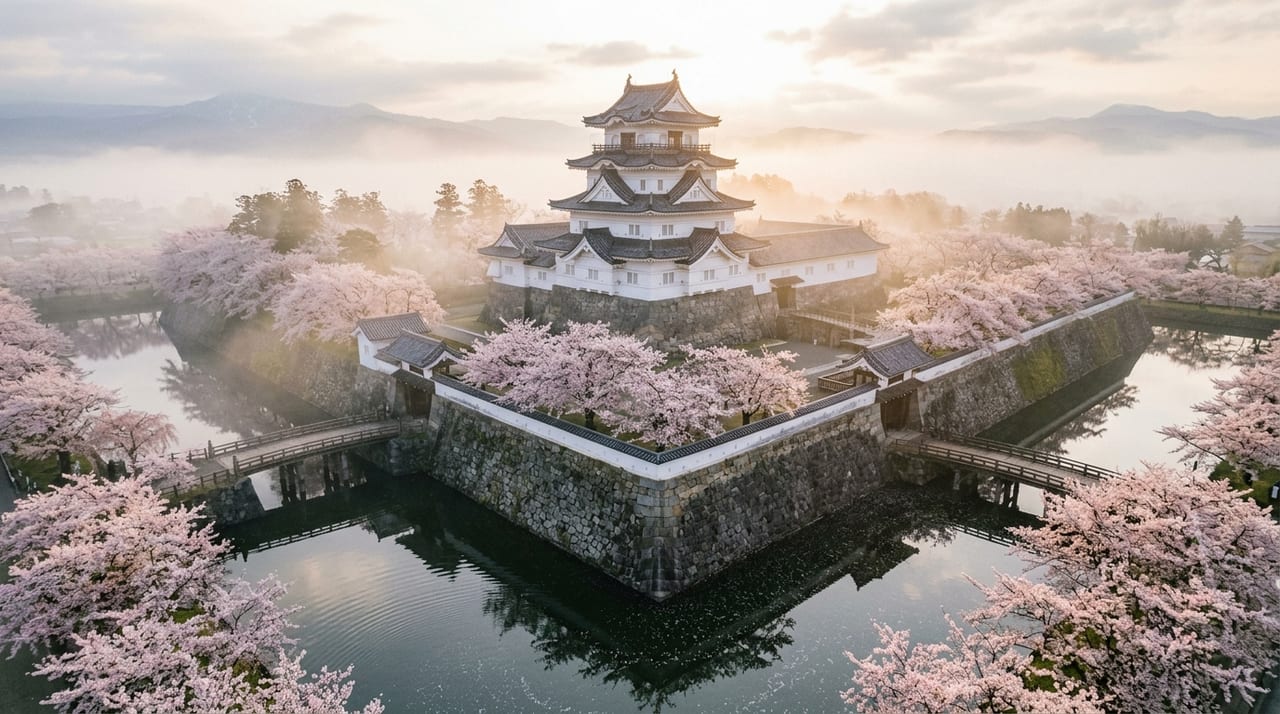
 * Image is for illustrative purposes only.
Yamagata Castle (Kasumi-jō)
山形城(霞城)
Yamagata Castle (Kasumi-jō) is a historic castle in the Tōhoku region (Founded in 1357 (Enbun 2), with major renovations after 1600 (Keichō 5)). Its lord was Mogami Yoshiaki.
Overview
About the Castle
Yamagata Castle originated when Shiba Kaneyori, of a distinguished house of Ōu, built it in 1357 (Enbun 2), and it served as the power base of the Mogami clan until the clan was stripped of its domain in Genna 8 (1622). Under the eleventh-generation lord Mogami Yoshiaki in particular, it underwent a dramatic transformation and was developed into one of the Tōhoku region's leading early modern castles. At the Battle of Sekigahara (Keichō 5, 1600), Yoshiaki sided with Tokugawa Ieyasu, and he withstood the massive army of Uesugi Kagekatsu through skillful diplomacy and strategy. Thanks to this achievement, he was promoted after the war to a major daimyo with 570,000 koku, and he launched a large-scale expansion of the castle. The area inside the sannomaru covered about 235 ha, the largest in the Dewa-Mutsu region.
Architecture and Structure
The honmaru housed a magnificent palace, and high stone walls and a broad outer moat emphasized the castle's imposing presence. The east great gate of the ninomaru has been restored today, conveying the sheer scale of the castle at the time. The castle's name Kasumi-jō is said to derive from the fact that during the Keichō Dewa campaign, the Uesugi forces deployed to the west could not see the castle's location because it was shrouded in mist. After the Mogami clan was stripped of its domain (kaieki) in Genna 8 (1622), the domain of Yamagata was assigned to various houses, including the Torii, Hoshina, and Matsudaira families. Although the main buildings were dismantled after the abolition of the domains, the stone walls and moats were maintained throughout the Edo period.
Development of the Castle Town
The Yamagata castle town developed into a commercial city that benefited from river transport on the Mogami River. The streets of the castle town laid out by Yoshiaki were basically in a grid pattern, and place names derived from market days, such as Nanokamachi and Tōkamachi, remain today. The Mogami River is a renowned river throughout the land, celebrated by Matsuo Bashō in the verse 'Gathering May rains, swift flows the Mogami River,' and its water transport supported the castle town's economy. Yamagata was also a major producer of safflower (beni-bana), and the wealth accumulated through safflower trade raised the cultural level of the castle town. Mogami Yoshiaki also had the aspect of a literary warrior who enjoyed poetry, and he had connections with renga masters.
Battles and Warfare
The Keichō Dewa campaign (1600), which was linked to the Battle of Sekigahara, was the greatest turning point in the history of Yamagata Castle. Against the tens of thousands of troops led by Naoe Kanetsugu, a general under Uesugi Kagekatsu, Yoshiaki resisted tenaciously with Hasedō Castle as his frontline. While coordinating with Date Masamune, he checked the advance of the Uesugi army. When the Uesugi forces received word of the defeat of the Western army at Sekigahara and withdrew, Yoshiaki personally led the pursuit from the front. He then quickly conquered the Shōnai region, which had been Uesugi territory.
Tourism and Experience
Kasumi-jō Park today is known as a cherry blossom spot, and in spring about 1,500 cherry trees color the ruins of the ninomaru. The stone walls of the Ichimonji Gate at the honmaru and the restored east great gate of the ninomaru convey the scale of the castle at the time. At the Yamagata City Kyōdo-kan (former main building of the Saisei-kan), visitors can view medical materials as well as historical materials on Yamagata Castle and the local region. A combined tour with the nearby Yamadera (Risshaku-ji) is a signature cultural travel course representing Yamagata.
Connection to Swords
Mogami Yoshiaki's connection to swords is illustrated by an anecdote transmitted in works such as the Uyō Gunki. In his youth, while staying at a hot spring for treatment, he was attacked by bandits and defended himself on his own. His father, Yoshimori, praised his valor and granted him the famous blade 'Sasakiri.' Yoshiaki himself was a valiant commander of great courage who fought with the ferocity of a lion unleashed in battle. He is said to have stood more than six shaku tall, and an anecdote survives that the iron command baton he used on the battlefield weighed as much as two swords. In Yoshiaki's era, artisan quarters were established in various parts of the Yamagata castle town. The Mogami family lost its domain in a succession dispute known as the Mogami disturbance, during the generation of Yoshitoshi (Ienobu), Yoshiaki's grandson. The Mogami Yoshiaki History Museum preserves armor associated with Yoshiaki, including a thirty-eight-ken sō-fukurin helmet, along with his personal belongings. These offer valuable materials that convey the martial prowess and aesthetic sense of the Mogami family. Yoshiaki maintained a complex relationship with Date Masamune. His sister Yoshihime was Masamune's mother, so the two were related by marriage, yet they were politically opposed.
Highlights
- Restored Ninomaru East Gate—a gate of a scale comparable to the castle gates of Edo Castle, restored in 1991
- Ichimonji Gate Stone Walls of the Honmaru—the site of the honmaru's main gate, where the Ōte Bridge was restored in 2006
- Cherry Blossoms at Kasumi-jō Park—approximately 1,500 cherry trees in full bloom, one of Tōhoku's premier hanami spots
- Yamagata City Kyōdo-kan (former Saisei-kan main building)—a nationally designated Important Cultural Property of Western-style architecture, displaying medical materials and historical materials on Yamagata Castle and local history
- Mogami Yoshiaki History Museum—a specialized museum offering a detailed account of Yoshiaki's life and the Keichō Dewa campaign
- Yamadera (Risshaku-ji)—the setting of Matsuo Bashō's celebrated verse 'Stillness—the cicada's cry penetrates the rocks,' about 20 minutes by car from the castle
* Opening hours and admission fees are subject to change. Please check the official website before visiting.