 * Image is for illustrative purposes only.
Sendai Castle (Aoba Castle)
仙台城(青葉城)
Sendai Castle (Aoba Castle) is a historic castle in the Tōhoku region (Built in 1601 (Keichō 6)). Its lord was Date Masamune.
Overview
About the Castle
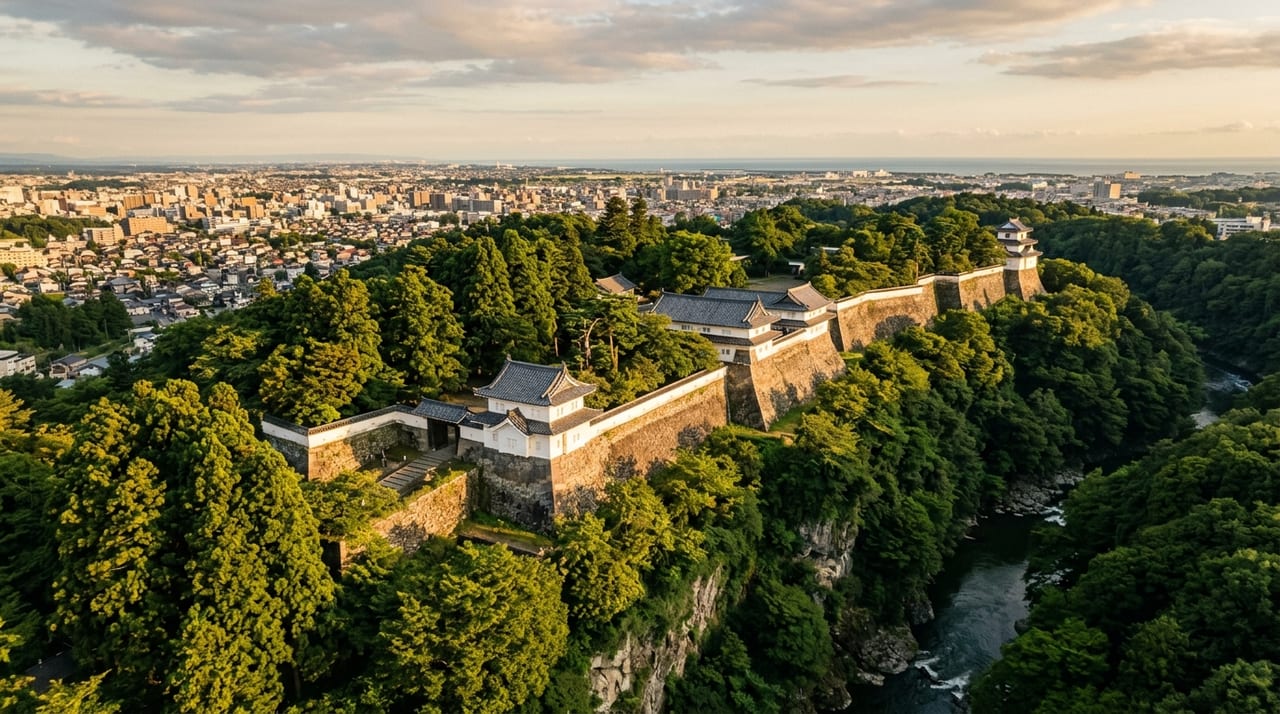
Sendai Castle was a magnificent residence built in Keichō 6 (1601) by the One-Eyed Dragon (Dokuganryū), Date Masamune, and it is the seat of the Date family. Sited on the eastern tip of Mount Aoba and protected on three sides by the Hirose River and Tatsunokuchi Gorge, its natural-fortress terrain vividly shows the strategic eye Masamune had honed in the Sengoku period. Masamune deliberately did not build a donjon. Instead, he built a majestic shoin-zukuri palace in the Honmaru. This is said to have been a strategic judgment characteristic of Masamune: while showing submission to the Tokugawa shogunate, he asserted his own aesthetic sense through the dazzling design of the palace interior.
Development of the Castle Town
The great hall of the Honmaru palace spanned 430 tatami mats. It was designed similarly to the great hall of Jurakudai and decorated with gold-and-blue wall paintings by artists of the Kanō school. The Ninomaru housed the center of government and supported the administration of the domain. The castle town of Sendai developed as the foremost city in the Tōhoku region. The town construction promoted by Masamune was characterized by grid-pattern streets and the development of artisan quarters. The origin of the City of Trees is said to lie in the residential woodlands Masamune encouraged, and cedar and zelkova were planted in samurai residences. The majesty of the Sendai domain, with its 620,000 koku, overawed the other domains of Tōhoku, and Masamune's diplomatic skill extended as far as dispatching the Keichō Embassy to Europe.
Culture and Crafts
The dispatch of Hasekura Tsunenaga as envoy to Spain and Rome speaks to the breadth of Masamune's international outlook. The Date family's dazzling sense of beauty gave rise to the term datemono, and the designs of armor and sword fittings concentrate its refined aesthetics. The jet-black armor and crescent-moon helmet ornament that Masamune himself wore still captivate people today as among the most iconic emblems of any Japanese warlord. From the Honmaru of the Sendai Castle ruins, one can take in the whole of Sendai city and the Pacific Ocean, and the equestrian statue of Date Masamune greets visitors with dignified majesty.
The Spirit of Bushidō
That figure embodies the unyielding spirit of Masamune, who lived his whole life as a champion of the Tōhoku region. Although Masamune's home domain was reduced by Toyotomi Hideyoshi's Ōshū Settlement in Tenshō 19 (1591), he built a great domain of 620,000 koku in the Sendai area. The history of Sendai Castle is a story of Masamune's wisdom and sense of beauty, and of the samurai pride rooted in the soil of Tōhoku. As the principal castle of the Date family, Sendai Castle is the castle that most profoundly embodies the Japanese sword and the samurai aesthetic, a sacred site that every sword enthusiast should visit at least once.
Sightseeing and Experiences
Guarded by the clear waters of the Hirose River and the greenery of Mount Aoba, this castle still conveys Masamune's aspirations after more than 400 years. Sendai is also known as a city of gyūtan, and gyūtan enjoyed after strolling the castle grounds makes a particularly memorable part of the trip.
Connection to Swords
Date Masamune is renowned as one of the foremost sword collectors among the Sengoku daimyō, and his discerning eye became a model for later sword enthusiasts. Among the famous swords Masamune owned, the Bizen Osafune-made Shokudaikiri Mitsutada is especially well known. It is said that the name derives from the occasion when Masamune executed a retainer and cut down, candlestick and all, the retainer who had hidden behind a bronze candlestick. Mitsutada was a master smith of the Bizen Osafune school in the mid-Kamakura period, and his style is known for its splendid chōji-midare hamon and bright, clear jigane. The Shokudaikiri Mitsutada is said to have been presented by Masamune to the Mito Tokugawa family. It had long been thought to have been destroyed in the Great Kantō Earthquake, but in 2015 it was found to be preserved in its fire-damaged state at the Tokugawa Museum (Mito), and it is now displayed in that fire-damaged form. The sword Ōkurikara is also known as a treasured blade handed down in the Date family, and its majestic form, carved with a Kurikara dragon, symbolizes Masamune's dignity as a warrior. Masamune patronized Kunikane as a sword smith in service to the Sendai domain, laying the foundation for the lineage of sword smiths in Sendai. The first Kunikane was a smith who, on Masamune's orders, went up to Kyoto and studied under Etchū-no-kami Masatoshi, and who brought to Sendai the Yamato-den style of the Hoshō line, characterized by masame-hada. Kunikane's blades are founded on a dignified straight hamon (sugu-ba), and their jigane is well regarded for its beauty. Thereafter the name Kunikane was passed down through generations, and the smiths continued making swords as the orthodox smiths of the Sendai domain until the bakumatsu period. Sword fittings handed down in the Date family are likewise known for their dazzling and refined designs. The tsuba, menuki, and fuchi-kashira created by metalworkers are treasures that convey the Date family's sense of beauty to this day. The Sendai City Museum holds a large number of swords and sword fittings associated with the Date family.
Highlights
- Equestrian Statue of Date Masamune — a symbol of Sendai standing on the Honmaru site, with its crescent-moon helmet ornament shining in the wind of Mount Aoba
- Panoramic view of Sendai city and the Pacific Ocean from the Honmaru site — experience the view of the realm that Masamune once saw
- Sendai Castle Kenbunkan — displays a 1/50 scale model of the Honmaru great hall and a full-scale reproduction of the floor of the jōdan-no-ma
- Sendai City Museum — holds a large number of swords, armor, and sword fittings handed down in the Date family
- Zuihōden — a magnificent Momoyama-style mausoleum, the culmination of Masamune's sense of beauty
- Natural walking paths of Mount Aoba — stroll through the gorge scenery of the Hirose River and forests that change with the seasons
* Opening hours and admission fees are subject to change. Please check the official website before visiting.