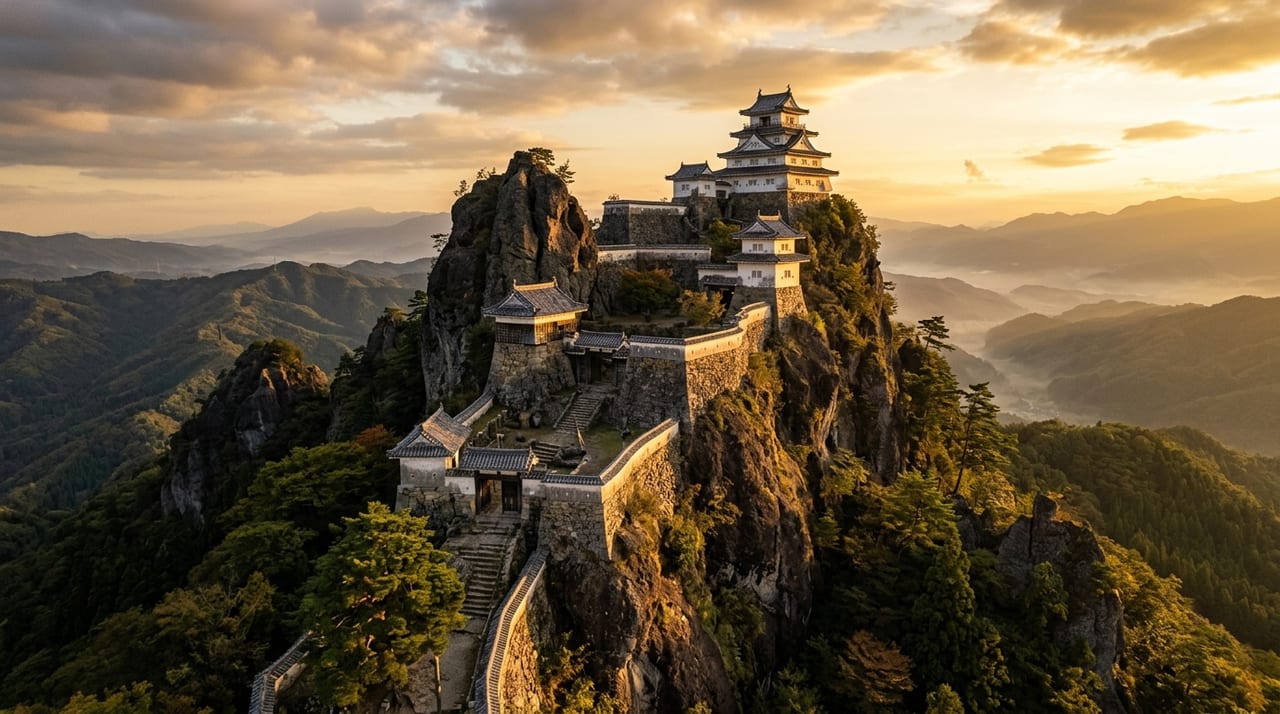
* Image is for illustrative purposes only.Kōriyama Castle
郡山城
Kōriyama Castle is a historic castle in Tōhoku dating from the Built by the local Kōriyama clan during the Tenbun era (ca. 1532–1555). In 1590 (Tenshō 18), Gamō Ujisato was enfeoffed in Aizu. During the Edo period, it served as a strategic stronghold on the border between Nakamura and Nihonmatsu domains., whose lord was Tamura clan → Gamō Ujisato → Uesugi Kagekatsu → Gamō Hideyuki → Katō Yoshiaki → Matsudaira (Hoshina) clan → Itakura clan.
Overview
Kōriyama Castle was a strategic hilltop and semi-mountain stronghold positioned at the crossroads of the Ōshu Highway and the Banetsutsu Road in central Fukushima Prefecture. Built on a terrace west of the Abukuma River northwest of present-day Kōriyama city center, this castle served as a pivotal base for Ōshu governance from the Sengoku period through the early Edo period, and was the stage upon which multiple daimyō competed for control.
The castle's origins date to the Tenbun era (1530s–1550s). Kōriyama Castle (also called Inari Fortress) in Asaka District is said to have begun as a defensive stronghold built by the local Kōriyama clan. The Tamura clan was a regional power that skillfully maintained equilibrium among the powerful Ōshu daimyō—the Date, Sōma, and Ashina clans—while controlling the Kōriyama region. They are also renowned for Yoshihime, daughter of Tamura Kiyonobu (lord of nearby Miharu Castle), having become the principal wife of Date Masamune.
With Toyotomi Hideyoshi's pacification of Ōshu in 1590, the Tamura clan's rule ended. In the same year (Tenshō 18), Gamō Ujisato was transferred to Aizu, bringing Asaka District under his domain. Ujisato was renowned not only as a warrior but also as a tea master and cultural patron; as a senior disciple of Sen no Rikyū, he brought the aesthetic sensibilities of chanoyu to Ōshu. During Ujisato's tenure, the castle and castle town of Kōriyama underwent systematic development, establishing the foundation for Ōshu as a cultural and economic center.
After the Battle of Sekigahara (1600), Ōshu saw the Uesugi, Gamō, and Katō clans take turns ruling the Kōriyama region. From the mid-Edo period onward, the Miharu Domain (Tamura clan) and the Kōriyama area bordered each other, and the castle town developed as an agricultural and commercial center along the Abukuma River valley. During the late Edo period, the region became a battlefield during the Boshin War (1868), and parts of the castle and its town suffered war damage.
After the Meiji Restoration, Kōriyama Castle was decommissioned and its structures were completely dismantled. Today, portions of the stone walls remain on the grounds and surroundings of Asaka Kunitsuko Shrine, and the Asaka Historical Museum (housed in the former Asaka Middle School main building, designated a National Important Cultural Property) preserves and exhibits the samurai culture and local history of the Kōriyama and Asaka regions. Since the modern era, Kōriyama has rapidly developed as an agricultural and industrial city through the Meiji government's Asaka Development and Water Diversion projects, and now flourishes as a central hub city in central Fukushima Prefecture. While the castle ruins area is now a park and residential district, the terrace west of the Abukuma River retains traces of the former castle layout.
Connection to Swords
The deep connection between Kōriyama Castle and Japanese swords can be understood through two dimensions: the sword culture of three warrior families—the Tamura, Gamō, and Katō clans—and the history of swordsmithing in Ōshu. First, the figure of Gamō Ujisato (1556–1595) is essential to understanding Kōriyama Castle's sword culture. Ujisato served Oda Nobunaga from his youth and achieved numerous military exploits as a renowned general. Simultaneously, as a senior disciple of Sen no Rikyū, he possessed deep knowledge of chanoyu and the decorative arts, and was a connoisseur of the finest swords of his era. The aesthetic sensibility that Ujisato brought to Aizu and Kōriyama extended beyond tea ceremony alone and became the catalyst for establishing the artistic standards of sword fittings—tsuba, menuki, and scabbard—in Ōshu. Several of the swords favored by Ujisato still survive today, and particularly the celebrated blades transmitted as "swords in the possession of Gamō Ujisato" are treasured among sword enthusiasts. Second, there is the sword culture associated with the Tamura clan. The Tamura were a prominent Ōshu family who entered into matrimonial ties with Date Masamune, and successive clan heads transmitted locally-forged swords commissioned from Ōshu smiths throughout their household. The samurai class in the Kōriyama region had access to fine blades from both local Ōshu swordsmiths and renowned smiths of Edo and Kyoto. Furthermore, from the perspective of sword distribution in Ōshu, Kōriyama functioned as a nodal point on the Ōshu Highway and Banetsutsu Road, serving as a transit hub for the distribution of blades and sword fittings from Edo and Kyoto throughout the Northeast. Swordsmiths, polishers, and scabbard makers in the castle town supported the maintenance of swords for traveling samurai, and it is believed that sword-related artisans concentrated in the Kōriyama castle town. During the period when Katō Yoshiaki (1563–1631) held fiefs in the Kōriyama region, the warrior culture of the Katō—famous as one of the Seven Spears of Shizugatake—also influenced the castle town. The Katō family's sword collection includes celebrated blades gathered through their years of service in Iyo and Aizu, and the multifaceted nature of their samurai culture richly colors Kōriyama Castle's sword history.
Highlights
- Stone walls at Asaka Kunitsuko Shrine — preserved stonework conveying the castle's remains, located in the city center
- Asaka Historical Museum (former Asaka Middle School main building) — a Meiji-era building designated as a National Important Cultural Property, exhibiting samurai culture and local history of Kōriyama and Asaka
- Chanoyu and sword culture associated with Gamō Ujisato — the aesthetic sensibility and sword fitting craftsmanship traditions that Ujisato, a senior disciple of Sen no Rikyū, established in Ōshu
- Matrimonial bonds between the Tamura and Date Masamune — Yoshihime (of the Tamura) was Masamune's principal wife, and the Tamura were a prominent family central to the Ōshu warrior alliance
- Castle town at the crossroads of the Ōshu Highway — a strategic logistics hub that functioned as a transit point for sword and goods distribution between Edo and the Northeast
* Opening hours and admission fees are subject to change. Please check the official website before visiting.