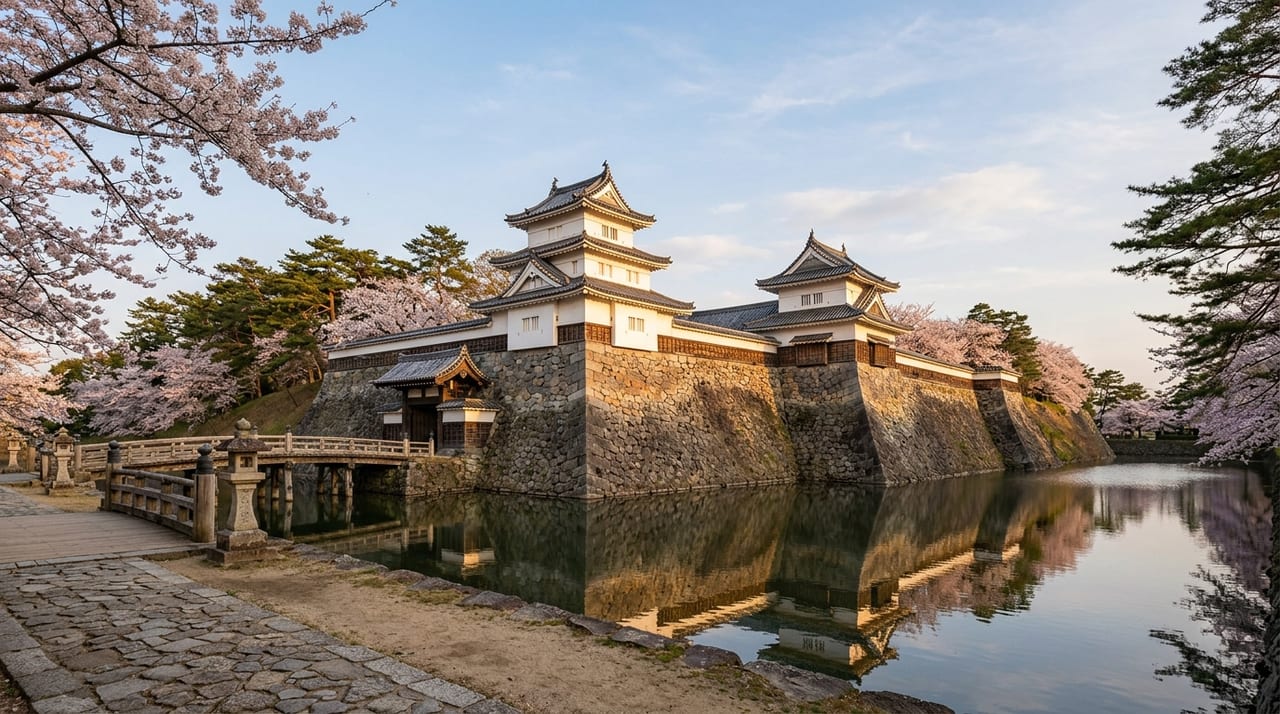
 * Image is for illustrative purposes only.
Kakunodate Castle
角館城
Kakunodate Castle is a historic castle in Tōhoku dating from the Sengoku to early Edo period (c. 1467–1620s abolition), whose lord was Ashina clan → Tozawa clan (Tozawa Moriyasu) → Satake clan (Ashina Yoshikatsu) → Satake North family.
Overview
Kakunodate Castle is a mountain castle built on Kojosan Hill (also known as Komatsuyama) in the Senboku District of Ugo Province (present-day Kakunodate, Semboku City, Akita Prefecture), serving as a strategic political and military center of southern Dewa during the Sengoku period. The castle's founding dates to approximately Ōei 31 (1424), when the Tozawa clan under Tozawa Iemori relocated its seat to Komatsuyama Castle (Kakunodate Castle). Following internal clan conflicts, it became the headquarters of the Sengoku daimyo Tozawa clan. During the era of Tozawa Morisada (1566–1590), Kakunodate attained its greatest prosperity, and Morisada, excelling in both civil and military arts, earned the epithet "Kirin of Northern Ugo." Morisada died young at age 25, arresting the expansion of Tozawa power, though Kakunodate's cultural legacy was transmitted to later generations. Following the Battle of Sekigahara in 1602, Satake Yoshinobu, transferred from Hitachi Province (Ibaraki Prefecture), established Akita Domain (Satake Domain), bringing the Kakunodate area under Satake control. Subsequently, Ashina Yoshikatsu, a retainer of the Satake clan, organized the castle town in Genwa 6 (1620), and following the extinction of the Ashina clan, the Satake North family (Hokke) inherited and sustained it. In the early Edo period, Kakunodate Castle was abolished under the one-castle-per-domain law of 1615, but the castle town persisted as a samurai residential district, maintaining its renowned character as "the little Kyoto of the Michinoku." The samurai residential streets of Kakunodate are designated as an Important Preservation District for Groups of Traditional Buildings and are celebrated as a destination for weeping cherry blossoms, attracting hundreds of thousands of tourists annually. The castle ruins are protected as an Akita Prefectural Historic Site, with earthworks and trenches surviving on Kojosan Hill (Castle Hill). Kakunodate also served as a strategic junction on the trade route for iron and copper crossing the Ou Mountain Range, owing to its geographical position within the Hinokinai River basin. Dewa swordsmiths operated in the Kakunodate area, supplying blades to the warrior classes of the Tozawa and Satake clans. The Satake clan, originating from Hitachi Province, possessed deep expertise in Kanto sword culture, and sword appreciation and collecting flourished in the Kakunodate castle town.
Connection to Swords
The Tozawa clan managed the trade in iron and copper across the Ou Mountain Range, contributing to the securing of raw materials for Dewa swordsmiths. The Satake clan, with their background from Hitachi Province, were deeply versed in Kanto sword culture and established a tradition of sword appreciation and collecting in Kakunodate's samurai culture. Even today, displays of swords and armor can be found in the samurai residences of Kakunodate, conveying the region's sword culture to the present day.
Highlights
- Kakunodate samurai district — 'Little Kyoto of the Michinoku'
- Designated Important Preservation District for Traditional Buildings
- Home base of Tozawa Moriyasu, 'the Kirin of Northern Ugo'
- Nationally renowned for weeping cherry blossoms
- History of Dewa swordsmiths and mountain trade routes
* Opening hours and admission fees are subject to change. Please check the official website before visiting.