 * Image is for illustrative purposes only.
Tagajō
多賀城
Tagajō is a historic castle in the Tōhoku region (Founded in 724 by Ōno Azumabito; functioned as the Mutsu provincial capital through the late Heian period). Its lord was Ōno Azumabito (founder) / successive Mutsu Governors and Chinjufu Commanders.
Overview
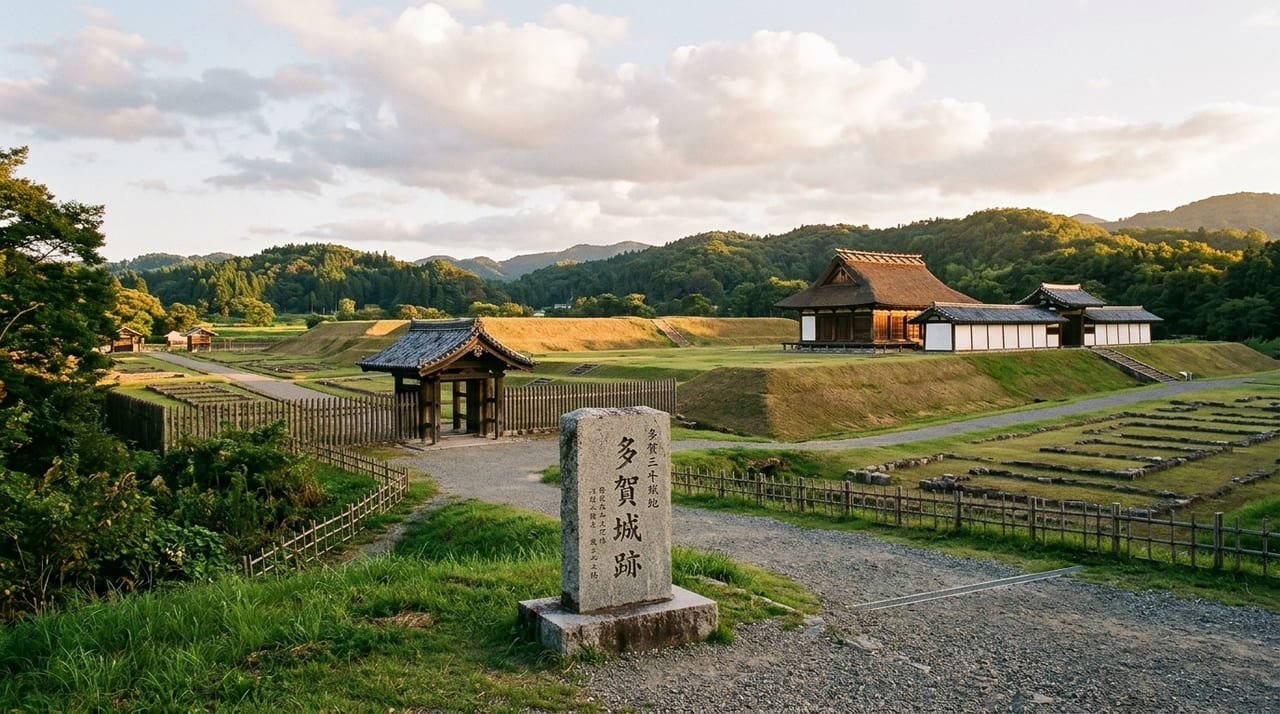
Tagajō is an ancient jōsaku (fortified administrative compound) located in Tagajō City, Miyagi Prefecture. From the Nara through Heian periods, it served as the provincial capital (kokufu) and military headquarters (Chinjufu) of Mutsu Province (modern-day Tōhoku region) — a major institutional center of the Japanese state. Unlike medieval and early-modern castles, Tagajō was a complex of official administrative buildings (kangas) composed of large post-and-beam structures and rammed-earth defensive walls (tsujibei).
Founded in Jinki 1 (724) by Ōno Azumabito, Mutsu Ansatsu-shi (Provincial Inspector), Tagajō served as the forward base during the court's military campaigns against the Emishi peoples of the north. It was also the seat of Sakanoue no Tamuramaro (758–811), the celebrated general credited with subduing the Emishi and expanding imperial control over the Tōhoku region — making the fortress inseparable from the history of Emishi conquest.
Within the compound stood a government hall (seicho), warehouses, barracks, and other official structures arranged with the same formality as Heijō-kyō in Nara. The site's most notable feature is the Tagajō Stele (also called Tsubo no Ishibumi), erected in Tenpyō Hōji 6 (762), which is counted among Japan's three oldest stone inscriptions and was designated a National Treasure in 2024. The stele bears inscribed distances between Tagajō and various locations across Japan, making it an invaluable document of Nara-period geography and road networks.
The fortress suffered devastation during the Iji no Atemaro Rebellion of Hōki 11 (780), when the government hall and other structures were burned by Emishi rebels. In the late Heian period, it gradually lost its role as provincial capital following the rise of the Ōshū Fujiwara clan. Today it is preserved as a Special National Historic Site, with the outer south gate, rebuilt in wood, and other restored features testifying to its former grandeur. Even during the Great East Japan Earthquake of 2011, the site's remains were largely preserved.
Connection to Swords
Tagajō's sword significance lies in its role as the frontline headquarters during Japan's earliest recorded large-scale military campaigns — the Emishi subjugation expeditions of the 8th and 9th centuries led by generals including the legendary Sakanoue no Tamuramaro. The weapons of this era were chokutō (straight swords) influenced by continental Asian models, predating the curved tachi and katana for which Japan is famous. Tagajō served as a weapons depot and military supply center, making it the scene of the earliest documented mass deployment of Japanese swords in warfare. Scholars trace the development of the curved Japanese sword (wantō) in part to the cavalry tactics refined through these northeastern campaigns, giving Tagajō an indirect but meaningful place in the story of the Japanese blade's evolution.
Highlights
- Tagajō Stele (Tsubo no Ishibumi) — 762 CE stone inscription, one of Japan's three oldest (National Treasure)
- Government Hall ruins — site of the administrative center of ancient Mutsu Province
- South Gate reconstruction — restored main gate conveying the grandeur of Nara-period government architecture
- Sakanoue no Tamuramaro heritage — command base of Japan's most legendary military general
- Tagajō City Archaeological Center — museum displaying excavated artifacts from the site
- Vast Special Historic Site precinct — one of Japan's largest ancient jōsaku remains
* Opening hours and admission fees are subject to change. Please check the official website before visiting.