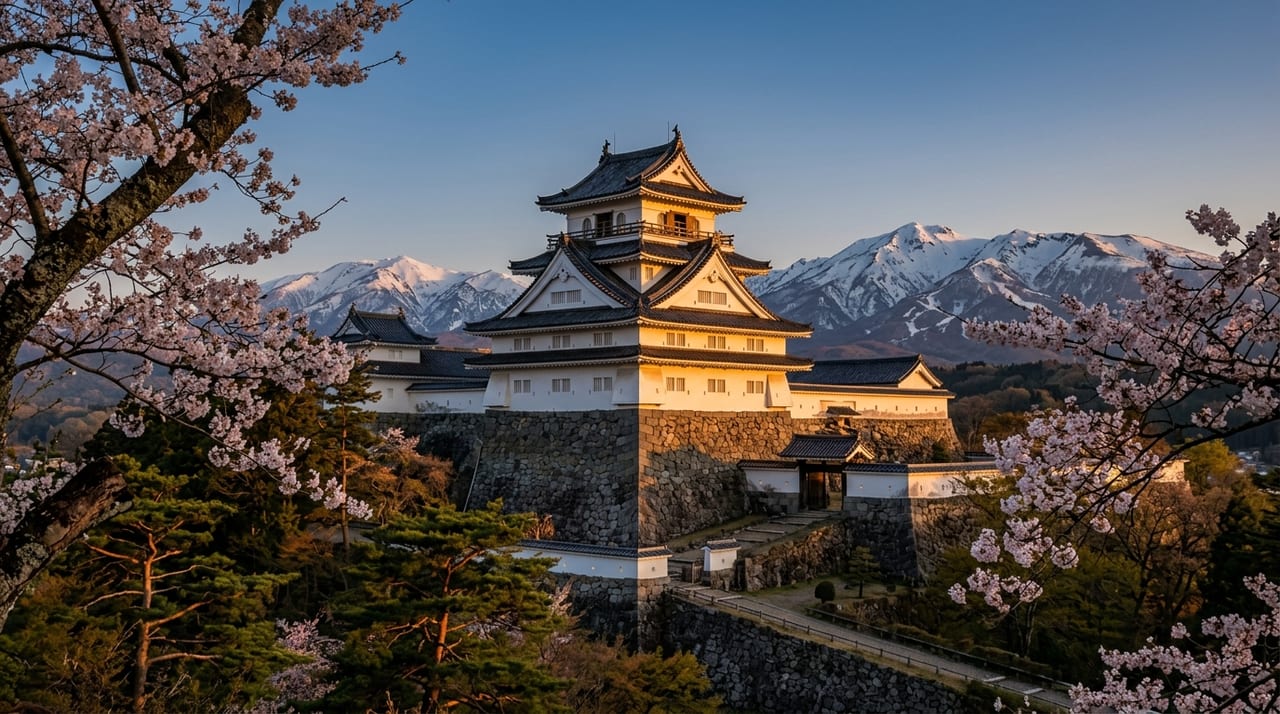
 * Image is for illustrative purposes only.
Kaminoyama Castle (Tsukioka Castle)
上山城(月岡城)
Kaminoyama Castle (Tsukioka Castle) is a historic castle in the Tōhoku region (Built in Tenbun 4 (1535)). Its lord was Buei Yoshitada (first lord) / Mogami clan / Toki family.
Overview
About the Castle
Kaminoyama Castle is a hirayama-style castle located at the southern edge of the Yamagata Basin, at the foot of the Zao mountain range. It is said to have been built by Buei Yoshitada in Tenbun 4 (1535). Thereafter it became the southern stronghold of the Mogami clan. In Tenshō 8 (1580), Mogami Yoshiaki destroyed the castle lord Kaminoyama Mitsukane and brought the castle under his control, and it became the stage of conflict with the Date clan of Yonezawa and the Uesugi clan. Mogami Yoshiaki was the uncle of Date Masamune, but he was a Sengoku warlord who clashed fiercely with Masamune. In the Battle of Sekigahara in Keichō 5 (1600), he belonged to the Tokugawa Eastern Army and played an active role.
The Mogami Clan and Kaminoyama Castle
After Sekigahara, Mogami Yoshiaki became a major daimyo with 570,000 koku, but the Mogami clan was dismissed and transferred due to internal clan strife (oie sōdō) in Genna 8 (1622). Thereafter, multiple daimyo families succeeded one another at Kaminoyama Castle. After the Toki family, the castle passed to the Kanamori family, and in Genroku 10 (1697) the Fujii Matsudaira family was enfeoffed and served as lords of Kaminoyama domain until the end of the Edo period. Kaminoyama Castle stands on a hill overlooking the hot spring town of Kaminoyama (Kaminoyama Onsen), a unique environment where castle and hot spring coexist. Kaminoyama Onsen is an old hot spring said to have been discovered by the priest Getsushū Shōnin in the Muromachi period (Tsuruhagi no Yu).
Replica Tenshu and Historical Exhibits
The current tenshu is a three-story replica tenshu built in Shōwa 57 (1982) on the site of the Ninomaru, and its interior is open to the public as the Local History Museum. The view of Kaminoyama city and the Zao mountain range seen from the castle is beautiful throughout the four seasons, and in particular the combination of Zao's snow and the castle is a scene representing Yamagata's winter landscape. Samurai residence streets remain in the castle town, passing the daily life and culture of Kaminoyama domain in the Edo period down to the present day.
The Rich Nature and Culture of Kaminoyama
Kaminoyama is also known as a cherry blossom spot in Yamagata, and in late April cherry blossoms bloom splendidly centered on the castle ruins. Along with Zao's juhyō (ice monsters), Kaminoyama Onsen wine, and Yamagata beef, Kaminoyama Castle is one of the important bases of Yamagata tourism.
Connection to Swords
During the Sengoku period, Kaminoyama Castle was the southern stronghold of the Mogami clan and stood at the front line of conflict with the Date clan and the Uesugi clan of Yonezawa. In the Keichō Dewa Campaign of Keichō 5 (1600), the castle garrison met Uesugi forces near the castle gate. The Toki family, which became lords of Kaminoyama domain in Kan'ei 5 (1628), is a family descended from the Toki clan, which was known as a shugo daimyo of Mino Province. At the Local History Museum inside the replica tenshu, special exhibitions are held, such as displays of armor and other holdings and sword exhibitions. Sword culture in Yamagata Prefecture, together with Sendai (Kunikane), Yonezawa (Uesugi family), and Tsuruoka (Shōnai domain), is an important example showing the diversity of samurai culture in the Tōhoku region.
Highlights
- Replica tenshu (three stories) — stands in Tsukioka Park, with a view overlooking the townscape of Kaminoyama Onsen
- Kaminoyama Onsen — an old hot spring said to have been discovered in the Muromachi period (Tsuruhagi no Yu)
- Samurai residence street — remnant of the castle town conveying the daily life and culture of Kaminoyama domain in the Edo period
- Views of the Zao mountain range — seasonal views of Zao and the Kaminoyama Basin from the stone base of the tenshu
- Kaminoyama Castle Local History Museum — museum inside the tenshu, with special exhibitions of armor and swords and displays on the history of the castle town
- Kaminoyama Cherry Blossom Festival — late April, cherry blossoms blooming at the castle ruins in contrast with the snowy Zao
* Opening hours and admission fees are subject to change. Please check the official website before visiting.