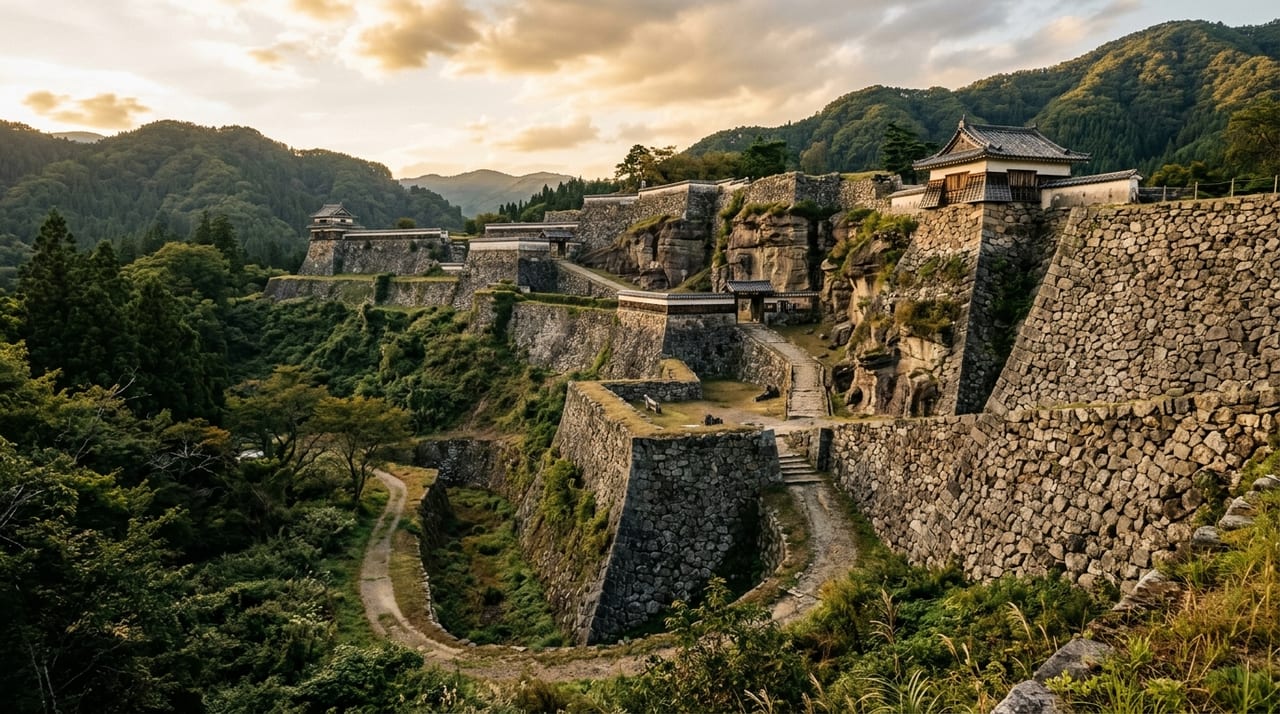
 * Image is for illustrative purposes only.
Kunohe Castle (Fukuoka Castle, Iwate)
九戸城(福岡城)
Kunohe Castle (Fukuoka Castle, Iwate) is a historic castle in the Tōhoku region (The residence of the Kunohe clan, said to have been built by Kunohe Mitsumasa in the Meiō era (1492-1501). It came to an end in Tenshō 19 (1591), when the Kunohe Masazane Rebellion ended in defeat to the Ōshū Shioki army of Toyotomi Hideyoshi). Its lord was Kunohe Masazane → Gamō Ujisato (renovated after the rebellion) → Nanbu clan.
Overview
Kunohe Castle (Kunohe-jō) is a medieval castle in Ninohe City, Iwate Prefecture, and the seat of the Kunohe clan, who ruled the northern part of Mutsu Province (today's northern Iwate Prefecture). As the site of the Kunohe Masazane Rebellion (Tenshō 19, 1591), the last armed resistance to Toyotomi Hideyoshi's Ōshū Shioki (pacification of Ōshū), it holds an important place in history as the castle ruins where the Sengoku period's path to national unification came to an end.
Kunohe Masazane was a local lord who ruled Kunohe District in Mutsu Province. Although he was a retainer of the Nanbu clan (the Sannohe Nanbu line), he kept a de facto independent position. When the Nanbu clan was brought under Toyotomi rule through Hideyoshi's Ōshū Shioki in Tenshō 18 (1590), the Kunohe clan was dissatisfied with its treatment and rose in rebellion in Tenshō 19 (1591).
The Toyotomi government dispatched the Ōshū re-pacification army under the supreme command of Toyotomi Hidetsugu. Some 60,000 troops under Gamō Ujisato, Asano Nagamasa and others besieged Kunohe Castle. The castle was a natural fortress, surrounded on three sides by rivers and divided into enclosures by dry moats. Masazane held off the large army with about 5,000 troops. However, on the 4th day of the 9th month, two days after the siege began on the 2nd day, he accepted a promise of clemency offered through the abbot of Chōkō-ji temple, the Kunohe family temple, whom Asano Nagamasa had dispatched as envoy, and surrendered the castle. The promise was not kept. Masazane was seized and executed, and the Kunohe clan was destroyed. With the suppression of this Kunohe uprising (ikki), Toyotomi Hideyoshi's unification of the country was completed.
The present Kunohe Castle ruins have been developed as a national historic site, and remains of stone walls that are thought to be the oldest in Tōhoku survive. The site is located near the Goshono Jōmon Site (a World Heritage site, part of the Jōmon Sites of Hokkaido and Northern Tōhoku), and development is advancing as a base for historical tourism.
Connection to Swords
The relationship between Kunohe Castle and Japanese swords can be discussed from two angles: the sword culture of the remote Tōhoku (Mutsu) region, and the sword appreciation of Gamō Ujisato, a rare cultured warrior who led one of the attacking forces.
Gamō Ujisato, one of the commanders of the re-pacification army that attacked Kunohe Castle, was a representative warrior-cultural figure of the late Sengoku period, skilled in the tea ceremony, literary arts and martial arts. He is also known as a Christian daimyō (baptismal name Leon). Ujisato ruled Aizu as the first lord of Tsuruga Castle (Wakamatsu Castle), and formed a distinct cultural sphere that fused southern barbarian (Nanban) culture with the culture of the Japanese warrior class.
As for the swords used by Tōhoku warriors, there was a group of swordsmiths in the region known as the Ōshū kaji (Ōshū smiths). In particular, in Mutsu Province, smiths of the Mokusa and Hōju lines were active from ancient to medieval times, and swords made in Ōshū also circulated in the Kinai region. Northern Iwate, which the Kunohe clan ruled, lay at the northernmost edge of the Ōshū sword culture sphere, and local smiths were responsible for supplying weapons.
After the surrender of Kunohe Castle, the Toyotomi government's pacification of Ōshū was completed, and the sword hunt (katanagari; the edict confiscating swords) reached Tōhoku as well, with swords collected from farmers and local forces. Kunohe Castle is positioned as a place that symbolizes the "end of the Sengoku period" for Tōhoku's sword culture.
Highlights
- Kunohe Castle stone walls (national historic site) — stone wall remains thought to be the oldest in Tōhoku
- Honmaru and Ninomaru remains — experience the fortified structure of natural cliffs and artificial earthworks and stone walls
- Display of artifacts excavated from Kunohe Castle (Ninohe City Archaeological Center) — introduces the course of events from the Kunohe Masazane Rebellion to the castle's abandonment
- Aizu-Wakamatsu Castle, associated with Gamō Ujisato — a famous castle later renovated by Ujisato, one of the commanders of the attacking army
- Goshono Jōmon Site (World Heritage) — a Jōmon-period World Heritage site near the castle ruins, showing layers of history
- Mabechi River, Shiratori River and Nekobuchi River — the natural defensive terrain of Kunohe Castle and the mountain scenery of northern Iwate
* Opening hours and admission fees are subject to change. Please check the official website before visiting.