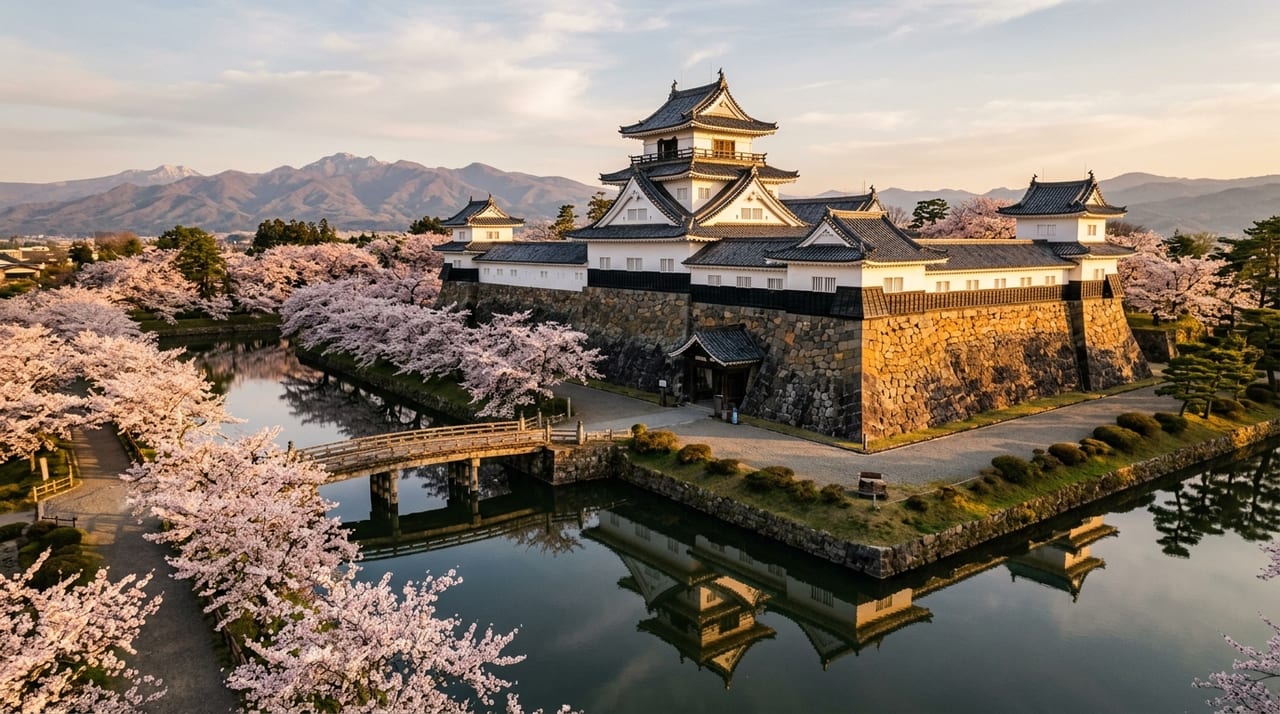
 * Image is for illustrative purposes only.
Yonezawa Castle (Maizuru Castle)
米沢城(舞鶴城)
Yonezawa Castle (Maizuru Castle) is a historic castle in the Tōhoku region (Said to have been built in Ryakunin 1 (1238); the Uesugi clan entered the castle in Keichō 3 (1598)). Its lord was Date clan / Uesugi Kagekatsu / Naoe Kanetsugu.
Overview
About the Castle
Yonezawa Castle is a flatland castle (hirajiro) at the center of the Yonezawa Basin, at the foot of the Ōu Mountains in southern Yamagata Prefecture. Its history traces back to Ryakunin 1 (1238) in the Kamakura period, when it is said to have been built by Nagai Tokihiro. During the Sengoku period it served as the base of the Date clan. Date Masamune was born in this castle and spent his early life here before pursuing dominance in the Sengoku era. However, as a result of Toyotomi Hideyoshi's Ōshū Sashioki in Tenshō 19 (1591), the Date clan was transferred to Iwadeyama, and in its place Gamō Ujisato entered Aizu and brought Yonezawa under his control. Yonezawa Castle returned to the center of history in Keichō 3 (1598), when Uesugi Kagekatsu was transferred to Aizu with 1.2 million koku and his right-hand man, Naoe Kanetsugu, became lord of Yonezawa Castle (60,000 koku, though sometimes given as 300,000 koku including retainers). For the Uesugi clan, Yonezawa remained the only home territory left to them after the defeat at the Battle of Sekigahara, and for more than 270 years until the Meiji era, it prospered as the castle town of the Uesugi family.
The Flowering of Uesugi Culture
The cultural legacy that Uesugi Kagekatsu and Naoe Kanetsugu brought to Yonezawa is immeasurable. After the Battle of Sekigahara, the Uesugi domain's koku assessment plummeted from 1.2 million to 300,000 koku, and Kanetsugu devoted himself fully to the financial reconstruction of the domain and the promotion of culture. His achievements, including the encouragement of industry, flood control projects, and the development of an educational system, are highly regarded as forerunners of modern domain reform. Kanetsugu is known for his helmet with the single character 'ai' (love) as its front crest, and historians continue to debate whether the character expresses benevolent love or devotion to Aizen Myōō. In any case, Kanetsugu's character, that of a warrior who also possessed deep learning and cultural sensibility, formed the foundation of Yonezawa's cultural soil.
Uesugi Yōzan's Reforms
In the mid-Edo period, the Yonezawa domain faced a crisis on the verge of financial collapse, but the ninth domain lord, Uesugi Yōzan (Harunori), carried out sweeping domain reforms and overcame it. Yōzan's reforms, built on frugality and the promotion of industry, earned a reputation that reached even the West. There is an anecdote that U.S. President John F. Kennedy named him the Japanese person he most admired (though its authenticity is uncertain). Yōzan's famous saying, 'Naseba naru, nasaneba naranu, nanigoto mo naranu wa hito no nasanu nari keri' (Where there is a will, there is a way; whatever cannot be achieved is simply because people have not done it), is still quoted today as a treasure of Japanese leadership thought. This spirit can be said to embody the pinnacle of Yonezawa's samurai culture, representing a high-level integration of bushidō and practical ability.
Martial Gods and the Sword Tradition
Uesugi Kenshin is renowned as a warlord of righteousness (gi no bushō), and his spiritual pillar was deep devotion to Bishamonten. Kenshin rode out to numerous battles in his lifetime, and his fame as a god of war resounded throughout the eastern provinces. Swords and armor associated with Kenshin have been handed down through the Uesugi family for generations, and some are preserved at Uesugi Shrine and the Uesugi Museum (Yonezawa City). Uesugi Shrine, which stands on the site of Yonezawa Castle, enshrines Kenshin as its deity. It has become a sacred site of the martial arts, visited by martial artists and sword enthusiasts from across the country.
The Castle Town Today
The present site of Yonezawa Castle lies within the grounds of Uesugi Shrine. Statues of Kenshin and Yōzan stand at the castle ruins, and lotus flowers bloom in the moat. The entire castle site has been developed as a park and is also known as a cherry blossom spot in spring. Yonezawa is also known for traditional industries such as Yonezawa beef, Yonezawa-ori textiles, and Sasano Ittōbori woodcarving. Today it continues to captivate many travelers as a representative castle town of southern Yamagata, where the culture of the martial arts and the skill of artisans come together.
Connection to Swords
Any discussion of Yonezawa Castle's connection to swords cannot exclude Uesugi Kenshin, one of the greatest warlords in Sengoku history. Kenshin was a god of war said to be an incarnation of Bishamonten. Among the swords Kenshin possessed, the most famous is the Himetsuru Ichimonji. The Ichimonji school was a group of swordsmiths who led the way in Bizen during the Kamakura period, known for its splendid chōji-midare hamon and robust jigane. The Himetsuru Ichimonji is said to have been Kenshin's favored sword and was handed down through generations as a treasure of the Uesugi family. Kenshin also clashed five times with Takeda Shingen at the Battle of Kawanakajima (1553–64), and the clash of blades between these two great men is still told as the greatest contest in Japanese history. At the Uesugi Museum (Yonezawa City), visitors can view up close the treasures of the Uesugi family, including swords designated as Important Cultural Property, making it a must-visit sacred site for Japanese sword enthusiasts. Swords dedicated to Uesugi Shrine continue to be revered as conveying Kenshin's martial virtue, and martial artists and sword enthusiasts visit from across the country.
Highlights
- Uesugi Shrine (Honmaru site): a sacred site of the martial arts that enshrines Uesugi Kenshin, renowned as a cherry blossom spot in spring
- Uesugi Museum (Yonezawa City): houses and displays items associated with the Uesugi family, including the Important Cultural Property Himetsuru Ichimonji
- Statues of Uesugi Kenshin and Yōzan: a castle site where the spirits of a martial hero and a reform-minded lord both dwell
- Uesugi Family Mausoleum (National Historic Site): a solemn complex of mausoleums where successive domain lords of the Uesugi family, including Kenshin, Kagekatsu, and Yōzan, rest
- Keishōden (Uesugi Shrine Treasure House): houses treasures such as Kenshin's armor, swords, and jinbaori
- Yonezawa beef and castle town cuisine: enjoy a journey through history with the nationally renowned Yonezawa beef and local dishes
* Opening hours and admission fees are subject to change. Please check the official website before visiting.